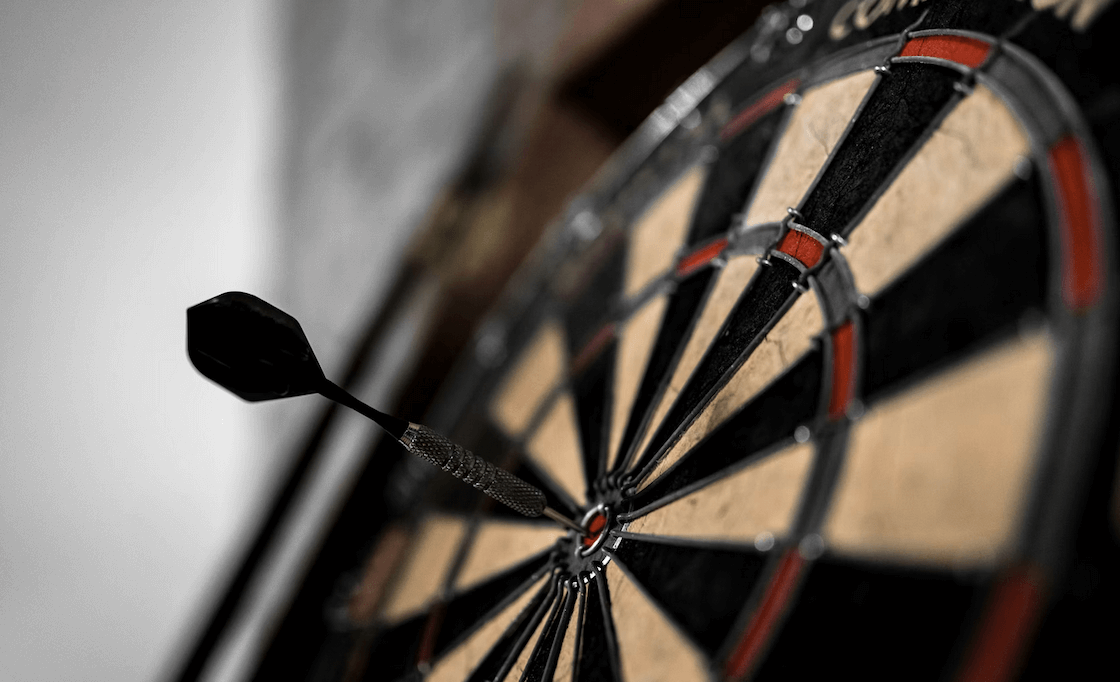
A regulation steel-tip dartboard needs 93.25" (WDF oche distance) from the face of the board to the throw line, plus about 24" behind the thrower for a comfortable backswing. That's roughly 10 feet of depth. Width is simpler: 2 feet clear on each side of the board, so about 5 feet of wall width.
Ceiling height matters. The bullseye mounts at 68" (5'8") off the floor, and the board itself is 18" diameter. A 90" ceiling is the practical minimum to clear the top of the board from fans and low-hanging fixtures. Electronic soft-tip boards are slightly less strict on backstop requirements but need 96" (8 feet) of throw distance per NDA standards, and cabinet versions add 3–4" to subtract from the wall.
The most common mistake is circulation, not ceiling or depth. The throwing lane is a no-cross zone during play. Don't mount a board where the lane crosses a doorway, a bar-access walkway, or the route to the bathroom. And if you're planning pool in the same room, keep the dartboard on a wall far enough from the pool table that the cue arc and the throwing lane don't overlap, ideally cue-length + 2ft of clearance.
Top-down view
Try this layout in your own room
Open the calculator pre-filled with this guide's items, then adjust the room dimensions to yours.
Open in calculatorFit result
Fits with compromises
Placed 1 of 1 items. Room utilization: 52%.
Conflicts (1)
- high Dartboard (Steel Tip / Regulation)
The dart throwing corridor (60" wide x 117" deep) is a no-cross zone during play. Don't place a dartboard where the throwing lane blocks a doorway, walkway, or access to bar/bathroom.
Suggestion: Mount the dartboard on a wall where the throwing lane does not cross any doorway or main walkway.
Placed items
- Dartboard (Steel Tip / Regulation) 8'0" × 10'1"
Room size tier guide
What you can realistically build at each square-footage tier.
| Tier | Headline |
|---|---|
Under 100 sqft | 55-65" TV, recliner, mini fridge, bar cart. No table games. |
100-150 sqft | 65-75" TV, loveseat or 3-seater, dartboard, arcade cabinets, foosball - if room is 11ft+ in one dimension. |
150-250 sqft | 75-85" TV, sectional, 8ft bar, dartboard. A 7ft pool table fits if one dimension is 13'6"+. |
250-350 sqft | Home theater OR 8ft pool + small bar. Both together = compromising one. |
350-500 sqft | 8ft pool + bar + TV area + darts, cleanly zoned. Golf sim is now an option. |
500-700 sqft | Pool + theater + bar + 1-2 additional activities (poker, racing sim, or shuffleboard). |
700+ sqft | Split layout: dedicated theater + games + bar + simulator as distinct zones with proper circulation paths. |
Related pages

Frequently asked questions
Pool Cue Vs Dartboard
A dart thrower stands ~8-10ft in front of the board; a pool cue needs 58" of backstroke on every rail. If the dartboard is on a wall the pool table's cue arc reaches, the two activities block each other. Solution: place dartboard on a wall that's at least (cue-length + 2ft) from the nearest pool table rail, or accept that both can't be used simultaneously.
Dart Lane Vs Walkway
The dart throwing corridor (60" wide x 117" deep) is a no-cross zone during play. Don't place a dartboard where the throwing lane blocks a doorway, walkway, or access to bar/bathroom.
Ceiling Height Darts
Bullseye is 5'8" off the floor. The board is 18" diameter. You need 90" minimum ceiling for the whole board to be clear of fixtures (fans, low lights).
Steel-Tip vs Soft-Tip Setup Differences
The two formats share a board height (5'8" / 173 cm to bullseye) but diverge on throw distance:
| Standard | Throw distance (face to oche) | Diagonal (bullseye to oche front) |
|---|---|---|
| Steel-tip (WDF/PDC/BDO) | 7'9¼" (2.37 m) | 9'7½" (2.93 m) |
| Soft-tip (NDA/DartsLive) | 8'0" (2.44 m) | 9'9½" (2.98 m) |
| Wheelchair (WDF) | 7'9¼" (2.37 m), bullseye at 4'6" (1.37 m) | N/A |
That's an extra ~3 inches of room depth for soft-tip. Cabinet-mounted boards add 3–4 inches to the wall side; subtract that from the throw distance you measure off the wall, not off the cabinet face.
Why Backboards and Surrounds Matter
Steel-tip darts that miss the board land somewhere. Without a backboard, that "somewhere" is your drywall, baseboard, or hardwood floor. Three layers of protection:
- Surround: the foam ring directly around the board, 18–24 inches OD. Catches close misses.
- Backboard: a sheet (cork, sisal tile, or 3/4" plywood with cork facing) 24×30 inches behind the board. Catches medium-arc misses.
- Floor mat: rubberized mat extending 3 feet in front of the throw line. Catches bounce-outs and stops dart-tip damage to floors.
A complete protection setup runs $50–$200 and saves a bigger drywall repair on day one.
Lighting the Board
Side-shadow on a dartboard is the silent killer of accuracy. Single-source overhead lighting throws a shadow from the dart-thrower across the board. Two solutions:
- Dartboard light ring: a circular LED that mounts directly to the board, ~$80–$200. Eliminates all shadow and highlights triple/double scoring rings. The professional choice.
- Two-source ceiling lighting: two bright fixtures, one on each side of the throw lane, angled toward the board. Cheap, but requires room layout cooperation.
Avoid single-source ceiling lights directly above the board. The dart shadow falls right onto the segment you're aiming at.
Floor Surface Behind the Throw Line
For steel-tip play, hardwood and tile both suffer dart-tip damage from bounce-outs. Solutions:
- Dart mat (rubber, dart-resistant, throw-line marked): $30–$80, 30×120 inches typical. The standard solution.
- Carpet remnant: free-ish, but won't show throw-line markings and dart tips can damage backing.
- Cork tile area: decent shock absorption, somewhat self-healing, ~$2–$4/sqft.
Dartboard Cost Reference (2026)
| Item | Range |
|---|---|
| Entry bristle board (no surround) | $30–$60 |
| Mid-range bristle board (PDC-grade) | $80–$150 |
| Premium tournament board (Winmau Blade 6, Unicorn Eclipse) | $90–$175 |
| Electronic soft-tip (residential) | $80–$300 |
| Electronic soft-tip (Arachnid 800-grade or DartsLive) | $400–$1,200 |
| Cabinet (wood, with chalkboard scoring) | $80–$300 |
| Surround | $25–$60 |
| Backboard / wall protector | $40–$120 |
| Dart light ring | $80–$200 |
| Throw mat | $30–$80 |
Total for a quality steel-tip residential setup: $200–$500. For soft-tip with cabinet: $300–$700.
Extended FAQ
Steel-tip or soft-tip: which is better at home? Steel-tip plays more like the pub/league standard, has better dart feel, and the bristle board is self-healing and lasts years. Soft-tip is family-friendly (no wall damage risk), keeps score automatically, and is the standard in many league environments outside the UK and pub-darts scene. If you ever plan to play league darts, default to steel-tip.
Why do real bristle boards have a "spider" of metal segment dividers? The thin steel/aluminum dividers separate the scoring zones cleanly and reflect bounce-outs differently than the sisal surface. Tournament boards use ultra-thin "razor wire" or staple-free dividers (Winmau Blade, Unicorn Eclipse Pro) to reduce bounce-outs by 30–50% over basic boards. A 3-dart cluster lands in 1.5 square inches; thinner wire = more darts in the triple 20 instead of bouncing off.
How long does a bristle dartboard last? Sisal fibers self-heal: when you pull a dart out, the fibers close back around the hole. Casual home play: 5–10 years. Heavy use: 2–4 years before the high-traffic segments (treble 20, bullseye) start to wear flat. Rotating the board 1/5 turn monthly distributes wear evenly across all 20 segments and roughly doubles useful life.
Can I mount a dartboard on drywall directly? Yes. The included mounting screw goes into a wall anchor or stud. The board itself doesn't stress the wall. The risk is missed darts, which is why a backboard or surround is mandatory for steel-tip play. Confirm the mount lands on or adjacent to a stud for a permanent installation.
What's the difference between a $40 dartboard and a $150 dartboard? At $40 you get coarse staple-banded sisal, thicker wire, glued (not woven) construction. Bounce-outs are common. At $150 you get tournament-grade African sisal, ultra-thin razor wire or staple-free, factory-balanced and rotation-friendly mounting. The difference is real and noticeable within a single game.
Where should the dartboard cabinet hinge open? Both directions if possible, but if forced to pick, open toward the throw line so the chalkboard scoring panel faces you while standing at the oche. Closed cabinet position should expose only the back of the cabinet to the wall.
How do I score 501, 301, and Cricket? 501/301: count down from 501 (or 301) to exactly zero, finishing on a double or bullseye. Cricket: hit numbers 15-20 + bullseye three times each to "open" them, then score on opened numbers your opponent hasn't opened. Most electronic boards include both modes. For steel-tip, a chalkboard-equipped cabinet handles scoring fine.
Do I need a dart sharpener? Steel-tip darts dull from hitting the spider wire. A dull tip increases bounce-outs. Light sharpening with a fine stone or dart sharpener every 50–100 throws keeps the point hooky enough to grab the sisal. Don't over-sharpen. Needle-sharp tips break easily and damage the board fibers.
What's a good dart weight for a beginner? 22–24 grams for steel-tip; 18 grams for soft-tip (rules cap soft-tip at 18g). Heavier darts fly straighter but require more throw force; lighter darts demand more accuracy. Start at 22g steel/16g soft and adjust ±2g based on whether your shots tend high (lighten) or low (heavier).
Can I play darts with a low ceiling (under 8ft)? The board itself fits a 90-inch ceiling. The issue is not the board: it's the throw arc, which for most adults peaks at 6'6" to 7'0" overhead. Low-ceiling throwers naturally adapt, but ceiling fans, low pendant lights, and HVAC vents in the throw path will catch darts. Mount a clearance check: stand at the oche, raise one arm overhead, throw a slow simulated arc. If anything is closer than 6 inches above your hand at apex, relocate the fixture or move the throwline.