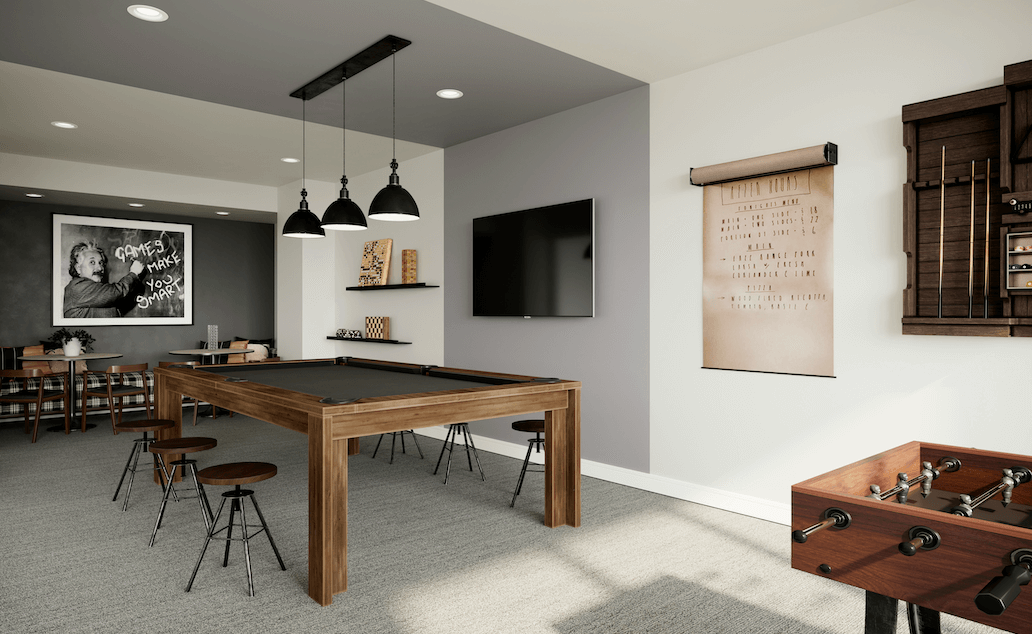
The short answer: a 7ft pool table needs a room about 13'4" × 17' for a full 58" cue. An 8ft table needs about 13'4" × 18'. A 9ft tournament table needs 14' × 18'. These numbers come from play-surface dimensions plus 58" of cue-swing clearance on every rail. That's the standard backstroke for a full shot.
You can shrink those rooms by choosing a shorter cue. A 52" cue is a comfortable compromise for most players and saves roughly a foot in each dimension. A 48" cue makes pool possible in rooms pool "shouldn't" fit, at the cost of occasional cramped shots near the rails.
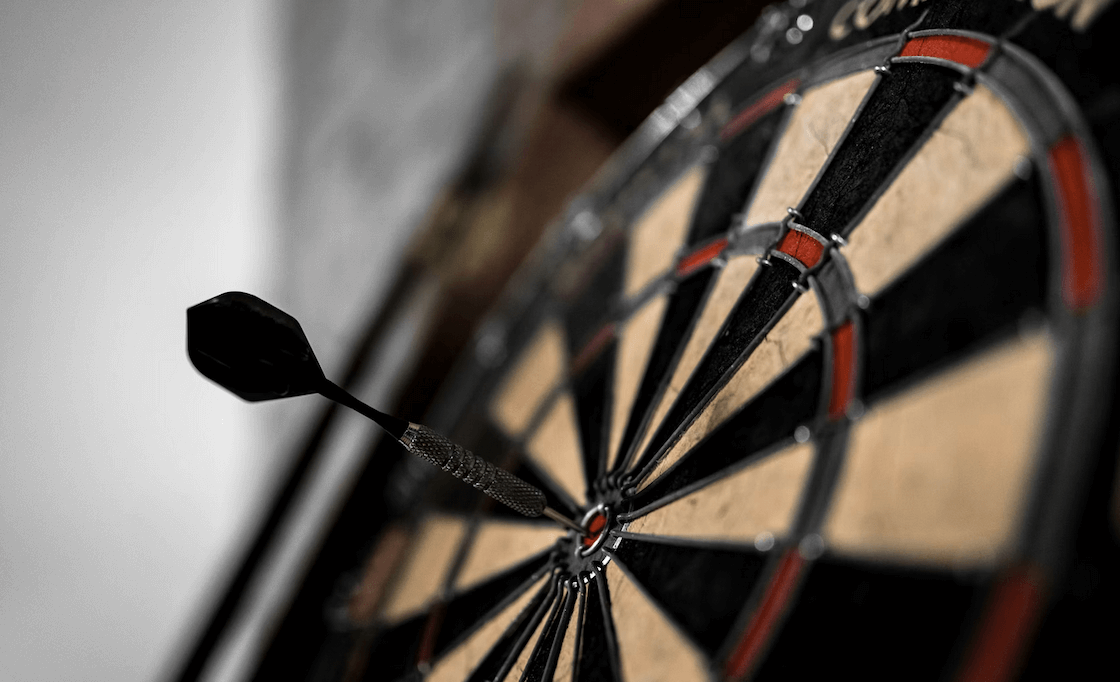
Two common layout conflicts to watch: a wall-mounted TV on the long side of the table sits in the cue backstroke path (keep 58" between rail and TV wall, or use a short cue on that side). A dartboard shares the same problem: the dart thrower stands 8–10ft in front of the board, and that thrower's zone will intersect the pool cue arc unless the dartboard is on a wall well outside the swing. Plan for at least 9ft ceiling if you want a proper pool-table light hanging at the standard 32–36" above the rail.
Top-down view
Try this layout in your own room
Open the calculator pre-filled with this guide's items, then adjust the room dimensions to yours.
Open in calculatorFit result
Fits with compromises
Placed 2 of 2 items. Room utilization: 84%.
Conflicts (1)
- high 8ft Pool Table
Delivery path check: pool table slates (up to 52" wide for 1-piece, 33-50" for 3-piece), shuffleboard playfields (up to 22ft long solid), pinball machines (29" wide but 76" tall with backbox folded to 34"). Measure every doorway, hallway, stair turn, and basement entry BEFORE ordering.
Suggestion: Measure every doorway, hallway, stair turn, and basement entry before ordering.
Walkway warnings
- Narrow passage between Wall Cue Rack and 8ft Pool Table: 2" of slack (under 24" is tight).
Placed items
- Wall Cue Rack 2'4" × 1'10"
- 8ft Pool Table 13'10" × 18'0"
Room size tier guide
What you can realistically build at each square-footage tier.
| Tier | Headline |
|---|---|
Under 100 sqft | 55-65" TV, recliner, mini fridge, bar cart. No table games. |
100-150 sqft | 65-75" TV, loveseat or 3-seater, dartboard, arcade cabinets, foosball - if room is 11ft+ in one dimension. |
150-250 sqft | 75-85" TV, sectional, 8ft bar, dartboard. A 7ft pool table fits if one dimension is 13'6"+. |
250-350 sqft | Home theater OR 8ft pool + small bar. Both together = compromising one. |
350-500 sqft | 8ft pool + bar + TV area + darts, cleanly zoned. Golf sim is now an option. |
500-700 sqft | Pool + theater + bar + 1-2 additional activities (poker, racing sim, or shuffleboard). |
700+ sqft | Split layout: dedicated theater + games + bar + simulator as distinct zones with proper circulation paths. |
Related pages

Best Corner Pool Tables for Small Game Rooms
Find space-saving corner pool tables that maximize play in tight game rooms. Compare sizes, materials, assembly, and play quality to pick the best fit. Plus tips.

How Artisanal Snooker Tables Are Built
Discover how artisanal snooker tables are crafted, materials and techniques that matter, plus tips to choose, customize and install one in your man cave.
Frequently asked questions
Pool Cue Vs Dartboard
A dart thrower stands ~8-10ft in front of the board; a pool cue needs 58" of backstroke on every rail. If the dartboard is on a wall the pool table's cue arc reaches, the two activities block each other. Solution: place dartboard on a wall that's at least (cue-length + 2ft) from the nearest pool table rail, or accept that both can't be used simultaneously.
Pool Cue Vs Tv Wall
A large wall-mounted TV directly on a long side of a pool table sits in the cue backstroke path. Either move the TV to a short wall, accept short cues on that side, or space the table 58"+ from the TV wall.
Ceiling Height Pool
Ceiling-mounted pool lights hang 32-36" above the rail. An 8ft ceiling gives 32" of drop which is tight; 9ft is comfortable. Account for fan/fixture height.
Door Access Heavy
Delivery path check: pool table slates (up to 52" wide for 1-piece, 33-50" for 3-piece), shuffleboard playfields (up to 22ft long solid), pinball machines (29" wide but 76" tall with backbox folded to 34"). Measure every doorway, hallway, stair turn, and basement entry BEFORE ordering.
Pool Table Lighting: Height, Wattage, and Spread
A pool table needs more lighting math than ceiling height alone. The bottom of the fixture should sit 30–36 inches above the slate for residential play (WPA tournament spec allows up to 40 inches when the fixture is non-movable, 65 inches when it isn't). Below 30 inches you'll bump the light during a follow-through; above 36 inches and the rails go dim and the felt color shifts.
Match the fixture length to the table:
- 7ft table: 3-shade bar, ~36 inches long
- 8ft table: 3-shade or 4-shade bar, 42–54 inches long
- 9ft table: 4-shade or 5-shade bar, 60–72 inches long
WPA spec calls for at least 520 lux (48 footcandles) on every point of the bed and rails. In practice that's 3,500–6,000 lumens of LED across the table. Three 12W LED tubes or four 8W shades will hit the target without making the rails hot.
Slate, Frame, and Floor Loading
The room-size question stops at the doorway. The next question is whether your floor can hold the table.
| Table | Slate weight | Total weight (3-piece) |
|---|---|---|
| 7ft | ~450 lbs | 700–800 lbs |
| 8ft | ~600 lbs | 850–950 lbs |
| 9ft tournament | ~850 lbs | 1,000–1,300 lbs |
For an upper floor or above a finished basement, that load concentrates on six leg points. Standard residential floor joists (2×10 at 16" OC, 12ft span) handle it, but verify your span chart or have a structural engineer sign off if you're outside that envelope. Concrete slabs are unconcerned. Tables tagged as "slate-bed" with one-piece slate (cheaper imports) are usually 1-inch slate; tournament 3-piece slate is 1-inch minimum (BCA/WPA spec) and typically 1.25–1.5 inches.
Flooring Under a Pool Table
Pool tables work on every floor type, but each has tradeoffs:
- Hardwood / engineered hardwood: best for leveling, long-term stability. Use felt floor protectors under the leg pads to prevent stain transfer from rubber feet.
- LVT / luxury vinyl plank: stable, waterproof, easy to clean. The padding layer in some products will compress under leg load. Check spec sheet for static load rating before buying.
- Carpet: fine for play, but level the table after the carpet pad fully settles (2–3 weeks). Dragging a table across carpet damages fibers; lift, don't slide. Permanent indentations under the legs are guaranteed and visible if you ever move the table.
- Concrete: ideal for stability. Add an area rug under the table for warmth and sound damping if the basement is otherwise cold/echoey.
Pool Table Cost Reference (2026 estimates, US market)
| Tier | Table | Slate | Delivery + install | Total typical |
|---|---|---|---|---|
| Entry | $1,500–$3,000 | 1-pc 7/8ft | $300–$600 | $2,000–$4,000 |
| Mid | $3,000–$6,000 | 3-pc 1" | $500–$900 | $3,500–$7,000 |
| Premium (Brunswick, Olhausen, Diamond) | $5,000–$15,000+ | 3-pc 1.25–1.5" | $700–$1,500 | $6,000–$17,000+ |
Add ~$200 for a refelt every 3–5 years (cloth wears at the rails first), $250–$400 for a leveling service call after a move, and $300–$1,200 for a fitted light fixture.
Extended FAQ
Should I get a 7ft, 8ft, or 9ft table? 8ft is the residential standard: about 80% of home tables sold. 7ft (often called "bar size") fits where 8ft doesn't and plays harder because of cushion proximity. 9ft is tournament/regulation; only get one if you have the room and you're a serious player. Most leagues in the US play on 8ft or 9ft depending on the league.
Can I put a pool table over a finished basement ceiling or upper floor? Yes if floor framing is adequate (2×10 or larger joists at 16" OC are fine in most cases). The concentrated load is six leg points carrying ~150–220 lbs each. Confirm with your local building department for any unusual situation. The bigger upstairs concern is sound transfer from breaks; rugs and acoustic underlayment help.
What's the difference between a 1-piece and 3-piece slate? 3-piece slate ships as three roughly equal slabs that bolt together onto a wood frame and are sealed with beeswax at the seams. The seams allow leveling to within ±0.005 inches across the whole bed and let the slate fit through doorways. 1-piece slate is one solid slab: cheaper, but harder to level perfectly and impossible to navigate through tight hallways or stairwells. Tournament-spec is always 3-piece.
Can I convert a pool table to a dining table? Yes. "Conversion" or "convertible" pool tables include a hardwood top that lays over the rails as a dining surface. The combined dining footprint is a foot wider in each direction than the table itself, so the room still needs cue clearance even when used for dinner. Folding-leg portable tables are not the same product. Those compromise on slate flatness.
How do I know if my doorway can fit a pool table? 3-piece slate ships in slabs about 33–50 inches wide (depending on table size). The frame disassembles. The rails come off. A standard 30-inch interior door is usually fine for component delivery; the question is the path: stair turns under 36 inches and 90° hallway turns are common rejection points. Reputable installers will pre-verify with a measurement visit; demand this before a non-refundable deposit.
Do I need a humidifier or dehumidifier for the room? Cloth and slate don't care about humidity, but the wood frame, cushions, and any wood pool light fixture do. Aim for 35–55% relative humidity year-round. Below 30% RH (winter, dry climates) the cushions firm up and the wood frame contracts; above 65% RH the cloth dampens and the rails play slow. A basement dehumidifier is the most common need.
How often should the cloth be replaced? Casual home use: 5–10 years before noticeable wear. Heavy use (daily play): 2–4 years. Watch for shiny "rail tracks" along the cushion lines. That's where the cloth fails first. A refelt is a 2–3 hour job for a pro and runs $200–$500 depending on cloth grade (Simonis 860 is the residential gold standard).
Is a folding/portable pool table worth considering for a tight space? Honest answer: no, if you actually want to play. Portable tables have MDF beds, soft rails, and unstable bases. They're fine for a kid's playroom or college apartment as a curiosity. For real play, a 7ft slate table in a slightly cramped room beats an 8ft portable in a perfect-fit room every time.
What's the resale value of a pool table? Slate tables hold value better than almost any other game-room item. A 10-year-old mid-tier table with a refelt typically sells for 50–70% of its purchase price on the local secondhand market. Premium brands (Brunswick, Olhausen, Diamond) often sell for 70–90% of original. The catch: buyer almost always pays delivery, which can be $500–$1,500. Plan for that in your purchase price calculus.