Best High-Precision Sim Racing Pedals for Your Man Cave
Last updated August 21, 2026 · By Zach Lane ·How we choose products · Affiliate disclosure

Tired of walking up to your rig and feeling like the pedals are the weak link? Same here. I put up with vague throttle, squishy brakes, and pedals that never stayed where I set them for way too long. Once I swapped to a proper pedal set, the whole experience changed. This guide breaks down what matters so you stop paying for shiny extras and start spending on parts that actually improve feel, consistency, and long-term value.
I’ll walk you through the tradeoffs between entry-level kits and pro-grade braking systems, why solid metal and adjustability matter, and which small accessories make more difference than the marketing hype. Expect practical buying tips, a no-nonsense look at where to save and where to spend, and a simple framework to pick pedals that match your budget and your setup. Read on and you’ll know what to prioritize and why.

Logitech G PRO Racing Pedals - Racing Simulator Pedals with 100kg Load Cell Brake, Fully Customizable, Swappable Springs & Elastomers, Modular Design

MOZA CRP2 Load Cell Pedals Pressure Sensor Pedal for Sim Racing Driving Video Games

PXN PD HM Brake&Throttle Sim Racing Pedals – All-Metal 2-Pedal Set with Hall Sensors, Adjustable Angle & Height, USB-A/Type-C/RJ45 Connectivity, Compatible with PC V99/V10/V12/VD Wheel Bases

DV480 Pro V5 SimRacing Dashboard-DDU-Display Sim Racing Dash with 5" Screen & 16 RGB LEDs for Simulation Racing Games Accessories

Logitech G Driving Force Shifter – Compatible with G29, G920 & G923 Racing Wheels for-PlayStation 5, Playstation 4, Xbox-Series X|S, Xbox-One, and-PC
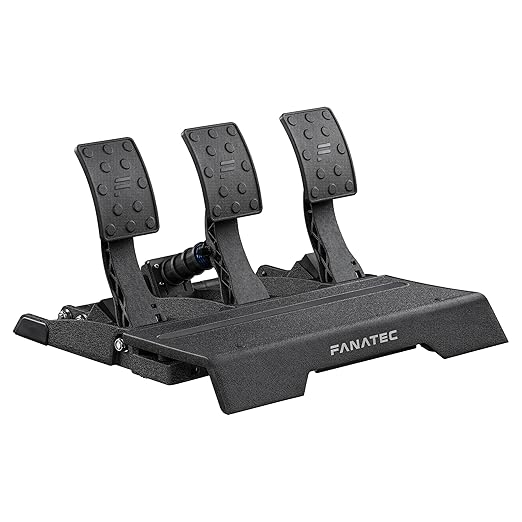
Fanatec Sim Racing CSL Elite Pedals V2 – 3-Pedal Set (Clutch, Brake, Throttle), Dual-Stage Load Cell Brake System, Hall-Effect Sensors – PC, PS5, PS4
Our Top Pick
The Fanatec CSL Elite V2 3-Pedal Set is my top pick if you want a serious upgrade for a home cockpit. The dual-stage load cell brake gives progressive, predictable stopping power that separates casual setups from something that feels right. Throttle and clutch use Hall-effect sensors, so inputs are precise and quiet for a long time. Put them under your feet and the rig goes from toy to purpose-built.
They’re built to last. All-metal construction and adjustable pedal faces let you fine-tune spacing, angle, and travel to match your seat and driving style. They play nice with major platforms, so whether you’re on PC or PlayStation they integrate cleanly and look the part. If you’re aiming to make your spare room feel like a proper cockpit, these are a smart upgrade.
These pedals improve lap times and the overall vibe of your setup. Real feel, rock-solid build, and easy customization make them worth the move.
Key benefits and standout features:
- Dual-stage load cell brake for consistent, progressive stopping power and fine brake modulation.
- Hall-effect sensors on throttle and clutch for precise, wear-free input.
- Full metal construction for durability and a premium look that fits a high-end setup.
- Multiple adjustment points (pedal angle, spacing, and travel) for a personalized setup.
- Plug-and-play compatibility with PC and PlayStation platforms, and it talks to the rest of the Fanatec gear without adapters.
- Designed for longevity, so the pedals remain consistent through heavy use and long sessions.
Core Pedal Sets That Make Your Rig Feel Like a Real Car
Cheap-feeling pedals kill immersion. If they flex, misread inputs, or need constant fiddling, practice sessions become frustrating instead of productive. Core pedal sets are the foundation of any sim rig. For most people, a well-built two- or three-pedal set with reliable sensors and a rigid base will beat a flashy package with weak fundamentals.
When you shop, focus on sensor type, how the pedals mount, and whether the base is stable under load. Consistency under pressure matters more than gimmicks. Look for adjustability in angle and spacing so the pedals match your driving position without expensive mods. Check cable and connector options; modular designs save money later when you upgrade. I’ll point out where manufacturers cut corners and which modest upgrades give the biggest practical gains for your setup.
Logitech PRO Racing Pedals
If you want the pedals to match the rest of your cockpit, these Logitech PRO pedals deliver. The headline is a 100kg load-cell brake that translates foot pressure into consistent bite and repeatable muscle memory. Swapable gas and clutch springs plus multiple brake elastomers let you tune travel and stiffness in minutes. Slide each pedal for heel-and-toe spacing or remove a module entirely for single-foot setups.
Under the skin you get contactless Hall-effect sensors and metal reinforcements where it matters, so the feel stays crisp and accuracy holds lap after lap. In practice that means cleaner trail braking, fewer accidental lockups, and better lap times once you dial them in.
Who should pick these up. Serious sim drivers upgrading from basic paddle sets, anyone building a cockpit that looks as good as it performs, and people who want pro-grade hardware without a garage-level install. Pros: true load-cell braking, deep adjustability, modular layout, durable Hall sensors, easy spring swaps. Cons: premium price, and some buyers report missing accessory packs on arrival so inspect the box. Pairing is smooth with the PRO wheel, older wheels may need Logitech’s adapter to unlock full controls. Time to stop blaming the wheel.
Why Load-Cell Brakes Matter and How to Pick One
If you’ve ever stomped the brake and felt nothing, you know why load-cell brakes matter. They measure force instead of travel, which gives consistent, progressive braking and finer control under hard braking. The trick is separating true load-cell designs from marketing. Real units deliver smooth, linear resistance, solid mounting, and easy calibration. Cheap imitations might feel firm for a while and then drift.
When choosing a load-cell, balance peak force capacity with repeatability and adjustability. Higher-rated cells handle aggressive drivers but can feel too stiff for casual racers. Look for robust mounting that prevents the brake pad from shifting under load, and avoid designs that rely only on software to fix poor hardware. I’ll show how to spot genuine load-cell value, where returns diminish, and which features are practical must-haves versus price-inflating extras.
MOZA CRP2 Pedals
The MOZA CRP2 demands attention the moment you bolt it in. CNC aerospace-grade aluminum and a 3K twill carbon fiber heel plate make it look premium, and the heavy steel base keeps the pedals planted during aggressive inputs. These don’t flex like cheap units and they stay looking sharp after long sessions.
Performance is where it counts. A 200kg load cell gives authentic, progressive braking while the 15-bit angle sensor brings accurate throttle and clutch input. MOZA exposes deep tuning with up to 1,764 configuration combos through spring and damping block swaps. You can chase anything from a soft road-car feel to race-spec bite. The damping blocks come in multiple hardness levels so tuning pedal travel and feedback becomes a hands-on process.
Practicality is solid. Tool-free adjustments let you change pedal height, angle, and face quickly. Inverted mounting support expands placement options, and PC and Xbox compatibility make it versatile. Who benefits most. Serious builders and intermediate to advanced sim drivers who want precision and customization will get the most value. Casual players might find the tuning depth overkill, but the base feel already beats typical budget sets.
If you want pedals that look great on display and perform under pressure, the CRP2 is a meaningful upgrade. Pair them with a stiff pedal board and a solid wheelbase to unlock their potential. Ready to step up your rig.
Adjustable Pedal Sets That Fit Your Body and Your Driving Style
One of the fastest ways a rig feels wrong is when your legs and feet fight the hardware. Adjustable pedals let you dial in height, angle, and spacing so your position is natural and repeatable. If multiple people will sit in the cockpit, adjustability moves from luxury to necessity. Focus on range and precision of adjustment, ease of locking settings, and whether you can change things without tearing the pedal box apart. The best options give tool-free or simple wrench adjustments and stay rigid once set.
When comparing units, check the quality of the adjustment hardware and whether it holds up after thousands of hours. Look for indexed positions for quick resets and clear markings so you can replicate settings. Think about how adjustments affect leverage and travel. Cheap systems can add play or weaken structure, so prefer solid mechanical parts over plastic sliders. I’ll highlight which adjustment features actually help and which are mostly marketing.
Metal-Bodied Pedals That Stand Up to Real Use
If you want longevity, better feedback, and a premium response, metal-bodied pedals are the way to go. Metal reduces flex, improves feedback, and makes adjustments more repeatable. Metal doesn’t automatically mean overpriced though. What matters is how the metal is used. A well-engineered aluminum or steel chassis can beat a heavier unit that wastes material and money. Inspect joinery, fasteners, and whether wear surfaces are reinforced or replaceable.
When checking metal pedals, consider finish, corrosion resistance, and how serviceable the assembly is. Look for replaceable bushings or bearings at pivot points and tolerances that minimize slop. Heavy parts can feel solid, but poor design will negate that. I’ll call out metal builds that offer real value versus those that trade weight for specs.
PXN PD HM Pedals
If you want to move up from flimsy plastic pedals, the PXN PD HM set is a useful step. They replace cheap potentiometers with Hall effect sensors for smooth, drift-free input. The whole assembly is steel. You can tweak pedal angle, height, and lateral spacing to fit your chair. The included spring/damper lets you tune brake resistance up toward a realistic 20kg feel. Short version: real metal, real control.
This set shines when you want durability and customization without bleeding your wallet. They look at home under a racing seat. Mount them free-standing or bolt them to a board. Multiple connectivity options (USB-A, Type-C, RJ45) add flexibility. Important caveat. The brake isn’t a true load-cell. It uses Hall sensing plus a mechanical damper to simulate weight. That means solid value and predictable feel, but not the nuance of pro-level load-cell brakes. Also expect a sparse manual and some fiddly mounting spacing on certain rigs.
Who should buy. If you’re upgrading from bundled wheel pedals, want metal construction, and like tinkering, this is a practical choice for a setup that needs presence and performance. Pros: robust build, Hall sensors, adjustable geometry, realistic damper option, broad compatibility. Cons: not a load-cell brake, basic documentation, mounting quirks. Want a serious foot upgrade? Click below and check availability.
Fanatec CSL Elite Pedals V2
This set changes how your rig feels underfoot. The dual-stage load cell brake gives pressure-based feedback and believable pedal bite, backed by Hall-effect sensors on throttle and clutch for contactless precision. Tool-free elastomer stacks and an extra metal spring mean you can tune stiffness and travel without buying aftermarket parts. All-metal plates, detachable rubber covers, and sideways pedal position adjustment add durability and ergonomic fit, so they both look right in a proper cockpit and survive heavy weekend sessions. Connect via RJ12 to a compatible wheel base for the cleanest setup, or use USB for standalone PC use.
Who should buy it. Someone moving up from entry-level kits who wants pro-like braking and consistency without jumping to a wallet-draining top tier. Pros: realistic load-cell feel, solid metal build, easy adjustability, quiet operation, and broad platform compatibility with the right wheel base. Cons: the brake can feel stiff out of the box until you find the right elastomer combo, occasional firmware quirks reported (requires PC to update), and some setups may need minor pedal plate mods to fit. Bottom line. If you want a tangible lap-time and immersion upgrade that dresses your setup like a serious sim, these are high-value and practical.
Setting the Brake Up So the Sensor Earns Its Money
Here is the whole page in one grid before we get into the tuning, because the specs matter more than the marketing on any of these boxes.
| Pedal set | Price | Brake sensor | Throttle and clutch | Pedals |
|---|---|---|---|---|
| Fanatec CSL Elite Pedals V2 | $329.99 | dual-stage load cell | Hall-effect | 3 |
| Logitech G PRO Racing Pedals | $379.99 | 100 kg load cell | Hall-effect | 3, modular |
| MOZA CRP2 | $369.00 | 200 kg load cell | 15-bit angle sensor | 3 |
| PXN PD HM | $79.99 | Hall sensor plus a damper, tuned toward a 20kg feel | Hall-effect | 2 |
Three of those are genuine load cells and one is not, which is the honest reason for the price gap rather than the metal or the finish. For context on where this page sits in the wider market, entry load cells like the Thrustmaster T-LCM start around $200, serious sets such as the Heusinkveld Sprint run $500 to $700, and flagship systems pass $1,200. The middle of that band is where three of these four live.
The kilogram rating is capacity, not effort
Almost everyone reads a 200 kg load cell as a threat. It is not. That number is the sensor's capacity, and the pedal sits in a lever arrangement so a reasonable leg push lands a far larger load on the cell than your foot is producing. The Heusinkveld Sprint makes the point neatly: a 120 kg cell that delivers up to 65 kg of actual brake force at the pedal. At the extreme end, the Simucube ActivePedal runs an S-type cell rated at 2000 newtons, about 204 kg, and nobody is pushing that.
What you do with the number is calibrate it. Pedal software lets you map your comfortable full-press effort to 100 percent brake, and the target is a force you can hit repeatedly on lap 40 rather than lap 4. Somewhere around 30 to 60 percent of your leg strength is the usable band. Then shape the curve so the first third of the travel is progressive instead of hair-trigger, which is what makes trail braking possible at all. Two identical pedal sets calibrated differently feel like different products, and beginners lose weeks by cranking the force range to the sensor's ceiling and then wondering why their leg is dead after twenty minutes.
The mount is part of the pedal
A load cell brake pushes against whatever is holding it, and it does not care whether that thing is a rig or a piece of chipboard. Put 50 kg of leg force into a desk clamp or a folding wheelstand and the frame flexes, so the sensor faithfully reports the frame moving rather than your input. The pedals feel vague, you blame the pedals, and you buy better pedals that feel exactly as vague.
Fix the mount first. A rigid pedal plate or a proper cockpit costs less than the upgrade you were about to make, and it is the difference between a $79.99 set that feels honest and a $379.99 set that feels like mush. The same goes for geometry: match the pedal angle to your seat, keep the heel planted, and stop expecting a sensor to correct a seating position that was wrong before you sat down.
Useful Accessories That Complete a Racing Simulator Setup
A pedal set is only part of the picture. The right accessories can turn a good rig into a great one. Think sturdy mounting plates, protective covers, shifters, and displays that improve feedback and ergonomics. If you’re on a budget, add accessories that directly enhance control, comfort, or durability rather than cosmetic items that only raise the price. Ask whether an accessory solves a real setup problem or only addresses imagined shortcomings.
When you evaluate add-ons, check compatibility, ease of installation, and serviceability. Prioritize stuff that reduces wear, simplifies adjustment, or boosts input fidelity. Below I separate must-have practical extras from luxury items that are mostly status. Expect guidance on which small investments give the best long-term returns and which you can skip to keep the budget on performance.
MiYee DV480 Pro V5
This compact 5 inch DDU brings useful telemetry and a bit of style to a home rig. The 60Hz touchscreen (350 nits) with 16 RGB LEDs shows lap times, RPM, brake pressure, and other readouts without pulling GPU cycles. That’s handy when you’re running a graphically heavy sim and a high-end wheel and pedal combo. The CNC-machined 6061 aluminum and anodized finish make it feel like a proper metal accessory, not a cheap plastic toy.
What stands out is the practical feature set. It works with SimHub out of the box and lists support for 87+ titles, so it can show brake bias and force data that helps tune a load-cell brake. LED colors and brightness are adjustable, height is tweakable, and mounting hole spacing fits many brackets. For a setup that wants to look sharp and function well, this dash adds a useful focal point behind the wheel.
Who should buy it. You, if you upgraded to high-precision pedals and want glanceable telemetry to refine pedal travel and braking thresholds. Also good for builders who want a clean metal finish and custom LED accents. Not ideal if you need ultra-high refresh or a huge multi-line display. Some users report LED or setup hiccups and the included mounts feel basic, so expect a little fiddling. I used this to fine-tune my load-cell threshold and it improved consistency on long stints. Worth adding if your cockpit needs both function and flair.
Logitech Driving Force Shifter
This six-speed H-pattern shifter is an instant immersion upgrade for budget rigs. The steel gear shaft and hand-stitched leather knob give it an authentic feel when you row through gears. Push-down reverse works predictably, and the gated clicks help you lock into a shift pattern faster than paddle-only setups. Built-in clamps and bolt points mean you can mount it to a desk or rig and keep it from wandering during spirited laps.
The appeal is simplicity. It does what a shifter should do without pretending to be a pro-level assembly. It plugs into compatible wheels and integrates with G Hub on PC, so setup is straightforward if you’re already in that ecosystem. Little touches like the leather boot add polish. Modders will appreciate community tweaks for tighter throws or mount adapters if you like tinkering.
Best for the builder who wants tactile manual shifting without overcomplicating the space. If your goal is immersion for relaxed drives, rally runs, or trucking sims, it adds character. If you race like a pro every session, you may notice gate spacing and shift feel aren’t identical to a full sim-pro shifter.
Pros: solid materials, authentic look, easy integration with G-series wheels, secure mounts. Cons: not true sim-grade precision, mounting can be fiddly on thin frames, occasional wear reports. Want a practical add-on that gives your setup bragging rights? This fits the bill.
Take Action
You’ve got the essentials. Load-cell braking, contactless Hall-effect sensors, rigid metal construction, and repeatable adjustability are the features that actually change how a rig feels underfoot. The Fanatec CSL Elite V2 balances those traits well, giving real load-cell feel and durable metal parts. Logitech PRO pedals push further for pro-tier clutch and brake fidelity. MOZA CRP2 rewards you if you want CNC quality and deep tuning. For budget-first upgrades that still give metal and reliable sensors, PXN PD HM is sensible. A rigid mount and a calibrated force curve fix more than most hardware upgrades do, and both are free. Accessories such as the MiYee dash and the Logitech shifter add useful functionality rather than empty bling.
My plain recommendation. If you want the single most impactful upgrade for lap times and consistency, prioritize a true load-cell brake and Hall-effect throttle/clutch (Fanatec CSL Elite V2 or Logitech PRO). If you value tuning and premium materials, MOZA CRP2 gives long-term flexibility. If you’re coming from bundled wheel pedals on a tight budget, PXN PD HM delivers durability and feel without wrecking your wallet. Sort the mount and the calibration before you spend anything, and buy the MiYee or a shifter only if you’ll use the telemetry or manual shifting regularly.
Three quick checks before you buy. First, measure your pedalboard and seating position so you know whether you need adjustable geometry or a stiffer plate. Second, match sensor type to goals: choose load-cell for braking consistency, Hall sensors for low maintenance and longevity, and avoid potentiometer-based kits when possible. Third, confirm mounting compatibility with your wheelbase and rig. Those checks cut through the marketing noise and help you pick a unit that delivers lasting value.
A few practical tips. Inspect build details and swapability (replaceable elastomers, indexed adjustment positions, serviceable load-cells). Be skeptical of heavy weight or glossy finishes sold as performance; they often add cost without better feedback. Prioritize modular connectors and firmware update support so upgrades and repairs are easier. After install, spend time dialing springs, elastomers, and pedal angles; a short tuning session will extract most of the performance difference between similar sets.
Ready to upgrade. Decide which problem you want fixed (braking, feel, or ergonomics), shortlist one or two models above, and replace or add that component this week. Make the change, tune it, and enjoy the difference. Your space should feel like a purpose-built cockpit rather than an afterthought.