Best Chairs to Upgrade Your Man Cave
Last updated October 18, 2026 · By Zach Lane ·How we choose products · Affiliate disclosure

The room needs one anchor seat that matches how it is actually used, then two or three supporting pieces chosen around it. The anchor is usually a recliner sized to the people who sit in it: power recline with charging at the controls for the corner that never moves, a rocker if the room wants motion, a lift assist for the sitter who needs help standing up, and a manual push-back for the tight corner with no outlet to spare.
This guide picks the anchor first and the supporting seats after it: a compact manual recliner for the tight corner, a two-seat reclining loveseat with a console between the chairs, leather and fabric swivel accents for rooms with more than one focal point, a woven leather side chair for warm rooms, compact fabric overflow, and one gaming chair for the desk wall. The table below shows what each seat does at a glance, each section answers for one corner of the room, and the guidance at the end covers the tape checks, the upholstery decision, the base choice, the seat count and the delivery route through the door.

Ashley Leesworth Power Rocker Recliner, Dark Brown

Ashley Crestmeade Dual Motor Power Lift Recliner

Leather Push Back Recliner Chair, Black (Small Spaces)

YONISEE Loveseat Recliner with Storage Console
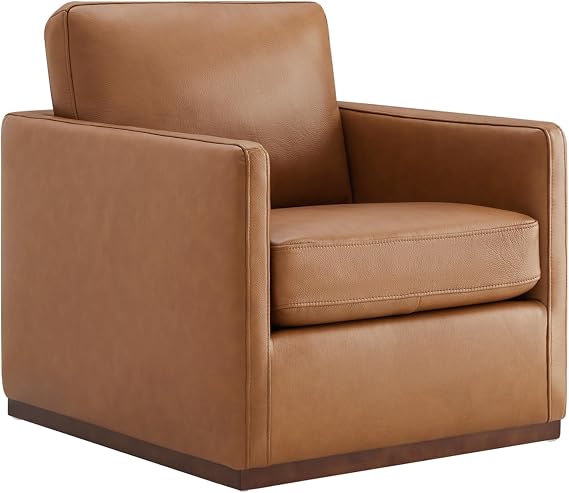
CHITA Genuine Leather Swivel Chair, Saddle (Fully Assembled)

CHITA Fabric Swivel Barrel Chair, Cream (Fully Assembled)

SAFAVIEH Munro Woven Leather Accent Chair, Light Honey (Fully Assembled)

POLY and BARK Verity Fabric Accent Chair, Distressed Green Velvet

ANJ Mid Century Modern Accent Chairs Set of 2, Beige

Razer Iskur V2 X Ergonomic Gaming Chair, Light Gray

CHITA Super Zero Gravity Leather Power Recliner, Navy Blue
The seats, compared by job and trade
The columns describe what each seat actually does for a room, not a score. Read down the column that matches your corner, then use the section for the seat that fits it.
| Pick | Best for | Recline and base | Upholstery at the touch points | The main trade |
|---|---|---|---|---|
| CHITA Power Recliner | Anchoring the room for film and gaming hours | Power, back and headrest moving independently, into a 140 degree zero gravity lie-back | Top-grain leather wherever the body touches | No rock or glide, sized for sitters 5'1" to 6'1" |
| Signature Design Leesworth Recliner | A hosting room that wants motion | Power recline in three positions plus a gentle rocker | Top-grain leather on seat, back and arms, matched faux elsewhere | The rocking motion cannot be locked off, one owner reports |
| Ashley Crestmeade Power Lift Recliner | Standing help for the sitter who needs it | Power lift with independent back and footrest, plus built-in heat and massage | A printed woven suede-look surface, 100 percent polyester | Rated 250 lb, so the headroom check comes first |
| zzlay Recliner Chair | Tight corners with no outlet to spare | Manual push back, 90 to 165 degrees | PU leather over PVC, wipe clean | No motors by design, one light solo sitter's chair |
| YONISEE Loveseat Recliner | Two people on different binge schedules | Manual split back, each side leaning 90 to 150 degrees by pull ring | PU leather with a diamond-pattern backrest | Reclining is body work, and the footrest takes a firm push to close |
| CHITA Swivel Accent Chair | A leather accent between two focal points | No recline, with a 360 degree swivel hidden in the wood base | Genuine leather | A 15 inch back interior, made for short-to-average sitters |
| CHITA Swivel Chair | A fabric accent where pets or a cold basement decide | No recline, with a 360 degree swivel on a wood base | 100 percent polyester | A deep barrel seat that rewards sprawl over upright sitting |
| SAFAVIEH Munro Accent Chair | A warm room that wants leather without the heat | No recline, an open woven frame | Leather straps in a tight basketweave | A firm strap sit on a 16 inch seat, not a padded lounger |
| POLY & BARK Verity Chair | The single corner a pair would crowd | No recline | Removable cushion covers over reversible foam | The lowest seat in the lineup at 16 inches |
| ANJ Mid Century Modern Accent Chairs, Set of 2 | Matched overflow for game-night crowds | No recline | Fabric armchairs with wipe-clean care | Two chairs to build out of the box |
| Razer Iskur V2 X | Long sessions at the keyboard and mouse | Reclines to 152 degrees, with 2D armrests adjusting height and rotation | Layered breathable fabric | A firm posture seat built for gaming, not for napping |
CHITA Power Recliner
Most rooms get their anchor here, and the pick is mechanical before it is taste. The CHITA Power Recliner runs two motors, moves the back and the headrest on separate controls, and holds real leather on the surfaces where your body and your hands actually land. Its headline move is the zero gravity position: CHITA describes the back lowering into a 140-degree lie-back with the footrest up, which is one button parking the entire body for a film, a nap or the fourth quarter.
Three positions are named on the maker's setup, TV, reading and zero gravity, and the headrest is the daily-tweak one. You can tip your neck forward into a controller angle or drop it back for a deeper movie pose without losing the lie-back you already set.
Charging lives at the seat. USB and Type-C ports sit in the control panel, so the phone charges at the hand instead of across the room, and the only real wiring challenge is the chair's own power line. That line is the commitment: the corner this chair owns needs an outlet within cord reach, because every position it offers runs on wall power.
Delivery is a one-box story, sized to clear a 27.8-inch doorway, and it arrives mostly assembled, the backrest sliding into the base, a couple of wire connections, then the plug. Tape the doorway before checkout, and if the route runs through a basement stair, the carton rule in the delivery section below decides the rest.
The fit band runs from 5 ft 1 in to 6 ft 1 in of seated height, and owners sit right at its edges: one at 5 ft 2 and one at 5 ft 7 report settling in for multi-hour sessions without feeling swallowed, and one owner at 6 ft 1 calls the seat small for him, which is the band's own top edge talking. Rated capacity is 350 lb.
One owner says he cannot tell the genuine leather section from the matched faux at a touch, which is as practical a compliment as that split gets. The trade is motion: this base does not rock and does not glide, a fixed and stable seat for a fixed pose. If the room needs a slow swell on game night, the Leesworth in the next section is the rocker built for it. Skip this pick for a sitter standing well past 6 ft 1 in, who wants more leg-room budget than the band serves.
Signature Design Leesworth Recliner
For a room that hosts, this is the anchor that also moves. The Leesworth is a power recliner with three recline positions and a gentle rocker underneath, built with a split that puts top-grain leather exactly where bodies and drinks land, on the seat, the back and the arms, with matched faux leather across the outer panels.
Set beside the CHITA above, the choice is motion against stillness. The CHITA parks a body at 140 degrees and holds it planted. The Leesworth keeps a gentle sway going through a fourth quarter and lets a sitter drift between TV positions with a nudge, which is what the hosting room actually asks for more often than not.
The fit leans tall. The plan runs 41 inches square, the arms sit 26 inches up, and 19 inches of open space runs between them, so the drink and the controller keep their route alongside the thighs. Two owners single out the seat height as the tall-sitter benefit, and two more note the cushions run firm, which sets cushion expectations at first sit rather than leaving them a surprise.
Placement and delivery both get real numbers. Ashley builds this depth with what they call a zero wall design, their wording for minimal space between wall and chair back, so the corner keeps more room behind the chair than the 41-inch read suggests. Door delivery has a 36-inch minimum, a number to tape before checkout.
The charging port is a zero-draw USB in Ashley's description, meaning it pulls power only while in use, which is the quiet advantage over a port that sits powered all day. The controls sit on the side, and two owners describe the side-mounted reach as farther than a lounge pose welcomes, so decide whether that reach annoys you before the chair takes position.
The trade is the rocker itself, and one owner's report is where the hard edge shows: the rocking motion cannot be locked off, and the same owner describes the chair tipping backward when he leaned far back with the footrest raised, so treat deep leans with the footrest up as a lean, not an anchor point. Two owners report the high seat leaving shorter sitters' feet barely touching the floor. Skip it for those sitters, and for a reader who wants a base that locks.
Ashley Crestmeade Power Lift Recliner: the chair that helps you up
Rising is the whole job here. The Crestmeade is Ashley's power lift recliner, built to hand a sitter up to standing on a powered assist, and it runs the back and the footrest on separate motors, so the feet can come up without the back going down. That independent footrest is also the reason this chair works for console-hour sitting, upright with the legs up.
The extras are end-of-day ones. Built-in heat and massage ship with the chair, and both cut off automatically at 30 minutes, so the seat runs its session and then quits instead of cooking itself against an empty cushion.
The footprint is the narrowest of the three recliners here, 35 inches wide, 42 high and 40 deep, with the arms at 26 inches and a 21-inch seat depth. In a corner that a full-size square recliner would crowd, that width is the difference between fitting the plan and rewriting it.
Ownership is light for powered furniture. It arrives fully assembled, the USB port lives in the hand control so charging stays with the hand, and a side pocket gives the remote somewhere to be. Upholstery is a printed woven surface in a suede look with the fiber at 100 percent polyester, so spill plans here are spot-cleaning plans.
The trade is capacity: the lift is rated at 250 lb, and the headroom rule in the fitting section below matters before the corner commits. Skip it for a sitter above that rating or a larger build wanting a wider seat. And in a household where nobody needs help standing, that corner does better work as a film chair, which is the CHITA anchor's job above.
zzlay Recliner Chair
The small room gets its recliner without wiring. zzlay built a push-back recliner measuring 30.3 inches wide, 39 deep and 39.3 high, the tightest recliner in this lineup with a full recline attached, and the mechanism has no motor and no outlet to negotiate: push back against the chair and it leans anywhere between 90 and 165 degrees, then eases upright again when your weight shifts forward.
The seat is PU leather over PVC, a wipe-clean pairing that reads like leather and takes spilled drinks without drama, and the phrasing matters: this is a PU build, not a hide, and the easy wipe care is the reason it suits the room it targets. The frame under it is metal, and the assembly is the tool-free, illustrated kind, which owners back up.
Owners describe this pick in exactly the small-room terms it aims for. Four of them name the small-room fit, three more call the tool-free assembly easy, and one says it reads smaller in person than the photos suggest, which is the right direction for a small room.
The trade is power, and it is deliberate. No motors means no outlet negotiation and fewer failure points in a room that reshuffles for game night. What it asks instead is the lean itself, and the role narrows accordingly: this is a chair for one light solo sitter, and it deserves the capacity check in the fitting section below before it becomes anyone's main seat.
Skip it for big-and-tall readers. And where two seats beat one reclining one, the ANJ pair below is the matched static answer.
YONISEE Loveseat Recliner
One wall, two people, opposite plans: the YONISEE Loveseat Recliner puts split-back manual reclining under two sitters and a storage console between them, all without a motor. Pull the rings inside either seat and that side's back leans from 90 to 150 degrees with the footrest out, so each sitter runs a schedule the other does not have to match.
The console is what makes the footprint pay for itself. Storage boxes and two drawers sit between the seats, four cupholders line it, and two phone holders that rotate a full 360 degrees give a screen a place to mount where both sitters can see it. That is a side table's job folded into the chair, right down to the drinks that usually end up sliding off an arm by the second half.
The trade this one makes is effort. Nothing here is electric: reclining is body work after the ring pull, the footrest takes a firm push against resistance to close, and the USB ports at the console charge low-power devices only, phones and tablets, not laptops. Those limits together are the compromise for a full reclining loveseat that runs on zero outlets.
Plan the wall span and the delivery separately. The piece measures 66.5 inches wide overall, 41 high and 28.7 deep, and it arrives as four boxes that may not land on the same day, 90 percent preassembled with about 15 minutes of finishing. Two trips into one room doubles the stair-corner challenge, so the route check below gets run once per visit.
YONISEE rates the alloy steel frames at up to 720 lb across the whole loveseat, and the plain reading of that number is a frame total, split across two sitters rather than claimed by either one. Skip the pick for a single-sitter room, and where two powered singles beat one shared manual footprint, the answer is one recliner pick above per sitter.
CHITA Swivel Accent Chair
The leather half of the swivel decision. The CHITA Swivel Accent Chair is a genuine leather drum on a wood base with a 360-degree swivel hidden inside it, so the silhouette stays clean and the seat still turns. It is rated at 300 lb, and it ships fully built in a single 64 lb box, no assembly day attached.
Where it earns its base is a corner that watches two focal points. The sweep is the feature, and the sweep needs open floor: a chair like this pays its own way where the screen runs one wall and the bar or the fireplace runs another, while a fixed seat that always faces one place would hand those inches back to the walkway. The base rule in the guidance below settles the argument for a specific room.
The trade sits in the numbers. The seat stands 19 inches high, the back interior tops out at 15 inches, and the arms reach 25, so a taller sitter ends up leaning over the low back instead of getting head support from it. This chair is built with short-to-average frames in mind, and the 15 inches between cushion and shell is the check a tall reader runs first.
The leather behaves well in a warm room: CHITA's own description is that the hide develops a patina and breathes with use, and the care routine is wipe and spot clean, with dry cleaning as the deep option. In a heated room, a breathing leather surface is the version of the material worth having.
Skip it where a tall sitter wants head support. And in the cold-basement or claw-risk corner, where the material decides rather than the shape, the fabric half of this pair below carries the same job.
CHITA Swivel Chair
Same pivot, different tradeoffs. The CHITA Swivel Chair is the fabric half of that decision, a barrel shape in 100 percent polyester on the same hidden wood-base swivel, rated at 350 lb, and it arrives fully assembled in one box.
The footprint is the tightest of the accent picks here, 31.1 inches square and 28.3 inches tall, which makes this the chair that tucks under a window line or into the corner a taller drum outgrows.
Owners give the pick its small-room report: one names it the room's sleek centerpiece, one praises the rotation as running smooth and effortless on the base, and a third found the seat running deeper than expected.
That depth is the sit decision. The seat runs 23.2 inches wide and 22.1 deep inside the barrel walls, and the two ways to sit live differently at those numbers: a sprawler with feet up has the afternoon won, while a reader who sits upright near the front edge loses back support against the same walls. Choose this chair for the lounge, not for poker posture.
Polyester at 100 percent settles the material case: spot clean, wipe clean and dry clean care, no leather chill in a cool room, and fewer stakes around pet claws. Where the touch of real hide matters more than any of that, the leather swivel above is the same job with different consequences.
SAFAVIEH Munro Accent Chair
A warm room that still wants leather does not want it padded. The Munro is SAFAVIEH's woven leather accent chair, leather straps woven in a tight basketweave across the seat frame with no rigid cushion on the sit, and a curved wood backrest that continues into the arms on an open frame. Its case in a warm room is structural: a woven strap seat is not a sealed pad, the version of leather that behaves in heat instead of holding it.
It is also the smallest piece in the lineup, 22 inches wide, 21 deep and 29 high, at 11 lb to lift and a fully built arrival, so repositioning is a one-hand job. It is rated at 275 lb.
The trade shows up at sit level. A strap seat over a firm frame is a side chair, not a padded lounger: the 16-inch seat height and 17-inch depth place it beside a fire, a reading lamp or the bar, and take it out of four-hour film duty.
Upkeep is two lines, dust the leather regularly with a soft, dry cloth and skip the harsh cleaners, with the damp cloth reserved for the wood. Two owners carry a real finish caveat in with the praise: the light raw wood drinks grease and hand prints at the touch, so set it away from game-snack night where that matters.
Skip it where small messy hands share the chair, and where the reader wanted a padded leather lounger, which the CHITA leather swivel above serves instead.
POLY & BARK Verity Chair
Some corners need exactly one chair, and the Verity is the single-seat answer here, a compact fabric lounge chair on a walnut-stained ash frame that arrives fully assembled. It measures 25 inches wide, 34.5 deep and 31 high, among the narrowest pieces here, and its 16-inch seat sits at the lowest height in the lineup alongside the woven leather Munro, over reversible high-density foam cushions with covers that come off for washing. POLY & BARK describes the upholstery as stain-resistant performance textiles.
Three owners describe the chair arriving as promised and settling in comfortably, and one cat owner says the claws have not snagged the fabric.
The trade is the height. At 16 inches, this ties the Munro for the hardest rise on this page, so test your knees against a 16-inch surface at home before buying. The chair rewards the sitter who drops in and stands up without thinking about it, and taxes the sitter whose knees keep score.
The narrow width matters as much as the height: this is the chair that fits the corner a pair would crowd, the reading nook, the single overflow seat beside a desk. It weighs 26 lb and is rated at 275 lb, so the corner it sits in is a decision, not a commitment.
Skip it if you need a higher seat to rise. And where the room says two chairs, the matched ANJ pair below is the next decision up.
ANJ Mid Century Modern Accent Chairs, Set of 2: the matched overflow pair
For the reader who has counted two overflow chairs into the plan, the ANJ set is the matched pair, two mid-century fabric armchairs on solid wood frames with flared legs, each rated at 300 lb, ordered once in a beige that stays quiet in most rooms.
The assembly day is the cost of the match. Both chairs build from parts with instructions and hardware included, and owners put the work at about 15 minutes per chair with labeled screws, so the total is a relaxed half-hour. One throw pillow comes with the pair, and anti-slip foot pads keep its legs off the wood floor.
What the pair buys is overflow symmetry: two seats hauled in for game night and pushed back until next weekend, or a conversation corner that rounds out the plan without demanding a third focal piece. The usable sizing numbers are 23 inches of seat width and 22 of seat depth, and the high-density foam fill sits firm, which two owners note outright and a third found softer and more memory-foam-like than expected.
Care is the wipe-clean kind, the practical answer for a chair whose job happens every weekend.
The trade is what a static chair cannot do: no recline, no lift, and a back that will not fold into a lounger after midnight. Skip the pair for a reader who wants recliner-grade back support, and when a room fits one corner chair instead of two, the Verity above is the single while the pair waits.
Razer Iskur V2 X
The last pick changes the body's job instead of its pose. The Iskur V2 X is Razer's posture-first gaming chair, an upright seat with a built-in lumbar arch, 2D armrests that lift and rotate to keyboard height, and a 152-degree recline for the rounds where the game is on pause.
The lumbar arch is fixed into the backrest rather than shipped as a separate cushion, so it stays put as the back tilts and there is no loose pad to re-find after every session. Razer builds the seat with reduced edges and a multi-layered breathable fabric over molded foam, and the whole arrangement assumes hours at a keyboard, which is exactly what the room should ask of it.
Fit is a desk-wall question. The footprint takes 27.58 inches square, the back climbs 49.64 inches and the frame is alloy steel with a 299 lb rating, which makes this the tallest piece in the lineup by a comfortable margin. Check the wall behind the desk for the 152-degree swing and give the route from the door a look, since the finished build stands nearly four feet tall.
Assembly is instructions and parts in one sitting, easy work by four owners, and four more describe the finished build as sturdy, big and stable. Two owners call the seat firm, and read that steadiness as the posture design doing its job. One owner's practical tip is swapping the stock casters for better ones, and one owner, comparing against Razer's fuller V2 in the same family, argues some of that chair's lumbar features never made this X build.
The trade is furniture: this is the task chair of the room, firm, upright by default and running on casters, so the long nap should happen in a recliner somewhere else in the plan. Care is a monthly wipe with plain water and a microfiber cloth, no soap.
Skip it for the reader whose sessions are lounging or hosting, and for the one whose gaming is already a desk-chair habit. Where the same corner has to carry both the gaming and the film, the CHITA recliner above is the compromise, upright for the rounds and 140 degrees flat when the controller retires.
The measurements that decide the fit
Every chair in this guide answers two different tape questions, and they are not the same number. Its overall dimensions say whether it fits the room, the wall span, the doorway and the distance around the side tables. Its seat dimensions say whether you fit the chair, and those are the numbers that decide a sit after the box is open.
Three seat measurements earn the tape:
- Seat depth, from the front edge of the cushion to where the backrest firms up. A gap of about two fingers behind the knees marks the upright fit, feet flat and back supported. A deeper seat buys sprawl and punishes anyone who sits close to the edge and loses the backrest.
- Seat height, floor to the sitting surface. Rising is the harder direction. The two 16-inch seats here, the Munro and the Verity, flatter a sunken pose and tax a knee getting out, most of the rest sit higher, and the Crestmeade exists for the sitter for whom rising was never easy.
- Arm height, floor to the armrest at rest. Forearms during a session are one job. The other is the side table: measure its top, not just the chair, because the drink and the controller only have a home if the arm clears it.
Recline clearance is the check a corner forgets. Before a recliner takes its spot, set the chair the way it will live, lean it back to its full drop, and read the space behind it against the product's own clearance-to-recline note. The full push-back lean here runs to 165 degrees on the zzlay, and every powered recliner in this guide opens to a lie-back too, so the wall behind the corner has its own job in this category, and the tape decides whether the corner survives it.
Capacity has one sensible practice across the whole lineup: buy with headroom, not to the limit.
Where guests congregate, treat a 300 lb rating as the planned floor for the seats you expect to fill. Two owner anecdotes in this lineup argue the same discipline: one zzlay owner's footrest flexed under legs of about 180 lb, and the ANJ pair, rated 300 lb per chair, carries two breakage reports in its owner sample, one from a chair a few weeks in under a guest of about 180 lb, the other from a chair that arrived broken in poor packing. Those are reports, not a failure rate, but they matter most to the two picks that deserve their own check here, the Leesworth and the zzlay, so run the headroom question against your own weight and your heaviest guest before either anchors the room.
Upholstery for the room you actually have
Start from the room, not from the chair you like. The rule is heat on one side and chaos on the other. A heated, settled room with a reader willing to condition leather carries real hide well. A cold basement, a shed in winter, a dog with claws or a room where drinks get set on arms pushes the decision to fabric, and the colder the room, the smaller the leather answer gets.
Inside leather, full grain is the hide with its surface untouched, marks and all, and top grain is the layer under it, sanded to an even face, which is why it is the practical choice on furniture and also why its scuffs show more on a smooth surface. The finish underneath matters as much as the grade: aniline leather has no protective coat, so it takes every mark and remembers them as patina, while semi-aniline carries a thin protective face that trades a little of that character for easier cleanup, and any hide left in a bright window fades.
Faux leather, PU and PVC are coatings over a fabric base. They clean with a wipe, they read as leather from across the room, and they fail at the seams first, since a plastic surface crackles as it ages, worse in a warm room where it feels sticky to sit in and worse still with sun. The blunt skip is bonded leather, a mix of leather fibers on a polyurethane film, which peels early and has no repair once it starts.
On the fabric side, the pattern holds: tight weaves hold up to pet claws, release pet hair better, and crease less, so they lead wherever a pet lives. Performance fabric is the spill answer, a tight polyester weave is the working middle, and microfiber takes most spills off with plain water without trapping hair the way the soft pile fabrics do. Velvet and loose corduroy are the ones that trap hair and show creases first.
Abrasion ratings deserve one careful read. Listings like to quote double rubs from the Wyzenbeek test or cycles from the Martindale test, and the industry body to read those numbers against is the Association for Contract Textiles, whose voluntary guideline sets residential, low-traffic use at 15,000 double rubs Wyzenbeek or 20,000 cycles Martindale, and public, high-traffic use at 30,000 and 40,000. Two rules keep a quoted count straight, both ACT's. The two methods do not correlate, so a Wyzenbeek count beside a Martindale count is not a comparison. And bigger is not a lifespan promise: ACT's own required statement for results above 100,000 double rubs is that they have not been shown to be a reliable indicator of increased fabric lifespan, and repeated tests of the same fabric can vary by up to 60 percent or more. When a quoted number needs checking, ACT's low-traffic guideline page is where the residential bracket lives.
Swivel, rocker or fixed: the floor decides
A chair's base decides how much of the floor the room keeps, and which moments you can reach without standing up.
A swivel earns its keep in a room with more than one focal point, the screen on one wall and the bar or a fireplace on another, so the sitter can follow the game and the conversation without dragging the chair across the rug.
The cost is floor. A swivel needs open room on every side to do its full turn, which is why a chair wedged into a corner spends the feature unused. In that corner, the fixed base hands those inches back to the walkway.
The rocker is its own decision, and it belongs to the hosting room: the chair where someone is always shifting a little, where the motion is the comfort. The Leesworth above is this lineup's rocker, the CHITA anchor is its fixed opposite, and the room's own use decides which one is the right corner. A spring-return swivel, which pulls itself back to face forward after a turn, and a glide base, which trades turning for a steadier, quieter shift, each serve their own narrow setups.
The after-sale question a spec sheet cannot answer is how a swivel's bearings will feel in year three, so that one is learned by sitting in it late, and the protection is keeping the return rights while the chair is still returnable.
How many chairs the room seats, and how to mix them
One anchor seat per person who is in the room every week, then overflow for the guests who show up. The overflow chairs are a different class of furniture: they do not need to match the anchor in comfort or looks, they only need to be there when the door opens. So the count before checkout runs like this:
- One anchor, a recliner here, per weekly regular.
- One or two accent chairs, the swivels and the woven leather pick do this job in this guide, that also read as corners of the room the rest of the week.
- One matched overflow pair, the ANJ set of 2, for the crowd nights when the door opens wider than a calm one.
The walkway is the first thing to protect, and the tape decides it, not a guide. The path from the door to the bar needs room to pass through with a platter in hand even on the fullest night, so run the doorway check in the delivery section below against your own room before counting chairs past it.
One matching thread beats a matching set. Four identical chairs read like a waiting room, so keep the common element to one shared color or material running across the room's pieces, and cut the accents to a pair at most. And if the overflow you really want is a couch or a casual floor lounger, those roles live in their own posts on this site, since this guide keeps to single seats plus the one two-seat loveseat.
Getting it inside: the carton, the door, the stairs and the outlet
The hardest part of the chair's trip is not into the room, it is into the house. The thing you are carrying is the shipping carton, so measure the carton, not the finished chair, and check it against the clear doorway, the hallway length and every stair turn before checkout. A chair that "ships fully assembled" is a delivery convenience until the route turns.
Door width is a detection problem in your own house, not a standard: measure the clear opening with the door swung wide, because casing and swing eat inches, and common interior doors run near 32 inches, older houses less. The lineup's own delivery facts show how wide those numbers run: the CHITA power recliner ships in one box sized to fit doorways 27.8 inches or wider, the Leesworth sets a 36-inch minimum door width, and the YONISEE arrives as four boxes that may not land on the same day. The Crestmeade, both swivel chairs, the Munro and the Verity come fully built in a box apiece, and the ANJ pair and the Iskur arrive as assembly kits.
Stairs kill the assembled box before the doorway does, because a straight flight tolerates a tilted box and a turn at the bottom does not. If the route to your room has a turn, favor the chair that ships in parts: a few minutes with a screwdriver beats a chair stranded on a landing, which is usually where that story ends.
Then the power route. A powered recliner quietly demands an outlet within the cord's reach of the chosen corner, and every furniture reshuffle afterward replays that demand. Manual reclines, the push-back and the loveseat's ring pull, trade that cord for body work, which is a clean trade in a room that reshuffles. Ports also live where the chair puts them, at a control panel or in a hand control, so check where a phone actually charges while you are seated before hosting hour, not after.
Man cave chair questions, answered
Which picks here need an outlet, and what does the cord plan look like?
Three recliners run on power: the CHITA has USB and Type-C in its control panel, the Leesworth has the zero-draw USB port, and the Crestmeade carries its USB in the hand control with a side pocket. The zzlay and the YONISEE trade power for body work, push-back and pull rings respectively, and the YONISEE's console USB ports top off low-power devices only, phones and tablets. The cord plan is in the delivery section, from the outlet behind the base to the tape on the doorway.
How much room does a recliner need behind it?
Treat this as your own measurement. Set the chair on the spot, lean it back to its full drop and read the space behind it against the product's clearance-to-recline note before the placement is final. The Leesworth is the one pick here built with that wall space in mind: its zero wall construction keeps the wall gap minimal. Everything else takes its recline space out of the room's depth, so the taped check decides whether the corner survives the lie-back.
Which seats survive pets and spilled drinks?
Fabric is the pet-and-spill camp in this lineup: the fabric CHITA Swivel is 100 percent polyester with spot, wipe and dry clean care, the ANJ pair wipes clean, and the Verity pairs the maker's stain-resistant performance textiles with removable cushion covers. The zzlay's PU leather over PVC takes spilled drinks with a wipe. Leather is its own camp: the CHITA recliner and the leather swivel keep a spot and wipe routine, and the woven Munro straps want the soft dry cloth and no harsh cleaners. The room-condition rule in the upholstery section above decides which side of this question a specific room lands on.
My guests run bigger than I do, or rising is hard. What changes?
The capacity conversation lives in one place, the fitting section above, and it is worth going back for: plan the guest seats from a 300 lb rating up and run the headroom question against the Leesworth and the zzlay before either anchors the room. The Crestmeade is the pick for the rising problem, a powered lift for the sitter who needs the standing help. And the two 16-inch seats, the Munro and the Verity, are the hardest rises in the lineup, so weigh them last when guests include older knees.