Best Countertop Pizza Ovens for Fast Pies in Your Man Cave
Published on November 3, 2026 · By Brandon Dixon ·How we choose products · Affiliate disclosure

If pizza night is the main event in your cave, the default is a dedicated countertop oven: the Chefman Indoor Pizza Oven, 12-Inch, Stainless Steel, with named crust presets and a stone and peel in the box, in exchange for a deep, roughly 19-by-17-inch patch of counter. If the counter has to earn its keep all week, the Gourmia Electric Indoor Pizza Oven with Air Fry, Stainless Steel does pizza night plus the daily air-frying and toasting. If pizza is a few-times-a-month thing on a small counter, the PIEZANO 12-Inch Electric Pizza Oven covers it on the gentlest circuit load of the three.
The real decision is between classes, not badges. A dedicated oven spends its whole design on one job, putting serious heat into a stone deck and holding it there, and asks for a permanent patch of counter in return. A multi-function oven splits that capacity across the week, so pizza night shares a footprint with weekday toasting and air-frying, and the compromise shows up in counter width. Everything below stays in indoor countertop electric territory: no outdoor wood-fired builds, no propane burners, no camping gear.
The three ovens at a glance
All three reach 800-degree-class heat on a household outlet. The differences are what else the box does, how much counter it claims, and what it asks of your circuit.
| Oven | Best for | Documented heat | Power draw | Footprint and weight | The trade |
|---|---|---|---|---|---|
| Chefman Indoor Pizza Oven, 12-Inch, Stainless Steel | The dedicated-pizza default | Both elements 300 to 800 °F | 1700 W (about 14.2 A at 120 V) | 18.7 × 17 × 10.94 in, 23.3 lb | The deepest footprint here, spent on a single job |
| Gourmia Electric Indoor Pizza Oven with Air Fry, Stainless Steel | One appliance for pizza night plus everyday air frying and toasting | 170 to 500 °F, up to 800 °F for pizza stone preheat | 1800 W | 17.5 × 21 × 11 in, 28.5 lb | Widest footprint in the lineup, the price of seven functions |
| PIEZANO 12-Inch Electric Pizza Oven | Occasional pies on a small counter | 800 °F | 1200 W (10 A at 120 V) | 13.62 × 13.77 × 6.49 in | A 12-inch pie ceiling and the least recovery muscle |
Chefman Indoor Pizza Oven, 12-Inch, Stainless Steel: the dedicated pick that takes the counter

For the cave that orbits around pizza night, this is the default. Five touchscreen presets cover the pies you actually make, Neapolitan, New York, thin crust, pan and frozen, with Manual as the fallback for everything else, and a frozen Friday-night pie is a button press instead of an argument with a dial. Both heating elements run from 300 to 800 °F, and the pizza stone, the peel and a digital cookbook are in the box, so the first session needs no other purchases.
A top-temperature number is the wrong thing to shop on by itself. A pizza bakes mostly from the surface it sits on, and an ordinary kitchen oven gets its air hot long before any stone inside it gets near true deck heat, which is why home-oven pies blister slowly and dry out before the base browns. A dedicated unit concentrates its heat into the stone instead, so the base sears while the top finishes. What decides the crust is what the deck holds through the bake, not the biggest number on the box.
Chefman says the unit retains heat for back-to-back cooking, and a queue of hungry people is the situation that claim speaks to. Every quick cook time in this class carries the same conditions: a fully hot deck, a thin dough and a light topping load. Cold dough, a loaded pie or a deck still recovering between pies takes longer and browns unevenly.
The door drops down in front and the window is double-paned, a small design decision with a real payoff at 800 °F. Every peek inside dumps heat the deck has to rebuild before the next pie, so check through the glass and keep the heat where the crust needs it.
Measure before you commit. The body runs 18.7 inches deep, 17 inches wide and just under 11 inches tall, and the dropdown door adds its swing out front. Plan a landing spot beside it for a hot 12-inch pie, because the peel needs somewhere to set down that is not the other appliance. If the oven will live on a shelf between pizza nights, plan that shelf too, since 23.3 pounds is a real carry. It is cETL approved and carries a one-year assurance from Chefman, an ownership inclusion rather than a verdict on quality, but part of the math.
Then there is the circuit. 1700 watts at 120 volts works out to about 14.2 amps, close to the practical ceiling of a shared 15-amp household circuit. Count what else lives on that circuit before unboxing, because the microwave, the kettle and a space heater all draw from the same budget at halftime.
What this pick costs is counter: a roughly 19-by-17-inch patch, permanently. It is the deepest unit here, and nothing about it is built for a weekly commute to a shelf. If the counter is shared with a kegerator or the oven has to live in a cabinet between pizza nights, this is the wrong shape, and the Piezano below is the specific smaller answer.
Gourmia Electric Indoor Pizza Oven with Air Fry, Stainless Steel: one appliance for pizza night and every other night

For the reader with one outlet's worth of counter and a standing rule against single-purpose appliances, this is the pick. The Gourmia stacks an 800 °F pizza-stone preheat on top of seven everyday functions, so the box that bakes Friday's pie also toasts Tuesday's bagels and air-fries the rest of the week. The price is 21 inches of counter width, the widest footprint in this comparison.
The top and bottom burners adjust independently. That matters on the pie that comes out wrong: more upper heat for a pale top, less lower heat for a scorched base, fixed on the next round without changing ovens.
The preset list leans pizza, six settings covering Neapolitan, New York, thin crust, pan, frozen and manual, then air fry, bake, roast, broil, toast, bagel and dehydrate for everything else. A touch panel, an LED display and an interior light fill out the controls, and the light earns its keep the first morning you check a bagel without opening the door. Gourmia says 12-inch pizzas come out in as little as 2 minutes.
The temperature range is the number to read on a combo. 170 to 500 °F covers most functions, and 800 °F is reserved for the pizza stone preheat. Pizza heat is there when the stone needs it, and the rest of the range covers ordinary oven work.
Measure width first. The body runs 17.5 inches deep, 21 inches wide and 11 inches tall, and at 28.5 pounds it is the heaviest unit here, which matters most if it commutes to a shelf between uses.
On power it draws 1800 watts, the largest draw in the lineup. Run that against a standard 120-volt circuit and it comes to 15 amps, a full household circuit's budget. This is the pick that wants the circuit mostly to itself.
Cleanup is where the combo pays you back: the air fry basket, the wire rack and the drip tray are dishwasher-safe, and the stone gets a hand wash.
Width and weight are what that versatility costs. If you never air-fry or toast, you are paying counter width for functions you will not run, and the Chefman above is the dedicated answer, one job done outright in about 19 inches of depth instead of several done acceptably in 21 inches of width.
PIEZANO 12-Inch Electric Pizza Oven: the small-counter, few-pies-a-month pick
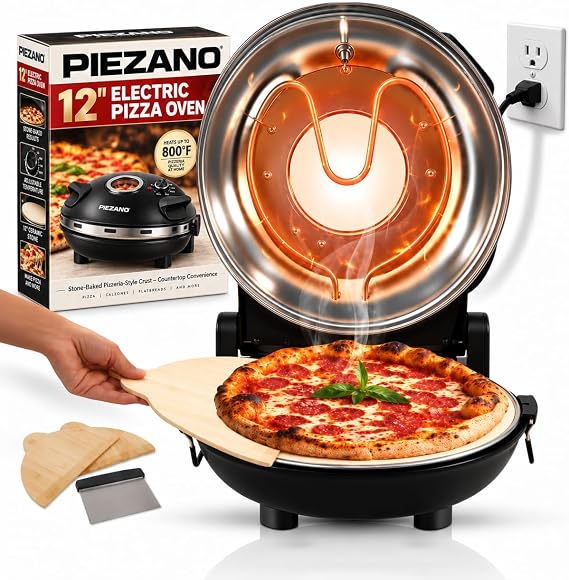
For a few pies a month on a small counter, this does the whole job on a gentler scale. The Piezano heats to 800 °F, gives you separate knobs for the top and bottom elements, and occupies roughly a 14-inch square of counter, a patch neither of the other two fits. At 8.3 pounds, storage is a shelf, not a commitment.
The controls are knobs, not menus. One dial runs the top element, one runs the bottom, and a built-in gauge on the lid reads the temperature inside, so you adjust by what you see through the tempered-glass window instead of guessing. The smallest oven here still lets you fix a pale top on one knob and a scorched base on the other.
The box is generous for its size: the oven, a 12-inch ceramic stone that lifts out for cleaning, two wooden peels, a dough scraper and a recipe guide. Two peels is the quiet luxury here, one for launching and one for turning the pie mid-bake. The maker also sells a first-party replacement stone, so a worn deck is a parts order, not a new oven.
That small footprint still needs a landing plan. A hot 12-inch pie has to go somewhere the moment it leaves the oven, and nothing about a compact oven shrinks the pizza.
On the circuit it is the gentlest load here. 1200 watts at 120 volts works out to 10 amps, gentle enough to share a circuit with the fridge and the TV. Piezano says a fresh 12-inch pizza cooks in under 6 minutes, and the stone also handles calzones, flatbreads and reheated slices, with frozen pies thawed first per the maker's directions.
What the small numbers cost is capacity and recovery. Pies top out at 12 inches here. The maker's 14-inch sibling exists, not reviewed here, if size is the only question. Past that, a bigger-pie baker needs a class this trio does not document. If the counter and the budget stretch, the Chefman above is the bigger dedicated unit. The 1200-watt draw is also the least recovery muscle here when the pies start queueing.
Will your circuit and counter actually take it
Every oven in this comparison plugs into an ordinary household outlet, and all three will still trip a breaker if the room is not honest about what shares that circuit. The checks are parallel, not a sequence, and any one of them can stop the purchase before money moves.
- Count the circuit. The Chefman draws 1700 watts and the Gourmia 1800, the Piezano 1200. Whatever else already shares that outlet decides whether the breaker holds through a bake.
- Map the counter. Footprint numbers are taken with the door closed, and the Chefman's door drops forward. Hold the tape before anything ships and include the door swing, a landing spot for a hot 12-inch pie, the storage path and its weight if the oven commutes to a shelf, and the surface underneath, since a hot-running appliance sits there for an hour at a time.
The arithmetic is simple enough to do in the aisle. Watts divided by volts is amps, so on a standard US household circuit the two heavier draws land at or near the full 15-amp budget while the Piezano leaves room. A breaker that trips mid-bake is not bad luck. It is the circuit telling you what it can carry.
Read the nameplate, count what shares the circuit, and decide where the hot pie lands before the oven does.
The last check protects the room instead of the breaker. Each of these is sold as an indoor countertop unit, and each spends an hour at a time running hot on or near finished surfaces. Confirm the exact model is indoor-approved and follow its manual for placement before buying or first use. That check costs ten minutes.
Smoke, cleanup, and what keeps the deck working
The first complaint anyone has about an indoor high-heat oven is not the pizza, it is the smoke alarm two rooms away going off mid-bake. Normal use makes some smoke, and it has three manageable causes, each with a mechanical fix.
Loose flour is the first. Launch flour and semolina scorch fast on a hot deck, so use less than feels right and knock the excess off the dough before it goes in. Drips are the second. Cheese, sauce or oil that lands on bare deck burns into the next pie's smoke, so dress the pie within its rim and scrape the deck between bakes. The third cause is the oven itself in week one, when the first full-heat cycles burn off manufacturing residue. Many makers recommend an empty first preheat, and each model's manual governs how to run it.
Deck care is mostly about what you do not do. A stone deck wants dry cleaning once it is fully cool, a scrape and a brush, and it dislikes water, soap and sudden temperature swings as a class. Give it its full run-up to temperature before the first launch of a session, because a pie launched onto a deck still climbing bakes unevenly. The Gourmia's stone gets a hand wash, the one piece of its cleanup that skips the dishwasher. The Piezano's stone lifts out, so even a deep clean is a sink job instead of an oven job. The Chefman's stone follows the same dry habits.
On accessories, the useful list is three items long: a launch peel sized to the pies you make, a way to check deck temperature (an infrared thermometer handles it), and a turning aid for the mid-bake spin. The Chefman and the Piezano both ship peels, and the Piezano ships two, which covers launch and turn on day one. The Gourmia leaves the launch peel to you. Everything else out there, screens, gloves, covers and cleaning kits, is situational at best.
One honest close for a specific reader. If pizza happens twice a year, none of these earns a permanent counter patch. Keep the counter clear, accept that the occasional pie comes out slower and paler than a stone-deck bake, and the room never changes. Everything above is for the reader who bakes more than that, and for him the question was never whether a stone-deck oven belongs in the cave, only which one fits the counter he already has.