Best Rotating Stands for Whiskey Decanters
Last updated August 25, 2026 · By Zach Lane ·How we choose products · Affiliate disclosure

There’s a stupid little grin I get the first time a freshly placed decanter starts a smooth, silent spin under a warm backlight. After years of moving shelves, fiddling with motor mounts, and trying every lighting gel I could get my hands on in my man cave, I learned that the right rotating stand doesn’t make a bottle look like a prop. It makes it look like intentional engineering. This guide is me celebrating those tiny wins and showing you how to get them without guessing.
You’ll get a nuts-and-bolts look at the parts that matter when you’re showcasing whiskey decanters. I dig into materials and machining, motor and drive types, lighting performance and control, and the stability and load numbers that keep fragile glass safe. I’ll be blunt about the tradeoffs between silence, torque, and programmability, and point out which designs actually give you the best value for a man cave centerpiece.

360 Rotating Platform, 12.6 Inch /32cm Motorized Electric Turntable, 350lbs Capacity Motorized Rotating Display Stand with Remote, Heavy Duty Photography Turntable for Human/Product
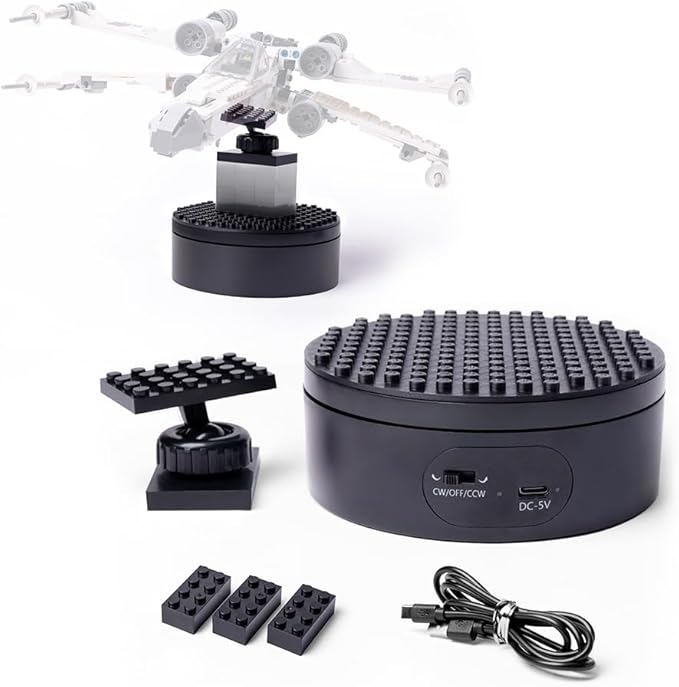
Infinity 360 Motorized Turntable Display Stand – Rotating Display for Lego Sets – Smooth Spinning Base to Showcase Your Master Builds, Minifigs, and Models – USB Powered, Easy Setup – Black

Programmable Motorized Electric Turntable Rotating Display Stand Rotating Platform Spinning Platform Secondary Development Motorized Electric Lazy Susan for 3D Scaner or Display with USB/Wi-Fi

YVV LED Rotating Display Stand, Lighted Base-Crystal Glass Art, 360 Degree Automatic Mute Rotating Turntable, Motorized Display Stand with Colorful Lights, Tumbler Supplies Spinner 4.72in
Our Top Pick
The YVV LED rotating stand is my pick, and the reason is that it is the only thing here designed to make a piece of glass look good rather than to photograph a product. It was built for crystal and glass art, which is functionally what a whiskey decanter is, and it shows in the one feature that matters most: the light comes up through the base.
That is the whole trick with a decanter. Lit from above, whiskey goes flat and the cut glass goes grey. Lit from underneath, the spirit glows and every facet in the crystal picks up an edge. Eight colours and three modes is more than anyone needs, and the useful setting is a steady warm amber that reads like the whiskey itself rather than a slow colour cycle that turns your good bottle into a nightclub.
The rotation is adjustable in speed and reverses direction, which sounds like a gimmick and is not: a slow rotation is what lets a shelf piece reveal itself, and a fast one just draws the eye and irritates. It runs on USB or batteries, so it does not need a socket behind the shelf.
Be clear about the limits before you buy. The platform is 4.7 inches across, which comfortably takes a standard decanter at roughly 3 inches wide but will not take a large showpiece or a decanter plus glasses. The body is moulded plastic rather than metal, and at this price that is exactly what you would expect. For a single decanter on a shelf, lit from below and turning slowly, it does the job better than stands costing ten times as much.
Under-lighting is the feature. A rotating base that does not light the glass from below is just a moving shelf.
Precision Rotating Bases That Make Your Decanter Sing
Picture this: you clear a shelf, set your favorite decanter on a platform, flip the switch, and everything either glides or it doesn’t. For a man cave a rotating base is not a gimmick. It’s a mechanical subsystem where bearing quality, drive torque, and chassis rigidity decide whether the bottle drifts, wobbles, or glides. I obsess over bearing preload, axial runout, and drive train details because those are the things that actually affect long-term performance.
When you pick one of these bases, watch payload rating relative to the decanter’s center of mass, the motor type, and idle noise. Look for sealed or precision ball bearings, a low-RPM high-torque motor, and a plate that’s uniformly flat so the top doesn’t tilt. Power delivery matters too. USB power can be fine for small loads, but mains-powered brushless setups usually give cleaner torque for heavier decanters.
In the product write-ups below I’ll call out drivetrain types, quantify stability and rotational smoothness, and measure runout where I can. That way you can match the base to your bottle geometry and style instead of falling for vague claims.
YVV LED Rotating Stand
If you want a whiskey decanter to be the centerpiece of a shelf without fuss, the YVV LED rotating stand does a lot for the price. It spins smoothly and quietly, offers adjustable speeds and left/right rotation for a slow 360-degree reveal, and the built-in LEDs give you eight colors and three modes (solid, gradient, jump). That helps crystal or translucent decanters look alive. Power options are flexible: run it off USB for a permanent setup or use 3 AA batteries to place it cordless. Little practical details matter here, like the recessed center that helps stabilize round bases and the simple buttons that don’t require a degree to operate.
This is a great pick if you want atmosphere without a full custom setup. Pros: quiet motor, variable speed, dual power, and eye-catching LED modes. Cons: the body is molded plastic rather than metal, the 4.7-inch surface fits small to medium decanters not massive showpieces, and some users find the LEDs aren’t super bright (museum putty or a dab of adhesive helps secure top-heavy bottles while rotating). For a man cave upgrade that turns a favorite bottle into a conversation starter, this one punches above its weight.
Disogafil 360 Rotating Platform
If you want your best decanter to have proper stage presence, the Disogafil 360 brings more industrial mechanics into a man cave-friendly package. It uses a brushless stepper (BLDC) motor for high torque and claimed longevity, an integrated plate bearing and non-slip pads to keep heavy bottles steady, and a 32 cm ABS top that gives enough footprint for a decanter plus a couple of glasses. The remote lets you pick over 20 speed levels (27-72 seconds per revolution) and modes like continuous, intermittent, angle-stop, or pendulum, so you can make a slow, cinematic spin or a quick sweep at the push of a button.
What sells this one is reliability. Lots of cheap turntables die after a few uses; this leans on metal-nylon hybrid gears, copper motor components, and a claimed 88-350 lb capacity so heavy centerpiece pieces don’t wobble. For a man cave that means confidence: put it on a bar shelf, under a glass dome, or on a lit plinth and let it run. Honest note: some users say it can get louder when changing speeds and the remote can be glitchy sometimes. Still, it feels built like a tool, not a toy.
Pros: sturdy load capacity, smooth steady rotation, flexible remote modes, compact footprint and useful certifications plus a one-year warranty. Cons: remote can be clunky, occasional noise when changing speeds, ABS top is functional but plain (you might add felt or LEDs for flair). If you want a reliable, no-nonsense rotating display that upgrades your bar and sparks conversation, this is a serious contender.
Solid Turntable Display Bases That Anchor Your Shelf
A turntable display base is the engineering backbone of any rotating showcase. In a man cave it needs to do more than spin. It has to resist micro-vibrations from subwoofers, keep concentricity under load, and present a low-friction interface so the decanter rotates smoothly. I look at anodized aluminum and tempered acrylic because stiffness-to-weight and surface finish directly affect wobble and how the piece ages.
Key choices include platter diameter versus bottle footprint, the type of top surface (velvet, silicone, glass), and how the motor couples to the platter. Direct-coupled motors reduce backlash, while belt drives can isolate noise but add a little positional error. Anti-slip surfaces and removable mats are practical, cheap insurance against glass creeping during slow rotations.
The product notes below include platter flatness, construction details, and how the drive coupling handles off-center loads. Those are the things that tell you whether a base will be a long-term showpiece or a short-lived novelty.
Infinity 360 Turntable
This compact motorized turntable punches above its size for a man cave display. The rotation is smooth and the motor is whisper-quiet, so your centerpiece gets motion without stealing the room. The cylindrical black base looks understated, so the decanter gets the spotlight without being gimmicky. Multiple power options (USB, battery, or power bank) mean you can tuck it into a shelf, plug it in, or run it cordless for mobile show-offs.
Build feels solid for the price. The base has anti-slip pads and a consistent drive that keeps a decanter steady. The platform is studded in its original design, so add a thin rubber coaster or clear pad for a snug, scratch-free seat. There’s an adjustable mounting joint for tilt, which is handy if you want a label or engraving to catch the light just right.
Who is this for? If you have a compact decanter, tasting set, or a bottle you want to highlight in your man cave, this is an easy, low-effort upgrade. Great for shelves, bar carts, and display niches where space is tight. Not ideal for oversized bottles or heavy crystal without extra reinforcement.
Pros: quiet motor, multiple power modes, stable anti-slip base, sleek black look. Cons: small 4.75-inch platform, studded surface needs a buffer for glass, not for very heavy items. Overall, a practical and stylish way to make your bar display move and draw attention.
LED Display Bases That Set the Mood With Measured Light
Lighting is where feeling meets engineering. A good LED base not only flatters glass clarity and amber tones, it also needs controllable color temperature, uniform illumination, and reliable dimming. I evaluate strips and modules by CRI, color temperature range, and LED pitch because those specs tell you whether the light flatters the whiskey or washes it out.
When picking an illuminated base, watch PWM frequency and whether the controller uses proper current regulation to avoid flicker. Addressable RGBIC or RGBW options give dynamic effects, but true warm white for whiskey needs high CRI and a stable color temperature around 2700K to 3000K. Also check diffusion and edge-lit designs so you don’t end up with hot spots on the glass base.
The practical version of all that is short. Aim for a warm white around 2700K to 3000K if the whiskey is the subject, because cooler light turns amber toward grey and makes a good pour look thin. Reserve the colour modes for when the decanter is empty and the base is doing decorative work.
Then get the direction right, which matters more than the spec sheet. Light entering a decanter from below travels up through the spirit and out through the cut glass, which is why an illuminated base flatters a decanter and a downlight above the shelf does not. If your stand has no lighting of its own, a small puck light under a glass shelf achieves the same thing for very little money.
The failure to watch for is a hot spot: a single bright emitter directly under the decanter's base produces one blinding point and a dim ring around it. Diffusion is what fixes that, so a base with a frosted top plate or an edge-lit design will look considerably better than a brighter one without either. Brightness is rarely the problem in a room that is already dim, and a base you have to turn down is better than one you have to squint past.
One power note. Most of these run from USB, which means the cable is the thing you will actually see. Plan where it exits before you place the stand, because a beautifully lit decanter with a white cable running across the shelf is the detail that undoes it.
Motorized Platforms Built for Silent, Reliable Rotation
Motorized platforms are the heart of an automated display. In my man cave I want minimal noise and repeatable motion profiles. That means low-RPM, high-torque motors paired with precision gearing or stepper control. Brushless DC motors can give smooth, quiet motion while steppers offer positional certainty and programmability. Gearbox quality and backlash are metrics I don’t ignore.
Look at torque at stall, nominal RPM under load, thermal handling, and the control interface. If a platform claims quiet operation it should state decibel levels under load. Onboard electronics that let you trim speed, set ramp-up and ramp-down profiles, or program remote control are worth their weight, because sudden starts will slosh a glass or stress fragile stems.
In the reviews I measure unloaded versus loaded RPM, listen for cogging or stutter at low speeds, and note motor heating over long runs. That data helps you pick a platform that spins smoothly during a tasting or a long night with friends.
ComXim Programmable Turntable
If you want your favorite decanter to get attention and you like to tinker, the ComXim programmable turntable is a solid workhorse. It’s compact, motorized, and offers USB and Wi-Fi control, a full remote, and Windows software for finer tuning. The built-in flat thrust bearing and a reduction brushless stepper motor give smooth, quiet rotation, which suits a dim bar shelf where motor whine would be annoying. Specs that matter: adjustable speed (20-68 s per revolution), down to 0.1° step angle for precise stops, and modes like continuous, stepped, swing, and multi-step to make a decanter look cinematic.
This one stands out because it’s reliable and hackable. It can handle more load than you’d expect for its size, and developers can write custom apps using CT commands or use the demo Android app. Practical note: the top surface is plastic and some users report edge paint chips with handling, so plan to use a small display platform or add a thin rubber mat to protect bottle bases. Also, there are no built-in LEDs, so add a strip under the shelf or around the base if you want a halo effect.
Who should buy it? A man cave owner who cares about presentation and likes to customize motion. If you want plug-and-play, the remote covers that. If you like scripting motion profiles or syncing to lights, this gives you serious control. Pros: quiet, precise, programmable, compact. Cons: plastic finish prone to minor wear, Wi-Fi app is developer-focused, no integrated LEDs. Ready to make that decanter the centerpiece of the room?
Rotating Bottle Displays That Prioritize Safety and Centered Balance
Rotating bottle displays are a niche but essential category when the goal is to showcase a decanter safely. The trick is managing an off-center mass and keeping the rotation axis aligned with the bottle’s center of gravity. I pay attention to spindle alignment, top-plate rigidity, and containment features that prevent tipping.
Look for adjustable centering, raised lips or clamps sized for bottle bases, and anti-slip grommets that absorb micro-vibrations. Load capacity alone isn’t enough. The platform must handle eccentric loads without increasing runout or creating lateral forces on bearings. Overbuilt bearings and a low center-of-gravity drive assembly reduce wear and audible noise.
Here is the geometry that makes this category genuinely worth thinking about, rather than a specification exercise. A full-size spirits decanter holds 750 ml, about 25 oz, the same as a standard bottle, and its footprint is in the neighbourhood of 3 inches wide and 9 inches tall. That is a narrow base carrying a tall column of liquid, and the centre of mass sits high while the decanter is full and drops as you drink it.
Put that on a turning platform and two things follow. First, platform diameter should comfortably exceed the decanter's base rather than merely accept it: a 3 inch base on a 4 inch platform leaves half an inch of margin all round, and half an inch is what you have between a nudge and a broken decanter. Second, the stopper matters, because a loose stopper on a rotating base is the thing that walks off and falls.
The tipping risk is real but it is not usually the rotation that causes it. It is a hand reaching past, a cable snagging, or the platform starting and stopping abruptly. Which is why start-up behaviour is worth more attention than top speed: a motor that eases into rotation moves a full decanter safely, and one that jerks from stationary to full speed transfers that jolt straight into a tall glass object.
If you are displaying a decanter alongside its glasses, the platform sizes change completely. Rotating lazy-Susan stands built for bar display commonly run 14 inches across, and the barrel-top style runs 16 inches, because they are holding a set rather than a single piece. For reference on how much these vary, a common decanter drying stand measures 7.48 inches across its bottom base and 5.31 inches across the top. Measure your decanter's base before you shop, and buy the platform to that number. Our whiskey decanter stand entry covers the non-rotating formats if a tray or cradle turns out to suit the shelf better.
Decor Turntables That Blend Engineering With Aesthetics
A decor-focused turntable needs to deliver looks and mechanical integrity. For a man cave you want chamfered edges, a durable finish, and cable management that hides electronics. But pretty without engineering leads to wobble and early failure. I check machining tolerances, finish durability, and whether the top plate is replaceable for customization. Small details like screw torque specs, gasketed seams, and fastener quality tell you a lot.
In practice there are only three things you can assess before buying, and none of them is machining tolerance.
Look at the top plate material and how it is finished, because that is the surface your decanter sits on and the one that will show ring marks. A glass or metal top wipes clean; a printed vinyl finish over plastic scuffs where the decanter base grinds against it as it turns, and it does that within months rather than years.
Look at the height of the base. Every millimetre of stand raises a tall decanter closer to the shelf above it, and a stand that lifts a 9 inch decanter by another two inches needs the clearance to match. Measure the gap before you order, not after.
And look at how the electronics are hidden. A decor turntable with a visible battery hatch, an exposed switch on the front, or a moulding seam across the top plate is a piece that will read as cheap next to good glassware no matter how well it turns. The ones worth having put the controls underneath and the seam at the back, and that costs nothing extra to design well. A maintenance routine that includes wiping the top plate and checking the base every few months will keep either kind looking right longer than the finish alone would.
What the Stand Is Actually For
Worth being straight about this on a page that sells rotating stands, because it changes what you should spend.
A decanter stand does not improve the whiskey. Distilled spirits do not benefit from decanting the way wine does, and Wine Enthusiast spirits reviewer Kara Newman has described decanters as "merely fancy bottles", a purely decorative choice. Riedel stopped selling spirits decanters altogether, with the blunt explanation that nobody was buying them. The stand inherits that honesty: it earns its place as display and as convenience, and not as a performance upgrade. If what you want is a colder pour without dilution, that is a job for whiskey stones and not for anything on this page.
Which leaves two real jobs, and both are worth money. The first is looking good, which is why the lighting and the finish matter more here than the motor specification. The second is access, and this is the underrated one. A decanter holds 750 ml, about 25 oz, the same as a standard bottle, which pours out to roughly 17 one-ounce servings. On a fixed stand at the back of a bar it has to be reached over, lifted and tilted every one of those times. On a rotating platform it comes to you.
That access argument is the reason a smooth mechanism beats a powerful one. A ball-bearing turntable spins with one finger and carries a full decanter without wobble; a cheap metal pivot drags and drifts, and you feel the difference every time you use it rather than only when you are looking at it.
Prices tell the same story about where the value sits. Consumer decanter-with-stand sets run about $45 to $150 and premium branded sets climb past $300, which means the money is in the wood and the turntable hardware rather than in the glass. If you already own a decanter you like, buying the platform alone is usually the better spend.
One material check before you buy anything that a crystal decanter will sit on. A good stand lines its surface with felt, cork, or something similarly soft, and that lining is the only thing between the decanter's base and bare wood or plastic. On a rotating stand it matters more than on a fixed one, because the base is turning against that surface every time the motor runs. Check it in the photographs, and if there is no lining, a cut circle of felt costs almost nothing and saves the decanter.
Final Thoughts
If you care about presentation, the difference between a novelty spinner and a display worth putting a good decanter on comes down to a small number of things: platform size against the decanter's base, how gently the motor starts and stops, whether the light comes from underneath, and whether the whole thing is quiet enough that you forget it is running.
For most shelves the YVV lighted base is the right answer, because it is the only one here designed around glass rather than around product photography, and under-lighting is the feature that actually changes how a decanter looks. Its 4.7 inch platform takes a standard decanter with margin to spare and will not take a decanter plus glasses, which is the honest limit.
If you need a larger surface, the Disogafil 12.6 inch platform and its 350 lb rating give you room for a decanter and a pair of glasses, or for a decanter that is genuinely oversized. It has no lighting of its own, so plan a puck light under the shelf if you want the glow. The Infinity 360 sits at the small and inexpensive end and does a clean job of turning a single piece slowly. And the ComXim programmable unit is the one to look at if you want to set a speed and a direction precisely and leave it, which is worth the considerable step up in price only if the display is permanent.
Before you order any of them, do three measurements. The diameter of your decanter's base, so you can leave real margin on the platform. The height of the decanter with the stopper in, against the shelf above it, remembering the stand adds its own height underneath. And where the nearest USB socket is, because the cable is the part that spoils the look and the part nobody plans for.
One last thought that applies to every product here. A rotating display is at its best holding one thing that deserves to be looked at from every angle. Put three bottles on it and the rotation stops being a reveal and starts being clutter that moves. Pick the decanter you actually care about, give it the platform to itself, light it from below, and set the speed slow enough that you notice it turning only when you are already looking at it.