How to Fix Ground Loop Hum in Your Home Theater
Published on November 1, 2026 · By Chris Murphy

The hum is still there with the volume at zero. That detail matters more than it looks: a steady low buzz that ignores the volume knob is almost always a ground loop, not a failing speaker or a bad source. Two or more connected components are tied together twice, once through their power cords and again through a signal cable, and the small voltage difference between outlets pushes current through the audio shield. In a home theater the classic suspect is the cable box coax, with the subwoofer interconnect a close second.
The fix is to find the exact cable closing the loop, then match one fix to that path: a service-matched coax isolator, an RCA isolation transformer at the sub, or a power arrangement within its ratings. Start with the one-cable-at-a-time test below, coax first. The one thing never to do is pull the ground pin or use a cheater plug. That trades an annoyance for a shock hazard.
Quick answer
A steady hum that persists with the volume turned down is almost always a ground loop between connected components, usually through the cable coax or a subwoofer cable. Find the guilty path by unplugging signal cables one at a time, coax first, restoring each before the next. Match one fix to the path you find: a service-matched coax isolator, an RCA isolation transformer at the sub, or a shared circuit within its ratings. Never pull the ground pin or use a cheater plug. That trades a noise for a shock hazard.
Is that buzz actually a ground loop?
A ground loop hum has a signature, and it is a boring one. Steady, low, sitting at 50 or 60 Hz, and completely indifferent to the volume knob, because the offending current arrives through the cable shield rather than through the program signal. It often seems to come from everywhere at once, since several connected components are reproducing the same shield current at the same time.
Two checks separate a loop from its lookalikes. Listen for behavior first. A buzz that rises and falls with the refrigerator compressor, a dimmer, or the air conditioner kicking on is electrical interference riding the power line, not a loop between components. A loop hum does not change when anything in the house cycles. Second, if only the subwoofer is humming, unplug its input cable. Hum gone means the loop came through that interconnect and the sub's amplifier is probably fine. Hum still there with nothing connected points at the sub itself, and the stop conditions near the end of this article cover where that leads.
One other sound to rule out now. A sharp whine or hiss, rather than a low hum, is usually radio-frequency interference, a different animal that a ferrite addresses. That distinction comes back at the end, because a ferrite is the most common wrong purchase for this problem.
Why does connected gear hum as one system?
The mechanism matters for exactly one reason: it tells you which cables to pull. Every component references ground through its power cord. Connect those components with signal cables, and their chassis are now tied together a second way through the interconnects, the HDMI runs, the coax, the Ethernet. Two outlets almost never sit at exactly the same ground potential, so the small difference drives a current through the cable shields, and the amplifier reproduces that current as hum. The program signal is a passenger, which is why the volume control does nothing.
Powered subwoofers get hit hardest for practical reasons. Their inputs are unbalanced and high gain, their cable runs tend to be the longest in the room, and the sub often lives on the opposite wall, plugged into its own outlet. More voltage difference between outlets, more shield current, more hum.
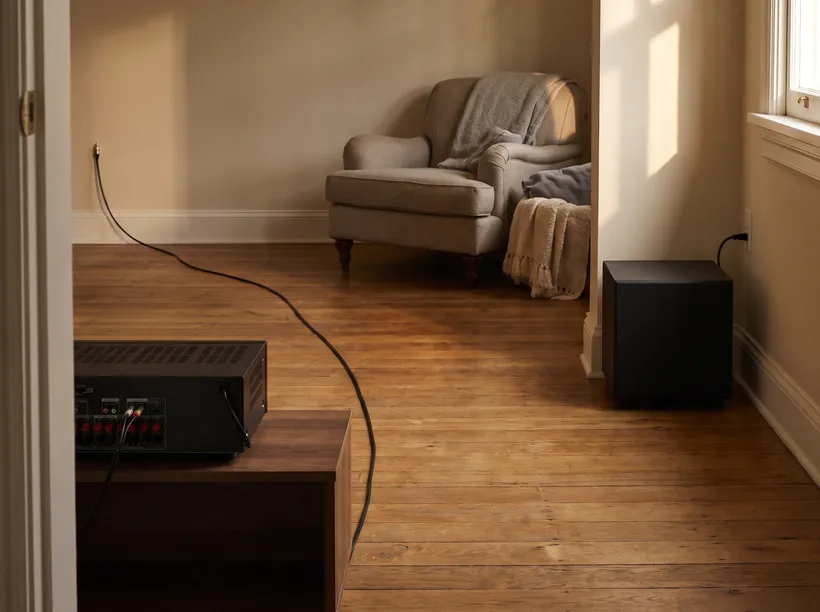
A ground loop isolator is the part built for this, and the order of operations matters. It is a small transformer that breaks the DC continuity of the cable shield while passing the audio signal magnetically. It goes in after the test names the guilty path, not before. Buy one first and you are guessing which of five cables needs it.
Which cable is closing the loop?
Turn the volume down before you touch anything. You are about to unplug live connections, and a quiet room makes the test readable.
Start with the cheapest test in the sequence. Plug everything onto one power strip or one branch circuit. If the hum falls substantially, you have proved that ground-voltage differences between outlets were contributing. Keep one caveat next to that result: this is a diagnostic, not automatically the permanent installation. Large displays and high-power amplifiers or subwoofers can exceed a strip's rating, and the equipment manufacturer's power requirements govern what the final arrangement can be.
Now the isolation sequence itself. If the whole system hums, start with the coax where it enters the receiver or display, then Ethernet, then HDMI, then the analog audio inputs. If only the sub hums, start with the RCA at the subwoofer itself. Pull one cable, listen, and restore it before you pull the next. When the hum drops out, the cable in your hand is the loop. Note which one it was, because that path decides the fix.
The sub test carries its own fork. Hum that stops with the RCA pulled came through the interconnect, and the sub's amplifier is likely healthy. Hum that continues with no input connected makes the sub the suspect. Moving the sub to another properly grounded outlet sorts that out. Hum that persists in the new location points at the sub. Hum that changes points back at the loop.
A guilty cable is not necessarily a defective one, though. Its shield simply turned out to be the best available return path for the loop current. Replacing it with a new cable changes nothing.
A hypothetical layout shows how short the sequence can be. Picture a cable box on one wall outlet, the receiver on another, and the sub across the room on a third. Whole-system hum, so coax first. Pull the coax at the receiver and the hum dies. The loop was the cable box's ground meeting the receiver's ground through the coax shield, and the sub across the room was humming on the same current. One pull named it.
Which fix matches the path you found?
Every confirmed path has one matching fix. Match them exactly and you buy one part instead of accumulating filters.
The coax path
If the coax killed the hum, the fix is a coaxial ground-loop isolator installed in line with the feed. One requirement matters more than price. The isolator must be designed for the actual service, because cable and broadband, satellite, and over-the-air feeds differ in DC-pass behavior and frequency range, and a mismatched device can cause service problems of its own. The home theater ground loop guide from Palomar Engineers lays out the matching requirements by service type, which is worth a read before you order.
An isolator never replaces the grounding a coax service is supposed to have. In a correct installation the coax shield is bonded to the building's grounding electrode system where the line enters the house. Missing or broken bonding is a job for the installer or an electrician, not something an inline part papers over.
The subwoofer RCA path
If the RCA at the sub was the guilty cable, the fix is a line-level isolation transformer between the receiver's sub output and the sub's input. It breaks the shield's DC continuity while passing the audio magnetically, which is precisely the interruption a loop needs.
Know the tradeoff before you buy. Low-cost transformers can roll off deep bass, cut output level, or saturate when driven hard. On a subwoofer, whose entire job is deep bass, those are not small compromises. Better-specified units avoid them at a higher price. Spend accordingly, or you will trade a hum you can hear for bass you cannot.
The power arrangement
If the strip test already quieted the system, the permanent version is the same idea. Everything on one branch circuit, or on a strip rated for the load, with the manufacturer's power requirements as the numbers that govern. A strip that comfortably handles a receiver and a couple of sources may not handle a large display and a high-draw subwoofer on top of them, so check the actual ratings before calling the arrangement final.
When HDMI looks guilty
If the test named an HDMI cable, do not try to fix it inside the HDMI cable. HDMI carries high-speed differential data, not an analog signal a transformer can interrupt, and an analog isolator has no business in that path. The fix is to find the other connection closing the loop: an analog audio cable, Ethernet, a second coax, or, when HDMI is the only signal connection between the two boxes, the ground path through their power cords, which is the case the same-circuit fix above addresses. HDMI rarely closes a loop alone. Improvising inside the HDMI path costs a wasted part and, at worst, the picture.
One last connection worth mentioning. Equipment that supports balanced XLR or optical connections can gain from switching types on long runs. Optical in particular breaks the electrical connection entirely. Balanced is not automatic immunity, though. Implementation and the remaining paths still matter, so retest after any swap.
What should you never do, and when do you stop?
The tempting fix lives in the junk drawer. Mine has a three-to-two cheater plug in it too. It stays there. Grounding-pin removal, a cheater plug, or a cord modified at the plug will often silence the hum on the spot, and that is exactly the problem. It works by disconnecting the equipment from the protective earth conductor, the path that carries a fault away and trips the breaker when something inside fails. Lift it, and a fault that should have tripped protection instead waits on the metal panel of the receiver at line voltage. The hum is annoying. That is a shock hazard.
The fix for hum lives in the signal path. The safety ground stays exactly where it is.
Every fix in the previous section works that way, interrupting a tiny and harmless loop current while protective earth stays connected.
The stop conditions are just as specific. A subwoofer that still hums with its input disconnected, after a swap to another properly grounded outlet, likely has an internal problem. The escalation is service or replacement, not enclosure surgery. Hum that follows the house instead of the system, showing up as other appliances run, points at wiring or grounding, which belongs to an electrician. And anything at the service panel or inside an enclosure belongs to a qualified person. The loop is your system's problem. The panel is somebody else's.
How do you confirm the hum is gone?
Prove it the way you use the room. Start with the system idle, volume at zero, the same condition the hum announced itself in. Then sweep every source and input with real content. Quiet dialogue, loud bass passages, cable channels, streaming. A fix that survives only the idle test is a partial fix.
The rule for a returning hum is simple. Hum on exactly one source means an uncorrected path remains, and you already know the sequence that finds it. Back to the one-cable-at-a-time test, starting with that source's connections.
Two habits cost nothing and prevent reruns. Route signal cables so they cross power cables instead of running parallel for long stretches. And pass on the ferrite. A clamp-on ferrite chokes radio-frequency interference because its impedance rises with frequency, which is exactly wrong for a 60 Hz loop hum. If a house near a radio transmitter has both problems, ferrite the RF and isolate the loop. Keep the sequence in mind for the next time the rack changes, too. New gear, new outlet, new loop, same one-minute test.