Best LED Cup Lights for Man Cave Game Nights
Last updated August 21, 2026 · By Zach Lane ·How we choose products · Affiliate disclosure

So I'm still thinking about last Saturday's game night. The beer was cold, the plays were tight, and for a few glorious rounds the cups actually looked like part of the set instead of just disposable vessels. That tiny LED puck stuck to the bottom of a solo cup threw a smooth wash of color across the table and suddenly the whole room felt dialed in. After years of fiddling with my own chill zone, I learned cup-level lighting does more than set the mood. It helps you find drinks in the dark, marks whose cup is whose, and subtly improves visibility without blasting the overhead lights.
This guide walks you through everything I obsess over when it comes to cup-level and peripheral beverage lighting. We'll dig into optical performance and luminance, battery chemistry and mAh, mounting systems and ingress protection, and the real-world tradeoffs between app-driven color profiles and hardware remotes. Expect detail-focused, practical explanations so you can pick lights that survive spills, long sessions, and the occasional over-enthusiastic friend. Stick around and I’ll help you cut through the specs so your chill zone lighting actually performs when it matters.

Cup Coaster for Bottles, AHIER 12 Pcs Led Coasters for Drink, Led Sticker Lights for Party, Wedding, Bar (Warm White)

GE 12-Inch LED Tap Light, Color Changing, Wireless Battery Operated, 100 Lumens, Under Cabinet & Closet Night Light for Kitchen and More, 41617-T1

PureOptics LED Color Changing LED Puck Light Kit with Remote, Tool-Free Install, Dimmable, 3-Pack, RGBW (Red, Green, Blue, Cool White), (LEDUC-PUCK-3RGB)

Philips Hue Smart 40W B39 Candle-Shaped LED Bulb - White and Color Ambiance Color-Changing Light - 1 Pack - 450LM - E12 - Control with Hue App - Works with Alexa, Google Assistant and Apple Homekit

Govee 100ft RGBIC LED Strip Lights, Smart LED Lights Work with Alexa and Google Assistant, LED Lights for Bedroom WiFi App Control Segmented DIY Multiple Colors, Color Changing Light, (2 x 50ft)
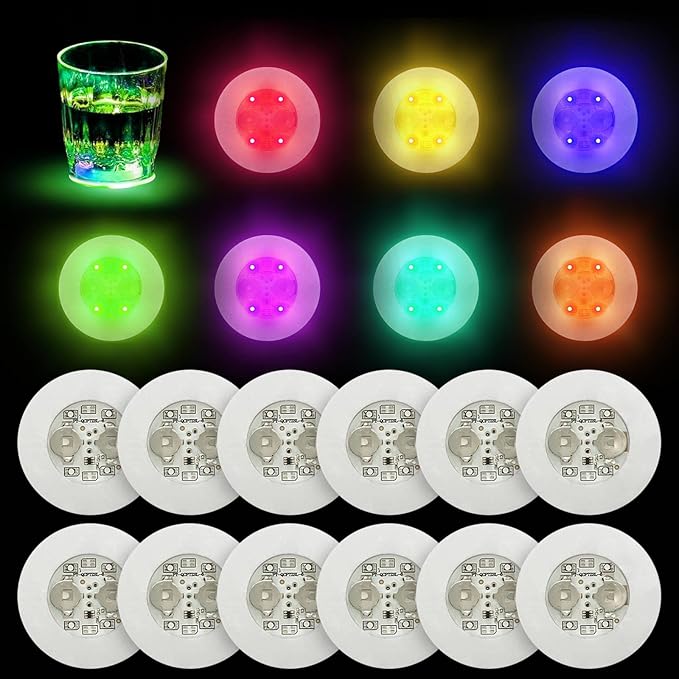
LOGUIDE LED Coaster Discs,12 Pack Light Up Coasters,7Colors RGB LED Bottle Lights,Bottle Glorifier, LED Sticker Coaster Discs Light Up for Drinks, Flashing Shotb Light (Multicolor)
Our Top Pick
LOGUIDE LED Coasters (12-Pack) are the easiest quick-upgrade for a chill zone if you don't want to deal with wiring or complicated installs. These slim, sticker-style discs sit under bottles and glasses and give a neat color pop that reads well on TV and across a pool table. For game nights they make it simple to mark player drinks, add halftime atmosphere, and keep the space feeling intentional. The 12-pack means you can cover a drink station or spread them across seating zones so no corner gets ignored.
Why it tops the list is simple: versatility without fuss. You get multiple color modes so you can go from chilled ambient hues to flashing party modes depending on the crowd. They run on replaceable button batteries, which is handy after a heavy weekend, and the low-profile design stays out of the way during play. Full disclosure, they won't replace a full LED strip when you need heavy backlighting, but for targeted cup and bottle accents they punch well above their size.
Small, smart, and flexible. Add targeted color and instant personality to drinks, tables, and bottle displays without a complicated setup.
Key benefits and standout features:
- 12-disc pack covers a full seating area or drink station for cohesive lighting.
- 7 color modes (steady and flashing included) to match playoff intensity or chill mode.
- Low-profile sticker design fits under bottles, glasses, and shot glasses for subtle placement.
- Replaceable button-cell batteries, easy to swap after extended use.
- Lightweight and portable. Move them around to switch zones between games.
- Well-reviewed by users, so you're not rolling the dice on quality.
Bright and Practical LED Cup Lights That Steal the Show
Cup-mounted LED modules are the unsung workhorses of any serious game-night setup. What matters most is optical design and power delivery. Look for diodes with enough lumen output to be visible under ambient light without washing out color, controlled beam angles to avoid hot spots, and diffusion (frosted lenses or micro-prismatic covers) that give a smooth glow across a cup. The mechanical interface matters too. Magnetic bases, silicone sleeves, and low-profile snap-fit housings all change how reliably a module stays attached when things get rowdy. From a performance perspective, check LED type (high-efficiency SMD 5050 versus lower-power 3528), drive current, and whether the unit uses high-frequency PWM dimming to avoid camera-visible flicker. Those are the tradeoffs I look for in the reviews below.
AHIER LED Cup Coasters
These AHIER cup coasters throw a surprisingly strong warm-white glow that makes bottles and glassware look sharper on game night. Each thin puck has four bright LEDs in a laminated foam core, so they sit light under a bottle and cast a clean wash through clear glasses. You get three modes, fast flash, slow flash and steady, so you can go from subtle backlight to attention-grabbing blinks. The adhesive pads make sticking them down quick, and the claimed 24+ hour runtime seems believable if you stick to flashing modes. Steady mode will chew through coin batteries faster, so keep spares handy.
If you like your chill zone to have a little stagecraft, these do more than you’d expect for their size. Best uses: bottle displays, whiskey tastings, or staged halftime drink shots. Pros: bright output for clear glass, easy stick-on mounting, multiple modes, and a dozen pieces for party scale. Cons: warm white only (no RGB), foam construction isn't very waterproof, and steady mode shortens battery life. Tip: keep extras on the counter for guests instead of pre-sticking every glass, and switch to flashing mode for long tournaments to save batteries. I even tucked one under a decanter and the amber color popped like a mini-bar spotlight.
LOGUIDE LED Coaster Discs
If you want your chill zone to look like a set instead of a storage unit, LOGUIDE coaster discs are one of the simplest upgrades you can make. They’re small stick-on pucks (about 2.36 inches across) with four LEDs and seven solid colors plus two flash modes, so you can color-code cups, highlight bottles, or create a glowing centerpiece. The laminated foam core gives a little cushion so glasses sit stable. They arrive with CR1220 cells installed and spares included, so you’re ready for one evening of use right out of the box.
These are great when you want a low-effort, high-impact accent: think team-colored cups during playoffs or a ring of colors around a pitcher so everyone knows which drink is theirs. Pros: big multi-pack, peel-and-stick application, distinct color choices, instant visual payoff. Cons: battery life and build solidity vary in reports, the adhesive can be aggressive (hard to remove), and the button can be awkward to press after attachment. Not meant for submersion or heavy daily use. Quick tips: use them on dry glass bottoms, press firmly once to seat the button before final placement, and stash spares. If you want a cheap, repeatable way to help people find drinks without flipping on the main lights, these are a fun, practical pick.
What Counts as a Cup Light, and What Does Not
This category has a definition problem, and it costs people money. A cup light is a thin disc that sits under a glass or a bottle and lights it from below, so the drink itself becomes the fixture. That is the whole idea. The glass acts as a lens, the liquid picks up the color, and a table of six drinks becomes six small light sources at exactly the height people are looking.
Four things get sold alongside it and none of them do that job:
- Bottle glorifiers. The lit pads bars use under a spirits display. Same principle, much larger, and built to sit permanently on a back bar rather than travel around a table.
- LED ice cubes. In the drink rather than under it. Fun, and a different product with a different failure mode, which is somebody swallowing one.
- Ambient strips and bulbs. These light the room, not the glass. Worth owning, and this page reviews two of them, but a strip behind the TV does nothing for the pint in your hand.
- Anything with a compressor or a heating element. A lit mini fridge and a temperature-controlled mug are drink gear. They are not cup lights, and a roundup that mixes them in is padding.
Why the Glass Matters More Than the Light
The same disc looks completely different under different glassware, which is the part no listing mentions.
Clear glass is what these are designed for. Light enters the base, refracts through the liquid, and the whole vessel glows. A pint of pale lager lights beautifully. A stout swallows the light and gives you a faint ring at the base and nothing else.
Opaque vessels defeat the entire mechanism. A ceramic mug, a metal tumbler or a red plastic cup gets a lit rim at the bottom and that is all, which is worth knowing before you buy a twelve-pack for a room that drinks out of koozies.
Where the glass ends up matters too. A disc on a coffee table in front of the sofa does its job, and the same disc on the arm of a recliner is a spill waiting for someone to lean. Base thickness decides how far the light travels. A heavy-bottomed rocks glass diffuses it into a soft glow, while a thin-walled pint carries it right up the column. Neither is wrong, but if you are picking discs to match a specific set of glasses, hold one up against a phone torch first and you will know within a second what you are getting.
Rechargeable Puck Lights: Power, Runtime, and Recharge Cycles
Rechargeable puck LEDs strike the best balance between performance and recurring cost when you want persistent illumination without swapping cells constantly. Watch battery chemistry (lithium-ion for energy density), capacity in mAh, and effective lumens per watt at different output levels. Prefer USB-C charging with built-in charge management and overcharge protection for longevity. Check advertised cycle life and whether the unit uses multi-stage charging to preserve battery health. Thermal management during charge and discharge matters too, so units with aluminum heat sinks or thermally conductive PCBs will outlast cheap plastic enclosures during marathon sessions. I’ll run real-world runtimes, recharge times, and lifecycle expectations in the deeper reviews.
GE 12-Inch Light Bar
This color-changing bar punches above its size for atmosphere and accent lighting. It offers a full spectrum of colors, a 100-lumen white mode for short task lighting, dimming, and a timer via an RF remote. I stuck one under a floating shelf behind glassware and it gave the whole area a consistent wash without cords everywhere. Mounting is easy with screws or double-sided tape so you can reposition it for movie nights, game days, or themed parties.
What sets it apart is simple control and ease. The remote saves favorite colors, does smooth fades, and has a timer so you don't waste batteries. For cave use, it's great for highlighting display bottles, backlighting a mini-fridge, or adding a visible drink zone without blinding lights. Not a replacement for hardwired fixtures, but it delivers flexible, portable color where you want it.
Pros: vivid colors, intuitive remote, wire-free mounting, and a useful white mode. Cons: it uses six AA batteries and some users see fast drain. My workaround was high-capacity NiMH rechargeables plus using the timer and lower brightness to stretch runtime.
BLACK+DECKER PureOptics Puck Lights
These compact RGBW pucks cram a lot into a small package. Tool-free mounting and a 12-inch sticky tape strip make setup fast. The included remote gives cool white, solid colors, and five color effects. Each puck fills out to roughly 24 inches with a flicker-free wash and you can link up to seven units for a continuous run. Five brightness levels plus memory recall help you lock in the exact look for late-night movie mode or high-energy game atmospheres.
What I like about this kit is the balance of form and function. They stay thin and low-profile yet give smooth fades and multiple color effects guests notice. LEDs claim long life and the kit includes a 12W adapter plus a limited warranty, which makes them feel like a semi-permanent install. Small anecdote: I slapped one under a floating shelf to light a lone whiskey bottle and it turned a dusty corner into an intentional focal point.
These work well if you want modular accent lighting without rewiring. Downsides: the remote can be the weak link, with range and responsiveness varying, and they won't act like smart-plug fixtures out of the box, often needing the remote to power on after mains power is applied.
Pros: fast install, linkable, multiple color/effect options, memory dimming. Cons: remote reliability can be hit-or-miss, not designed for full-room illumination.
Color-Changing LED Systems That Set the Mood and React to the Game
Color-capable LEDs can transform ambiance, but architecture matters. RGB, RGBW, and RGBIC are not interchangeable. RGBW adds a white channel for truer whites and deeper blacks, while RGBIC enables multiple colors in a single strip by multiplexing driver chips. Control matters too: IR remotes are simple, RF adds range, and Wi-Fi or Bluetooth unlocks syncing, app scenes, and voice assistants. Check refresh rate and PWM frequency to avoid banding or flicker on camera. In the upcoming reviews I'll weigh color gamut, white tuning, control latency, and how well each unit reproduces saturated colors under ambient lighting.
Philips Hue B39 Bulb
This little candelabra bulb packs a lot for its size. It puts out about 450 lumens and supports warm-to-cool whites plus millions of RGB colors, so you can set a warm wash for strategy sessions or punchy team colors for rivalry nights. It's an E12 shape that fits chandeliers, sconces, and fan sockets where a standard A19 won't. Control works via the Hue app (Bluetooth out of the box) and you unlock full features with a Hue Bridge. It plays nicely with voice assistants.
What makes it useful in a chill zone is how it layers with other lighting. Use these in sconces behind the TV, over a poker table, or above a bar to create low-glare cup-level illumination that still keeps the game as the focus. Hue scenes and dynamic effects let you change vibe in seconds: green for the home team, amber for a timeout, deep blue for movie mode. Color consistency is strong, so matched bulbs behave predictably.
Practical wins: quick Bluetooth setup for a single room, energy-efficient 9W draw, excellent color fidelity, and smooth dimming. Downsides: it's a premium option and many people pair them with a Bridge for rock-solid connectivity. Occasionally a reset is needed to re-pair, but support is usually helpful.
If you're building quality lighting and want it to do more than be background noise, these are a solid component. Buy a few matched bulbs for fixtures that flank your play area and add a Bridge if you plan to expand zones or automate scenes.
Govee 100ft RGBIC Strips
If you want to change the vibe of your chill zone without rewiring, Govee RGBIC strips are a no-brainer. RGBIC lets different segments show different colors at once, so you can run a warm backlight behind the bar, pulsing team colors around the TV, and a cool sweep under shelving at the same time. The app and voice control make it easy to switch scenes mid-game. Music sync works well at parties and adds an arena-like feel during big plays. The kit comes as two 50-foot reels, so you get a lot of placement flexibility.
Where these shine for game-night use is sheer coverage and customization. Use zones to mark player stations, highlight drink rails so people can find beers in dim light, or install strips in aluminum channels for a pro look that hides glue and evens the glow. Installation is straightforward but plan your prep. Clean mounting surfaces, test before final adhesion, and have extra 3M tape or mounting channels on hand. The app has lots of presets, though some users report adhesive failures or dead segments, so test early and mind the cut points.
Bottom line: great for guys building an immersive chill zone on a practical budget. Pros: huge coverage, segmented color control, smart-home integration, feature-rich. Cons: not waterproof, adhesive inconsistency, and some longevity reports. If you want immersive, multi-zone lighting that reacts to music and voice, these are a flexible option.
Battery-Operated LED Lights: Runtime Calculations and Practical Considerations
Battery solutions are ideal where wiring isn’t possible, but it comes down to energy budgets. Convert rated lumens into current draw and compare against battery capacity to estimate runtime. For example, a 100-lumen puck drawing 300 mA from a 2000 mAh pack will run roughly six hours before driver inefficiencies. Consider battery form factor: AA/AAA alkalines are easy to source, built-in lithium packs are denser but need chargers. Watch voltage regulation and low-voltage cutoffs to avoid abrupt brightness drops. I test runtime at multiple outputs and report how the lights behave as voltage declines.
Coin Cells, Runtime, and the Spares Problem
Almost every cup light on the market runs on a coin cell, and the two you will meet are the CR1220 and the CR2032. That choice is made for you by the disc's thickness, and it has consequences worth understanding before you buy a twelve-pack.
Runtime is a mode question more than a capacity question. Steady mode holds the LEDs on continuously and drains a cell fastest. Flashing modes duty-cycle the same diodes and stretch the same battery a long way, which is why a listing quoting 24 hours or more is usually quoting the flashing figure. Plan around steady mode if that is how you will actually use them, and assume roughly a quarter of the advertised number.
The spares problem is the real one. A dozen discs is a dozen cells, they all die within a week or two of each other because they were all installed the same day, and CR1220s are not something most people keep in a drawer. Buy a strip of them with the discs. It costs almost nothing and it is the difference between the lights working next season and the lights being in a box.
Two smaller things that decide whether a disc lasts:
- Can you actually open it? Some discs unscrew, some pry, some are sealed and disposable. Check before the adhesive is down, because a sealed disc stuck to a table is a one-evening product.
- Is the button reachable after mounting? The stick-on discs put the switch on the same face as the adhesive on some designs, which means peeling one off to turn it on. Press the button once to confirm it seats before committing to placement.
If you want light that never needs a battery, the answer is not a better coin cell. It is a mains-powered accent somewhere else in the room, which is what the strips and bulbs further up this page are for.
Waterproof and Spill-Resistant Lights Built for Rowdy Nights
If your chill zone hosts drinks and competitive play, you need lights that survive spills and outdoor tailgates. Ingress protection matters, so know the difference between IPX4 splash resistance and IP67 submersion. Sealing techniques like gasketing around buttons, potting compounds over PCBs, and overmolded cables seriously improve reliability over surface coatings. Also check connectors and charging ports; sealed magnetic chargers or covered USB-C ports reduce failure points. Materials matter too, because UV-stable plastics and corrosion-resistant contacts keep things working after sticky spills or humid basements. I call out IP ratings, sealing approaches, and run spill tests so you know which units will keep shining after a knock or a spill.
Where a Cup Light Actually Gets Wet
Read an IP rating on a disc that lives under a glass and you find it is answering the wrong question. These things rarely get submerged. What they get is condensation, and condensation arrives from underneath, continuously, all evening.
A cold pint sweats. The water runs down the outside of the glass, pools at the base, and sits directly on the disc for as long as the drink lasts. That is a slow soak against the seam rather than a splash, and it is the single most common way one of these dies. A basement that already needs humidity control makes it worse, because the sweat never really stops. The laminated foam-core construction that makes the cheap discs thin and cushioned is also the construction least able to cope with it, so treat "not very waterproof" in a listing as a statement about ordinary use rather than about accidents.
Three habits that matter more than the rating on the box:
- Dry the glass base before it goes down. Obvious, ignored, and it doubles the life of a foam-core disc.
- Don't pre-stick every glass. Leave the discs loose on the counter for guests to grab. A disc you can lift off and dry is a disc that survives, and the adhesive on these is aggressive enough that removing one later usually kills it.
- Keep them off the bar rail and the drip zone. The spot where drinks get poured is the spot where lights go to die, and there is no version of this product built for it.
If the room genuinely needs lighting that shrugs off spills, that is a job for a sealed strip or a puck with a gasketed button, mounted above the mess rather than under it. Sealing techniques like gasketing around buttons, potting compound over the board and overmolded cable entries are what actually separate a light that survives a wet night from one that reads IP67 on the packaging and fails at the switch.
Key Takeaways
You want lighting that performs, survives spilled beer, and actually helps gameplay. At cup level, optical design and power delivery are the most important factors. Sticker-style discs like LOGUIDE and AHIER give instant, low-profile color with replaceable CR1220 coin cells and good pop for TVs and tabletops, and they are the only products on this page that light the drink itself. Rechargeable puck lights and bars, the ones with lithium-ion packs, USB-C charging and aluminum thermal paths, give better long-term runtime and lower total cost of ownership. For mid-field accenting, the GE 12-inch light bar and the BLACK+DECKER PureOptics pucks provide linkable output and useful white modes, while the Philips Hue B39 and the Govee RGBIC strips deliver color fidelity and smart-home control for layered zones.
The Six Picks Side by Side
Sorted by what part of the room each one lights. Ratings are the current Amazon averages for each listing.
| Pick | What it lights | Rating | Buy it if |
|---|---|---|---|
| LOGUIDE LED Coaster Discs, 12 pack | the glass, from underneath | 5 | you want the whole table glowing for the price of a round |
| AHIER Led Coasters, 12 pcs | the glass, warm white only | 4.6 | bottles and whiskey rather than colored party cups |
| BLACK+DECKER PureOptics Puck Light Kit | a small pool of table or shelf | 4.2 | the drinks station needs to be findable in the dark |
| GE 12-Inch LED Tap Light | a wider stretch of counter | 4.2 | you want light where there is no outlet |
| Govee 100ft RGBIC LED Strip Lights | the room perimeter | 4.3 | the whole space should change color, not just the cups |
| PHILIPS Hue Smart 40W B39 Candle Bulb | an existing fixture | 4.4 | the lamps are already there and just need control |
Final recommendation. If you want the fastest visual upgrade with minimal fuss, start with a multi-pack of LOGUIDE or AHIER discs to color-code cups and mark stations, and buy a strip of spare coin cells at the same time. If you care about runtime and recharge cycles, prioritize rechargeable pucks with lithium-ion cells, USB-C charge management and reasonable thermal paths. Build toward perimeter and scene control with the Govee RGBIC strip or Philips Hue for precise whites and integration.
How to choose based on needs:
- Want portability and quick swaps? Choose coin-cell sticker discs and keep spares on the counter rather than pre-sticking every glass.
- Want mid-term reliability and lower maintenance? Pick rechargeable pucks with at least 2000 mAh and a charge-management IC.
- Need camera-safe, flicker-free output? Verify high PWM switching frequency or true constant-current drivers to avoid banding on video.
- Want immersive, multi-zone control? Go RGBIC or RGBW with app control and plan for wiring or quality adhesive channels.
Quick energy math to keep handy: a 100-lumen puck drawing 300 mA from a 2000 mAh pack runs roughly 6 hours before driver inefficiencies; double the mAh or lower the output to extend runtime during marathon tournaments.
Ready to upgrade your game nights? Try one low-effort change this weekend: put a LOGUIDE 12-pack under the center table to test color choices and adhesive behavior, or run a short section of Govee RGBIC to feel what segmented color zones do in your space. Keep spare CR1220s or a USB-C charger on hand and test modes at match brightness so you learn real runtimes.
Want a step-by-step plan or a parts list for a specific layout? Tell me your room dimensions, typical ambient light level, and whether you prioritize runtime or color fidelity, and I’ll map a spec-driven kit you can implement this week.