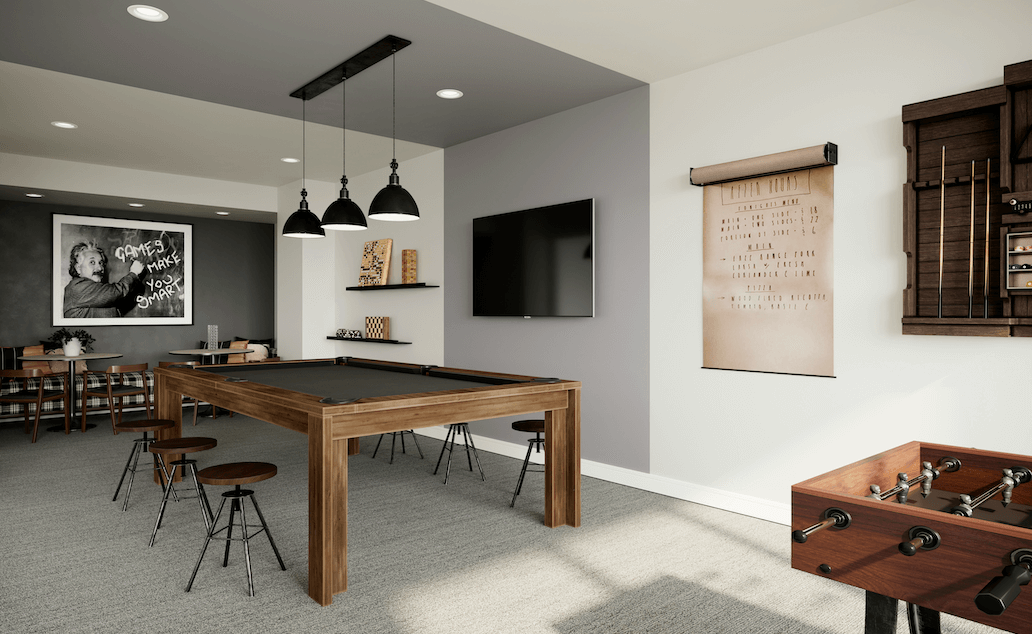
Single-system audio for separate rooms: one amplifier or receiver feeds each zone its own source and volume, with in-ceiling or in-wall speakers and app or keypad control.
Also known as: Whole-Home AudioDistributed AudioMulti-Room Audio
Multi-zone audio is a single system that pushes music to separate rooms from one control point, with each zone free to run its own source at its own volume. In a man cave that usually means one amplifier in a rack or closet driving pairs of in-ceiling speakers or in-wall speakers in the cave, the bar, and the patio. Each zone is a pair of channels, and the amplifier, an app, or a keypad decides what plays where. The same track can flood every room in sync, or the cave can run the football while the bar spins vinyl, and switching between those modes takes a tap on a screen rather than a wiring change.
The payoff is that you stop carrying speakers around. Wire once, and every room that will ever need sound is covered from a single central rack, which is a serious advantage when you are finishing a cave anyway. Zones are priced by the channel: a basic four-zone amplifier runs $400 to $800, while an eight-zone unit with built-in DSP runs $1,200 to $2,500, before speakers and wire. Background zones need only 20 to 50 watts per channel at 8 ohms, while a critical-listening space wants 75 to 150 watts, so the power budget follows the room's role rather than its size. That spread is why most budgets are set by zone count, not by the amplifier's brand. The multi-zone amp guide walks through the hardware choices for a home setup.
Multi-zone is not the same as owning a pile of smart speakers. A wireless speaker in each room is a collection of independent devices that happen to share a network, while a multi-zone system is one amplifier distributing real power to fixed speakers through permanent wiring. It is also not automatically multi-room in the strictest sense, even though the two terms are used interchangeably, and that distinction is what decides how many amplifier channels you actually need.
How the zone math works
A zone is an area of audio, not a square of floor plan. The same pair of channels can cover a kitchen and a dining room if they always listen together, which is how a six-zone system often serves eight or nine rooms. Every zone needs two channels, left and right, so a twelve-channel amplifier is a six-zone amplifier, and a nine-channel A/V receiver can run three zones or use its spare channels for rear surround in the main room. Receivers with seven or more channels typically include a powered Zone 2 pair, while nine- and eleven-channel models add a third zone, and dedicated distribution amplifiers go further, with six, eight, or twelve independently assignable zones in one box.
Impedance is the trap hidden inside the wiring. Two pairs of speakers wired in parallel on one channel cut an 8 ohm load to 4 ohms, three pairs push it below 3 ohms, and most consumer amplifiers are not stable there, which is how amplifiers overheat and shut down. Constant-voltage 70-volt systems sidestep that entirely, letting many speakers share a channel with simple wattage math on the transformers, but a home cave rarely needs them, since runs are short and speaker counts are low. Power matters too: a background zone gets by on 20 to 50 watts per channel at 8 ohms, while a home theater main room or an outdoor zone wants 75 to 150 watts to keep up with ambient noise. Match the amplifier's rating to the speaker load, confirm the secondary zones can decode digital sources, and wire with the right gauge for the run length.
Multi-zone vs. multi-room audio
Multi-room says where the sound happens; multi-zone says who controls it. A zone is a control area that plays one source, and several rooms can share a single zone, which is the detail that saves most of the money. When two adjoining rooms always play the same thing, wiring them as one zone uses one pair of amplifier channels and one volume decision, while treating each as its own zone doubles the amplifier you need. The mistake most people make is planning by room count instead of by independent sources. If the cave and the patio will always listen to the same feed, that is one zone, not two.
The smarter way to plan is to count the sources you genuinely need at the same time. A single pair of channels covering two rooms, with a volume knob in each, is cheaper and does the job, but the moment the cave must run the game while the patio plays the playlist, that is two zones and the amplifier needs two pairs. Good systems let you group and ungroup zones on the fly, so a party setting that floods the whole house can become two separate listening areas the next morning without a single wire moving. Plan for the worst-case simultaneous listening, and let grouping handle everything else.
Where the term came from
Distributed audio predates streaming by decades. Wired whole-house systems with a central amplifier, in-wall volume knobs, and speaker selectors were a fixture of 1980s custom installs, and A/V receivers added a Zone 2 output so a second pair of speakers could share the same receiver without a second box. The modern meaning, app-controlled zones that play different sources in sync, is a network-era invention, popularized in large part by Sonos, which made multi-zone control feel effortless for the first time. The zone concept came from the hardware itself: an amplifier channel pair, a volume point, an area of independent control.
As streaming replaced the CD changer, the term drifted from describing wiring to describing software, but the geometry has not moved. One zone still means one source and one volume decision, whether that decision lives on a rack-mounted keypad from the 1990s or in a phone app today. The hardware has also consolidated, with multi-channel amplifiers doing in one box what used to take a stack of receivers, which is why a whole-cave system now fits in a few rack units instead of a closet full of gear.
Common mistakes
The first mistake is loading two or three speaker pairs onto one channel and expecting the amplifier to survive. Parallel pairs drop the impedance below what the amp is rated to drive, so either wire through a load-handling speaker selector or give each pair its own channel, and read the minimum impedance on the amplifier's spec sheet before you add speakers.
The second is under-specifying power. A 20-watt channel that is plenty for a den will strain on a patio or a large open room, where background noise forces the volume up and clipping sets in. Outdoor speakers and big rooms want the higher-wattage channels or a bridged pair, so budget the power to the loudest room, not the average one.
The third is assuming every advertised zone is powered. Many receivers offer Zone 2 and Zone 3 as pre-outs that still need an external amplifier, so a receiver that claims three zones may quietly require three separate amplifiers to actually drive them. Read whether each zone is amplified or line-level before you count on it.
The fourth is ignoring the digital source problem. A secondary zone that cannot decode digital audio will sit silent until you run an analogue cable from the source, because the receiver lacks a DAC for that zone. If you plan to feed a streaming box or a TV to a second zone, confirm the connection path first, and count zones, check the speaker load, and buy the amplifier to the room before you buy the brochure.
Frequently asked questions
What is multi-zone audio?
Multi-zone audio is a single system that plays music in separate rooms from one control point, with each zone able to run its own source at its own volume. A zone is an area of audio, usually a pair of channels driving a pair of speakers. One amplifier in a rack or closet feeds speakers throughout the house, and an app, keypad, or receiver decides what plays where. It is the wired, whole-home cousin of a stack of smart speakers.
What is the difference between multi-room and multi-zone?
Multi-room says where the sound is, while multi-zone says who controls it. A zone is a control area that plays one source, and several rooms can share one zone if they always listen together. The practical difference is cost: wiring two rooms as one zone uses one pair of amplifier channels, while giving each room its own zone doubles the amplifier you need. Count independent sources, not rooms, when you plan the system.
How much does a multi-zone system cost?
A basic four-zone amplifier runs about $400 to $800, and an eight-zone unit with DSP runs $1,200 to $2,500, before speakers and wiring. In-ceiling or in-wall speakers add more per speaker depending on quality, and installation labor adds more. A simple two-zone receiver setup can stay in the low hundreds if you already own the receiver, while a whole-home install with several zones lands in the low thousands once speakers and wire are included.
Can I add zones later?
Yes, within limits. Most distribution amplifiers come in fixed channel counts, so expanding beyond the channels you bought means adding another amplifier or moving to a larger model. Many amplifiers offer bus inputs so multiple zones share one source, and speaker selectors can split one zone across extra speaker pairs. If you think you will expand, buy an amplifier with more channels than you need today, because retrofitting wiring later costs more than oversizing now.
Is multi-zone audio worth it for a man cave?
If you want music in the cave, the bar, and the patio without dragging a speaker around, yes. A single amplifier and a few pairs of ceiling speakers cover several rooms from one rack, and each zone gets its own source and volume. The cost lands mostly in wiring and the amplifier, so it pays off most when the room is being finished or remodeled. If you only ever listen in one room, a pair of good speakers beats the complexity.
Related terms
In-Ceiling Speakers
Flush-mount ceiling loudspeakers that fire downward for ambient music and Dolby Atmos height channels. Drivers span 4 to 8 inches with pivoting tweeters and 87 to 91 dB sensitivity.
Audio/Visual & TechIn-Wall Speakers
Flush-mount wall loudspeakers that fire horizontally at ear height for direct sound and precise stereo imaging. Drivers top out at 6.5 inches due to 16-inch stud spacing.
Room Types & SpacesHome Theater
A dedicated room with a large screen, surround sound, controlled lighting and tiered seating built for an immersive cinema experience. Room dimensions and viewing angles follow THX or SMPTE standards.
Audio/Visual & TechBluetooth Speaker
An active wireless speaker that streams audio from a phone or tablet over a Bluetooth radio link, trading a bit of wired fidelity for the convenience of carrying music anywhere.
Audio/Visual & TechSubwoofer
A dedicated, usually self-powered speaker covering roughly 20 to 200 Hz, taking the low end off the main speakers at a crossover point commonly set to the THX default of 80 Hz.
Audio/Visual & TechSoundbar
A single wide cabinet with multiple speakers and built-in amplification that replaces thin TV sound; wireless subwoofer and rear channels optional, HDMI ARC or eARC carries the audio.