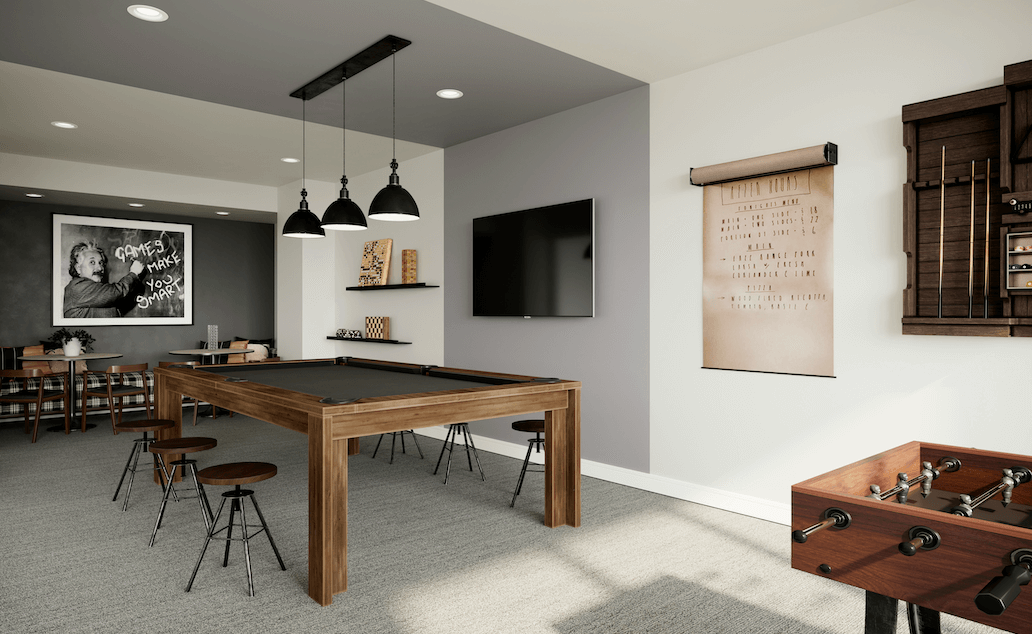
Single-bulb fixture that hangs from the ceiling on a cord, chain, or rod to throw focused light on a spot below. Hang the shade bottom 30 to 36 inches above a bar counter.
Also known as: Hanging LightSuspended Light
Fixtures, bulbs, and colour temperature for this are covered in our decor and accessories guide.
A pendant light is a fixture that hangs from the ceiling on a cord, chain, or rod and ends in a single shade that throws light down onto the surface below. It is the workhorse of the man cave bar: a pair of pendants spaced over the counter puts task light exactly where glasses get filled and cards get dealt, and the open space above the fixture makes the room feel taller instead of cluttered. Because the drop is adjustable, the same fixture serves a kitchen island, a pool table, or a bar top simply by shortening the cord. The height rule is the part people get wrong, and it is easy to state: hang the bottom of the shade 30 to 36 inches above the counter or table surface you are lighting. Over a standard 42 inch bar top that puts the fixture bottom roughly 72 to 78 inches off the floor, clear of heads for most guests. Space multiple pendants 24 to 30 inches apart on center, keep the outer fixtures at least 6 inches in from the ends of the bar, and the coverage comes out even. A pendant is not a flush mount, and it is not a chandelier. A flush mount sits against the ceiling and spreads ambient light across the room; a chandelier branches into multiple arms. A pendant is a single light source aimed at one spot, which makes it task lighting that happens to be decor, and the difference shows up the moment you light a bar with the wrong one.
How to size and hang a pendant over a bar
Measure from the counter, not the floor, and start with the 30 to 36 inch rule. For every foot of ceiling above 8 feet, add about 3 inches of hanging height, so a 9 foot ceiling calls for roughly 33 to 39 inches above the bar. If the bar sits at the standard 42 inches and the ceiling runs 8 feet, the fixture bottom lands around 72 to 78 inches off the floor, which clears the head of a standing adult and stays out of a leaning guest’s way. Sizing follows the surface below. A single pendant’s shade should measure about half to two thirds of the width of the counter it lights, so a 12 to 18 inch shade suits a typical 30 to 42 inch bar overhang. For a row over a longer bar, plan one pendant for every 2 feet of length or run a linear fixture, and space multiple pendants 24 to 30 inches apart on center. Bulb clearance matters more than people expect. The shade needs interior depth for the bulb, and a shallow cone will not swallow a globe or an Edison filament bulb. Check the fixture’s interior length against the bulb height before you buy, and confirm the listed fixture length plus your chosen drop lands in the 30 to 36 inch target, with a canopy wide enough to cover a standard 4 inch junction box. Put the pendants on a dimmer switch so the room can drop from prep light to bar mood without changing fixtures. Warm bulbs around 2700K read as bar lighting, while brighter, cooler output suits a work surface; the color temperature and lumens pages cover the numbers. Keep walkways clear. A pendant bottom in a path of travel should stay at least 7 feet off the floor, and bathroom rules are stricter, with 8 feet above a tub rim under most electrical codes.
Pendant vs. flush mount
The fixture people most often swap in is a flush mount, and the swap usually comes from ceiling height. A flush mount attaches flat against the ceiling with no visible gap and spreads light evenly in every direction, which is exactly what a low 8 foot ceiling needs to feel tall. A pendant hangs down, typically a foot or more below the ceiling, and throws its light in one direction, which makes it the wrong tool for general room lighting and the right tool for a task spot with a surface underneath. The rule of thumb: general light from flush or recessed fixtures, focused light from pendants. A bar room under an 8 foot ceiling still wants pendants over the counter, because there is a surface below to catch the light and heads stand to the side, while the same room’s main ceiling light should stay flush. Vaulted or 9 foot ceilings make pendants viable for general lighting too, since there is vertical room to fill.
Where the term came from
Pendant comes from the French verb pendre, to hang, and the word has meant something that hangs since medieval French. The lighting fixture that carries the name descends directly from industrial and warehouse work lighting, enameled metal shades on cords above factory benches, a lineage that gives the man cave its love of edison bulb pendants over the bar. Design history refined the form along the way, most famously with Poul Henningsen’s PH lamp of 1927, which used layered shades to soften the harsh downward light into an indirect glow. What started as a utilitarian factory fixture became, within a few decades, a statement piece that still does the original job: putting light exactly where the work happens.
Common mistakes
Mistake one is hanging too high. Above about 40 inches over the counter, the pendant stops being task light and reads as an ambient fixture, which defeats the point of buying a pendant at all, and below 30 inches people bump it and the light glares into seated eyes. Mark the 30 to 36 inch zone on the wall before you wire, then aim the bottom of the shade into it. Mistake two is ignoring walkway clearance. A pendant hung in a path of travel must keep at least 7 feet of clearance from the floor, and a cord that droops into head space is an injury waiting to happen. Raise it for the aisle even if it sits a little high over the surface. Mistake three is skipping the box rating and the bulb check. A heavy fixture on a ceiling box that is not fan-rated can pull loose, and a shade too shallow for the bulb leaves the bulb poking out. Read the fixture weight against the box rating, measure the shade’s interior against the bulb, and put the pendants on a dimmer so the room can switch from prep lighting to bar mood without a different fixture.
Frequently asked questions
How high should a pendant light hang over a bar?
Hang the bottom of the shade 30 to 36 inches above the bar counter top. Over a standard 42 inch bar that puts the fixture bottom roughly 72 to 78 inches off the floor, clear of heads for most guests. Add about 3 inches of hanging height for every foot of ceiling above 8 feet. Measure from the counter top rather than the floor, because bar height varies, and mark the zone on the wall before you wire.
What’s the difference between a pendant and a flush mount?
A flush mount attaches flat against the ceiling with no visible gap and spreads ambient light evenly across the room. A pendant hangs down on a cord, chain, or rod and throws focused light onto one spot below. Flush mounts suit low ceilings and general room lighting, while pendants suit task spots like a bar or table where there is a surface underneath to catch the light and heads stand to the side.
How far apart should pendant lights be spaced?
Space multiple pendants 24 to 30 inches apart on center and keep the outer fixtures at least 6 inches in from the ends of the surface they light. For a 6 to 8 foot bar or island, two or three pendants spaced that way cover the length evenly. Spacing below 24 inches looks crowded and can block sight lines, while spacing above 30 inches leaves dark gaps between fixtures.
How do I choose the right size pendant?
A single pendant’s shade should measure about half to two thirds of the width of the counter below it, so a 12 to 18 inch shade suits a typical 30 to 42 inch bar overhang. For general room lighting, add the room’s length and width in feet and use that number in inches as a starting diameter. Match the shade’s interior depth to the bulb so the bulb does not poke out below the rim.
Can I install a pendant light myself?
Yes, if you are comfortable with basic electrical work and you turn off the circuit at the panel first. Pendants mount to a ceiling junction box that must be rated to carry the fixture’s weight, and heavy fixtures may need a fan-rated box. If the wiring, the box, or the fixture feels beyond your skill, hire a licensed electrician, because mistakes in ceiling-fixture wiring are a shock and fire risk. Local codes govern what you are allowed to do yourself.
Related terms
Edison Bulb
A decorative bulb with a visible loop or spiral filament and a warm amber glow, styled after Edison's 1879 design and sold today mostly as an LED filament replica.
LightingDimmer Switch
A wall-mounted control that lowers light output by chopping the AC power wave, with wiring and load ratings that differ for incandescent, halogen, and LED bulbs.
LightingRecessed Lighting
Light fixtures installed flush in a ceiling opening, so the lamp sits inside the ceiling and only the trim shows. LED retrofits dominate, and IC rating decides whether they can touch insulation.
LightingColor Temperature (Kelvin)
A measure of a light source's color appearance, from warm amber at 2700K to cool blue-white at 6500K. The Kelvin number on every bulb box decides whether a room reads as pub, workshop, or hospital.
LightingLumens
SI unit of luminous flux, the total visible light a source emits as the eye perceives it. One lumen is one candela-steradian; household bulbs range from about 450 to 1,600 lumens.
LightingSconce
A light fixture mounted on the wall rather than the ceiling, aiming its beam up, down, or both, to light a hallway, a bar, or a wall without taking floor space.