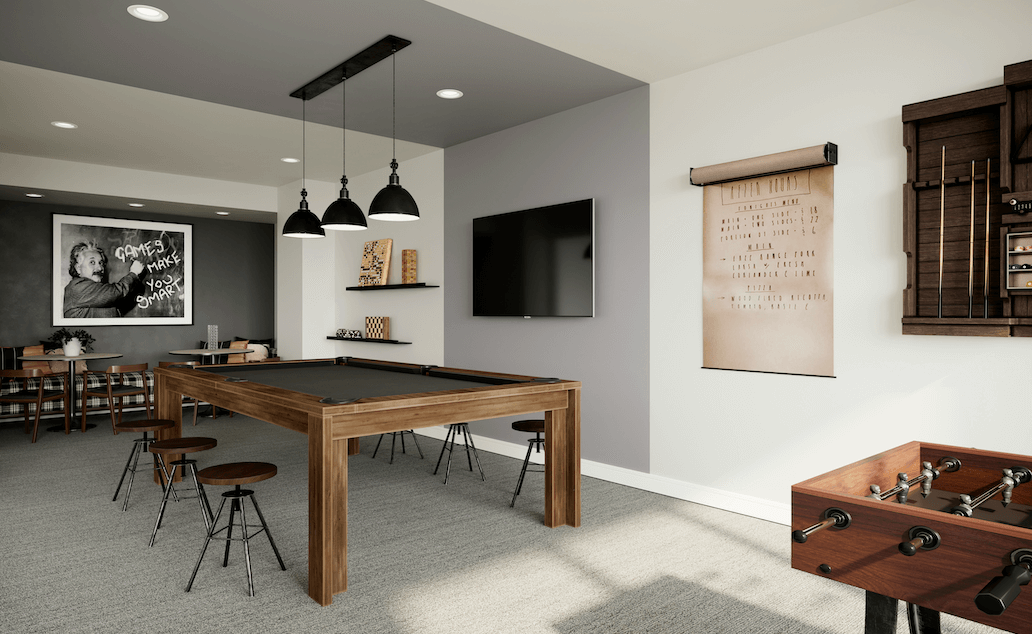
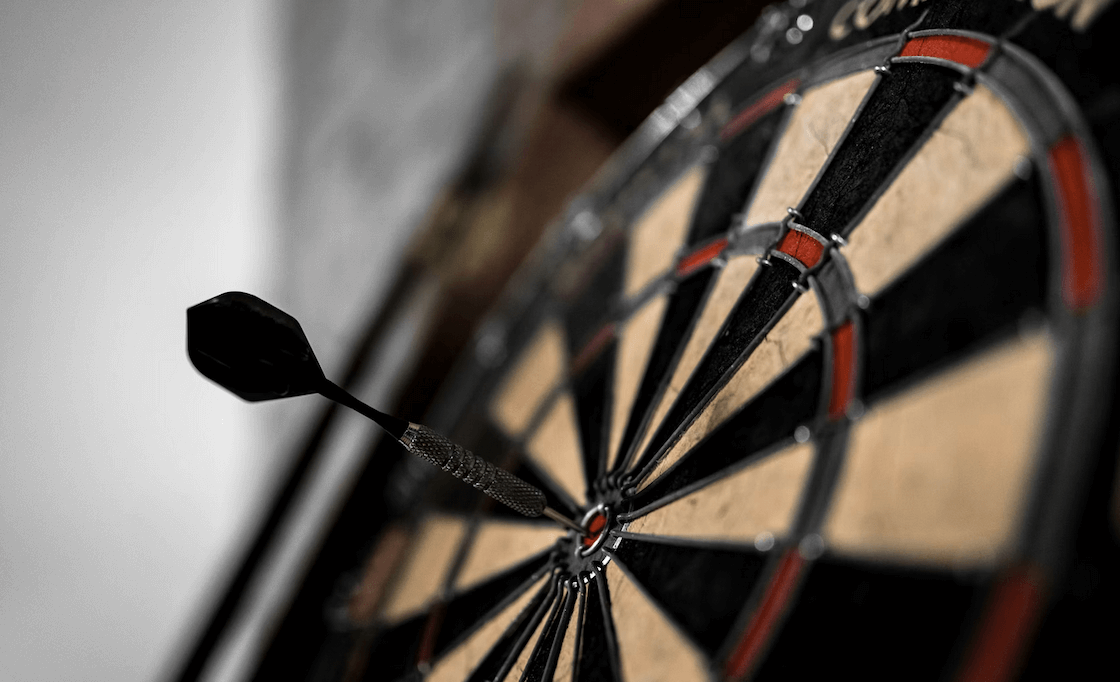
A 32×32 game room (1,024 sqft) is the scale where you stop compromising. The marquee activities (9ft tournament pool, a full L-shape bar with back bar, an 85" TV for the lounge zone, a dedicated golf simulator bay, and a steel-tip dart alcove) all coexist with comfortable walkways between zones. The question shifts from "what do I have to cut?" to "how do I arrange this so it feels like one room, not four hobbies stuffed in a warehouse?"
The planning move at this scale is zoning by noise and lighting. The pool wing wants a pendant 32–36" above the rail, a localized pool of warm light with the rest of the room dim. The lounge wing wants full light control (dark walls, no glare on the screen). The bar wing wants warm task lighting over the counter and glass shelving. The golf sim wants its own enclosure or a dedicated wall. The projector demands that corner stay dark during use. Keep the pool table and lounge on the same long axis so cue backstrokes never point into seated viewers, and put the golf bay on a short wall where the impact screen can absorb cleanly.
Ceiling height is the one constraint that doesn't scale with floor area. Plan for 10ft (120"): a driver swing needs 9ft minimum and the extra foot gives you headroom for pendant lights, ceiling fans, and any tiered theater platform you add later. Under 10ft you start stacking compromises: no driver, lower pool light, no riser.
Walkways are where 1,024 sqft either feels generous or feels like a cluttered hallway. Main circulation between zones wants 48" comfortable, 60" generous. Cue backstroke arcs (58" on every rail of a 9ft table), dart throwing lanes (10ft deep × 5ft wide), and bar stool pullbacks (30" behind each stool) are no-cross zones during use; they can border the main walkway but shouldn't bisect it. Draw the walkways first, then drop items into the remaining footprint. A tiered 5-seat theater row or a 14ft shuffleboard are natural additions if you want to push past the default layout; both fit this square footage, they just compete with the golf bay for length.
Top-down view
Try this layout in your own room
Open the calculator pre-filled with this guide's items, then adjust the room dimensions to yours.
Open in calculatorFit result
Fits with compromises
Placed 5 of 5 items. Room utilization: 73%.
Conflicts (4)
- high 9ft Pool Table (Tournament) + Dartboard (Steel Tip / Regulation)
A dart thrower stands ~8-10ft in front of the board; a pool cue needs 58" of backstroke on every rail. If the dartboard is on a wall the pool table's cue arc reaches, the two activities block each other. Solution: place dartboard on a wall that's at least (cue-length + 2ft) from the nearest pool table rail, or accept that both can't be used simultaneously.
Suggestion: Place the dartboard on a wall far enough from the pool table that the cue arc and the throwing lane do not overlap — or accept that only one game can be played at a time.
- medium 9ft Pool Table (Tournament) + 85" TV (wall-mounted)
A large wall-mounted TV directly on a long side of a pool table sits in the cue backstroke path. Either move the TV to a short wall, accept short cues on that side, or space the table 58"+ from the TV wall.
Suggestion: Move the TV to a short wall, use a shorter cue (52″ variant) on that side, or leave 58″ between pool rail and TV wall.
- high Dartboard (Steel Tip / Regulation)
The dart throwing corridor (60" wide x 117" deep) is a no-cross zone during play. Don't place a dartboard where the throwing lane blocks a doorway, walkway, or access to bar/bathroom.
Suggestion: Mount the dartboard on a wall where the throwing lane does not cross any doorway or main walkway.
- high 9ft Pool Table (Tournament)
Delivery path check: pool table slates (up to 52" wide for 1-piece, 33-50" for 3-piece), shuffleboard playfields (up to 22ft long solid), pinball machines (29" wide but 76" tall with backbox folded to 34"). Measure every doorway, hallway, stair turn, and basement entry BEFORE ordering.
Suggestion: Measure every doorway, hallway, stair turn, and basement entry before ordering.
Walkway warnings
- Narrow passage between Dartboard (Steel Tip / Regulation) and 9ft Pool Table (Tournament): 23" of slack (under 24" is tight).
- Narrow passage between 9ft Pool Table (Tournament) and Golf Simulator Bay: 2" of slack (under 24" is tight).
Placed items
- Dartboard (Steel Tip / Regulation) 8'0" × 10'1"
- L-Shape Home Bar (10x8ft) 12'0" × 12'0"
- 9ft Pool Table (Tournament) 14'4" × 19'0"
- Golf Simulator Bay 14'0" × 17'9"
- 85" TV (wall-mounted) 7'6" × 0'4"
85" TV (wall-mounted): Ideal viewing distance: 14'2" (range 10'0"–17'8")
Room size tier guide
What you can realistically build at each square-footage tier.
| Tier | Headline |
|---|---|
Under 100 sqft | 55-65" TV, recliner, mini fridge, bar cart. No table games. |
100-150 sqft | 65-75" TV, loveseat or 3-seater, dartboard, arcade cabinets, foosball - if room is 11ft+ in one dimension. |
150-250 sqft | 75-85" TV, sectional, 8ft bar, dartboard. A 7ft pool table fits if one dimension is 13'6"+. |
250-350 sqft | Home theater OR 8ft pool + small bar. Both together = compromising one. |
350-500 sqft | 8ft pool + bar + TV area + darts, cleanly zoned. Golf sim is now an option. |
500-700 sqft | Pool + theater + bar + 1-2 additional activities (poker, racing sim, or shuffleboard). |
700+ sqft | Split layout: dedicated theater + games + bar + simulator as distinct zones with proper circulation paths. |
Related pages

Best Corner Pool Tables for Small Game Rooms
Find space-saving corner pool tables that maximize play in tight game rooms. Compare sizes, materials, assembly, and play quality to pick the best fit. Plus tips.

Best Game Tables & Arcade Machines for Your Man Cave
Foosball, ping pong and arcade cabinets for a man cave, with the clearance each one needs and what separates a table that lasts from one that wobbles.

Top Gaming Desks with Retractable Console Shelves
Compare gaming desks with retractable console shelves. Learn build quality, shelf size, cable management, ergonomics, and the best picks by budget.

High-Tech Home Theater Blueprint
Plan a high-tech home theater for your entertainment den: detailed layout, AV picks, seating, acoustics, lighting, smart controls, decor and budget tips.

Radon & Soil-Gas Control for Basement Man Caves: Planning, Specs & Permits
Plan radon and soil-gas mitigation for your basement man cave: system types, code, costs, and a hiring checklist to help you hire and manage pros safely.

Wet Bar Plumbing for Your Basement Man Cave: Traps, Vents & Hiring Tips
Learn what to check before hiring a plumber for your basement man cave wet bar: traps, vents, drains, supply, permits, specs and cost-saving questions to ask.

How Artisanal Snooker Tables Are Built
Discover how artisanal snooker tables are crafted, materials and techniques that matter, plus tips to choose, customize and install one in your man cave.
Frequently asked questions
Pool Cue Vs Dartboard
A dart thrower stands ~8-10ft in front of the board; a pool cue needs 58" of backstroke on every rail. If the dartboard is on a wall the pool table's cue arc reaches, the two activities block each other. Solution: place dartboard on a wall that's at least (cue-length + 2ft) from the nearest pool table rail, or accept that both can't be used simultaneously.
Pool Cue Vs Tv Wall
A large wall-mounted TV directly on a long side of a pool table sits in the cue backstroke path. Either move the TV to a short wall, accept short cues on that side, or space the table 58"+ from the TV wall.
Home Theater Vs Bar Walkway
Back row of seating + bar behind it needs 48"+ of clear walkway. Check depths: sectional 40" + walkway 48" + bar depth 24-72" often overflows what people estimate.
Dart Lane Vs Walkway
The dart throwing corridor (60" wide x 117" deep) is a no-cross zone during play. Don't place a dartboard where the throwing lane blocks a doorway, walkway, or access to bar/bathroom.
Ceiling Height Pool
Ceiling-mounted pool lights hang 32-36" above the rail. An 8ft ceiling gives 32" of drop which is tight; 9ft is comfortable. Account for fan/fixture height.
Ceiling Height Golf
Driver swing needs at least 9ft of ceiling for a 5'10" golfer; taller players or aggressive swings need 10ft+. Under 9ft = you can't use woods/driver without risk of hitting the ceiling.
Door Access Heavy
Delivery path check: pool table slates (up to 52" wide for 1-piece, 33-50" for 3-piece), shuffleboard playfields (up to 22ft long solid), pinball machines (29" wide but 76" tall with backbox folded to 34"). Measure every doorway, hallway, stair turn, and basement entry BEFORE ordering.
(32×32 Dream Layout)
Zoning a 1,000+ sqft Multi-Use Game Room
The main guide covers what fits. The next question is how to make the room feel like a single coherent space rather than five hobbies stuffed into a warehouse. The pro move is zone planning along three axes:
Noise axis:
- Loud zones: pinball, arcade, golf sim impact (peaks at ~85 dB)
- Medium zones: pool, foosball, ping-pong, conversation/bar
- Quiet zones: poker, lounge/theater seating
Place the loudest zone furthest from the lounge. A pool table in the middle works as a "buffer" between zones: the click of balls is medium-volume and isn't disruptive.
Light axis:
- High-light zones: pool table (focused pendant), bar (warm task), poker (overhead directional)
- Variable zones: lounge/TV (full dimming), darts (dedicated board light)
- Dark zones: projector theater wing (full blackout)
If you have a projector, the rest of the room must accommodate it, meaning either total room blackout or a clearly-walled separation.
Walkway axis:
- Main circulation: 48–60" minimum, runs from the room entry through to the back of the room without crossing any active-play zones.
- Activity buffers: cue arcs, dart lanes, golf sim swings, bar stool pullbacks. These live off the main walkway, intersecting only at entry/exit points.
Draw the walkways on graph paper first, then drop activities into the residual footprint. This counterintuitively makes more activities fit.
Subwoofer and Speaker Placement Across Multiple Zones
A 32×32 room with multi-zone activity needs distributed audio, not one big stereo. Practical options:
- Whole-room background music: in-ceiling 6.5" speakers ($60–$300/pair) zoned by activity area, controlled by a multi-zone amp ($200–$800). Sonos system + 4–6 ceiling speakers covers most rooms for $1,500–$3,000.
- Theater-zone surround: dedicated 5.1 or 7.1.2 within the lounge zone, isolated bass to keep pool players from feeling the LFE thump during a critical break.
- Bar/pool zone: can share with theater background, but localized speakers (in-bar or pendant-mounted) over the bar give a "room-within-a-room" feel.
HVAC Sizing for Big Game Rooms
A 1,000 sqft fully-loaded game room with 5–8 occupants, projector, sim PC, kegerator, and mini-split's worth of LED lighting puts out 12,000–18,000 BTU/hr peak. That's a 1–1.5 ton dedicated HVAC zone. If the room shares HVAC with the rest of the basement, expect comfort to drift during big parties.
Plan dedicated supply + return ducting at minimum, or a dedicated mini-split for the game room zone.
Code Considerations for Built-Ins
Big game rooms typically include built-in features that hit code thresholds:
- Wet bar: GFCI outlets, dedicated circuits, drain venting (covered in home-bar guide).
- Theater riser: anything over a 7" rise needs a code-compliant riser (toe space, no tipping hazard, contrast tape on the front edge in some jurisdictions).
- Permanent darts/pool installation: typically not code-relevant, but homeowners insurance may require coverage update.
- Egress: if the room is a basement-finished space, code requires an egress window or door per occupiable space. Make sure your pool table doesn't block it.
- Smoke detector: code-required in finished living spaces. Install before drywalling.
- Sprinklers: required in some jurisdictions for newly-finished basement space over a square-footage threshold.
Pull permits when in doubt. Unpermitted basement finishing is the single biggest reason buyers walk away from a house at inspection.
Big-Room-Specific Mistakes to Avoid
- One central pendant tries to light everything. Plan zone lighting from day one. It's 4–8x harder to retrofit than to rough-in during build.
- No conversation seating. Game rooms need a 4–6 person lounge zone for hangout time when nobody's playing. Skip this and the room only gets used during scheduled "game nights."
- Forgotten storage. Cues, racks, dart cases, foosballs, balls, board games, paddles: they pile up. Plan 30–60 cubic feet of dedicated game-room storage.
- Bathroom access conflicts. Long walks to a bathroom across active zones (dart lane, cue arc) cause friction. Half-bath off the game room is a power move at this scale.
- Bar facing the wrong direction. Bartender should be able to see the TVs and the activity zones. Customers should face the bartender. Plan facing first.
Extended FAQ
Should I have one big open game room or smaller themed zones with walls? Open is more flexible and feels bigger; walled zones give better acoustic and lighting control. Compromise: half-walls or pony walls (4–5ft tall) that visually divide without isolating. Glass partitions between a sim bay and the rest of the room are popular: sound containment plus visibility.
What's the optimal ceiling height for a big game room? 10ft. 9ft is the practical floor for golf sim. 11ft+ adds dramatic volume and pendant flexibility but costs more in HVAC and finishing. Coffered or beamed ceilings at 10–11ft height feel huge.
Where should the entry door go? Off the main walkway, ideally on a short wall, opening into the entry/lounge zone, not directly into a play zone. A door that opens into the dart lane or cue arc is a recurring frustration.
Do I need separate WiFi for the game room? For a sim setup with online play, yes: a dedicated Ethernet drop (or a strong mesh node) inside the room. WiFi from across the house often delivers <50 Mbps to a basement and adds latency that ruins online sim play and 4K streaming.
Should I get a real arcade machine or a multicade? Real classic cabinets (Pac-Man, Centipede, Galaga) restored: $2,000–$5,000 each, original feel, real collector value. Multicades ($800–$3,500): one cabinet plays 60–4,000+ games, modern joysticks/buttons, no patina but instant variety. For a single arcade purchase, multicade. For a collection of 2–3+ machines, restored originals.
What's the resale impact of a finished game room? Mixed. Realtors report: a finished basement game room adds 50–80% of its build cost to home value. An over-personalized one (sports team logos, branded bar, themed everything) often subtracts value because new buyers see expensive remodel work. Build for broad appeal if resale is a factor; theme-decorate only with removable items.
How loud does a 32×32 game room get during a party? 20+ guests, music, pinball, golf sim, bar conversations: 75–85 dB ambient, peak 90+. Insulate the ceiling above the room (R-30 or higher in joist bays + resilient channels) if there are bedrooms above. Ground-floor installations are easier; basement installations need ceiling soundproofing.
Can I retrofit a 32×32 game room into an existing house? Most US homes don't have a 1,000 sqft uninterrupted space. Basements are typically 500–800 sqft, often with support columns. Real options: (1) finished basement consolidation (remove non-load-bearing walls), (2) detached outbuilding/pole barn ($150–$300/sqft to build), (3) finished attic on a large pre-truss home.
What's the budget range for an epic game room? Per-square-foot: $50–$300 for the build (basement finish) + $100–$500/sqft for the items (pool, sim, bar, theater). A 1,000 sqft fully-loaded game room is typically $80,000–$300,000 all-in for a fresh basement build with premium items. The items alone (pool, 9ft + bar full + theater + sim + darts + furniture) are $30,000–$80,000 even with smart shopping.
What are the most-overlooked features?
- Dedicated coat closet / drink storage near the entry
- Plug strips at outlet height along the bar back for blender/charger cycle-through
- Half-bath inside the game room (saves a 50ft round-trip every 2 hours of party)
- Sound-rated entry door (preserves cinema audio and contains kid noise)
- Recessed niche for the dart cabinet (no protruding cabinet in the wall plane)