Best Under-Stair Liquor Cabinets & Built-In Bars
Last updated August 21, 2026 · By Zach Lane ·How we choose products · Affiliate disclosure

Ever stood in front of that awkward under-stair void and thought, "This could be useful"? Me too. I always look at wasted space and see storage, display, or a place to improve how a room performs. This guide walks you through what really matters when you spec a built-in liquor cabinet or bar: load capacity and shelf span, material construction and edge-banding, integrated power and ventilation, glass and lighting specs, and the installation tricks that make a tight fit look like it was made for the space. No fluff, just practical, measurable advice.
You’ll get hands-on, technical guidance for the range of layout problems you’ll run into. We’ll look at units that tuck under stairs, corner footprints that turn dead space into useful storage, narrow vertical stacks for tight runs, and L-shaped builds that convert wasted square footage into a full-service bar. I’ll also dig into finishes from reclaimed wood looks to factory steel, the trade-offs between solid and engineered panels, and the electrical and cooling bits you need if you plan to hide a fridge or run LEDs. Read on so when you pick a unit it performs, installs cleanly, and lasts.

Aheaplus Bar Cabinet with Power Outlets, 67" Tall Wine Bar Cabinet Liquor Cabinets with LED Lights and Glass Holder, Coffee Bars Station for Living Room, Microwave Stand Bakers Rack Cabinets, Black

GDLF Corner Bar Cabinet with Fridge Space, Corner Coffee Bar Station with Storage, L Shaped Liquor Wine Cabinet for Home

BON AUGURE Coffee Bar Cabinet for Liquor, Small Storage Cabinet for Home Kitchen, Farmhouse Sideboard Buffet Cabinets, Industrial Alcohol Cabinets for Dining Entryway Living Room (Rustic Oak)

LOKO Industrial Buffet Sideboard Cabinet, Farmhouse Coffee Bar Cabinet with Sliding Barn Door, Buffet Table with Adjustable Shelves & Spacious Table Top for Home Kitchen Living Room

82.6" Tall Bar Cabinet with Power Outlets, 6-Tiers Reversible Wine Cabinet with LED Lights, Glass Holder & Wine Rack, Liquor Storage Cabinet Coffee Bar Unit Station for Dining Living Room, Grey Oak
GDLF Large Coffee Bar Cabinet with Fridge Space, Mini Fridge Cabinet with Wine Storage, Buffet Sideboard Table for Home, Fluted Modern Design,53.2" L

Set of 2 Small Display Buffet Cabinet with Arched Glass Doors, Modern Buffet Sideboard Coffee Bar Cabinet with Storage and Adjustable Shelves,for Kitchen,and Entryway,Natural
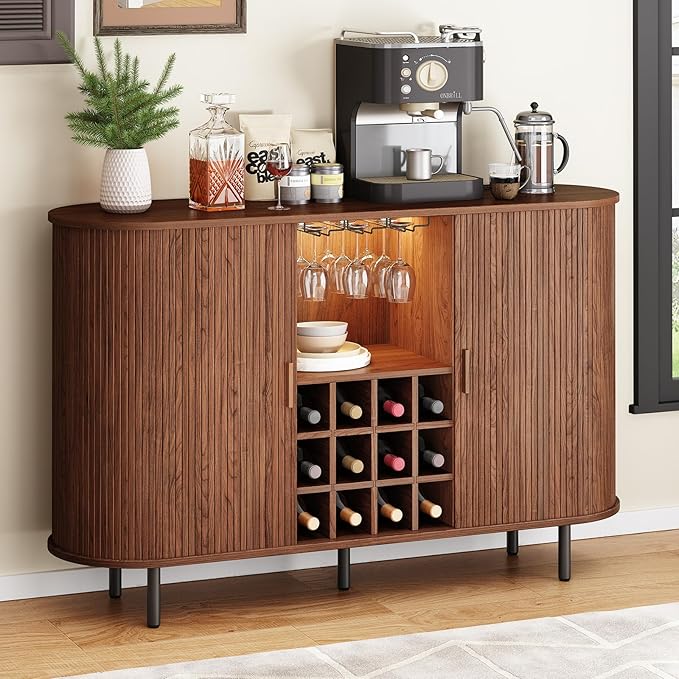
ONBRILL 55" Wine Bar Cabinet with LED Light,Modern Liquor Whiskey Coffee Station with Wine Rack and Glass Holder, Farmhouse Buffet Sideboard with Storage for Living Room, Kitchen, Entryway (Walnut)
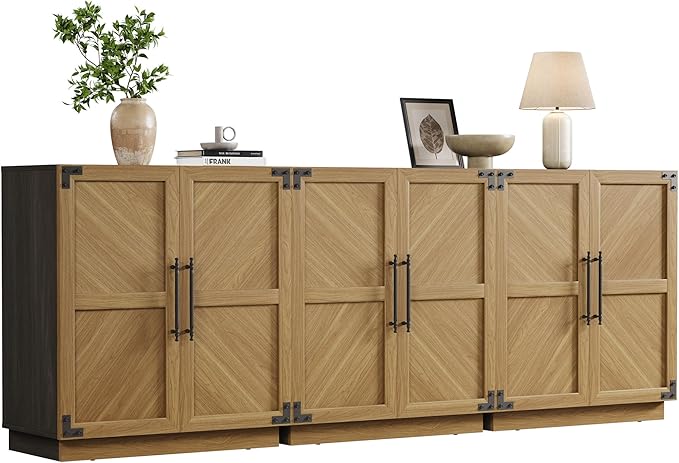
SICOTAS 92" Sideboard Buffet Cabinet with Storage – Extra Wide Farmhouse Credenza with Doors & Adjustable Shelves for Living Room, Entryway

Nathan James Jasper Modern Sideboard, TV Stand with Fluted Doors, Accent Storage for Kitchen or Living Room, Black Oak, Set of 3

82.6" Tall Bar Cabinet with Power Outlets, 6-Tiers Reversible Wine Cabinet with LED Lights, Glass Holder & Wine Rack, Liquor Storage Cabinet Coffee Bar Station for Dining Living Room, Rustic Brown
Our Top Pick
The Armocity tall bar cabinet is my pick because it solves the part of an under-stair conversion that costs real money to solve any other way: it puts a full bar's worth of storage into a footprint about the width of a doorway, with the power already in it.
At roughly 82.6 inches it is a tower rather than a tuck-under, so be clear about where it goes. It belongs against the tall side of a stair void, at the head of the run or in the hallway alongside it, not wedged under the slope where the ceiling is coming down to meet you. Used that way it turns the height you were never going to use into a 12-bottle rack, stemware holders, open shelving for a blender or a brewer, and a mesh-door cabinet for the bottles you would rather not display. The layout reverses, so it works against a left- or right-facing staircase.
The built-in AC outlets and USB ports are the detail I would actually pay for. Running power into an under-stair void properly means an electrician; a cabinet that carries its own outlets means one cord to a socket you already have, and no extension lead snaking across the floor to a bottle opener station.
Be realistic about the build. It is reinforced MDF on a metal frame, so it is durable rather than heirloom, the assembly is genuinely a two-person afternoon, and several owners reinforce the LED strip adhesive. For the money, in a space that was holding a vacuum cleaner last month, that is a fair trade.
Vertical is the cheapest space in an under-stair conversion, and this is the piece that uses it.
How to Maximize That Under-Stair Void with a Precision-Fit Cabinet
Under-stair cabinets are the single best way to reclaim dead space and centralize beverage storage. Geometry is the limiting factor, so start with a precise template: measure rise and run at 3 to 5 points, capture the soffit slope, and transfer those dimensions to a full-size cardboard mockup before you buy anything. Trust me, that cardboard will save you a headache.
Structurally, pick units with adjustable shelving on steel pins or heavy-duty cam fittings, not thin particleboard dadoes. Look for a plywood carcass, edge-banded fronts, and soft-close concealed hinges to avoid racking in an angled cavity. If you plan electronics, allow for ventilation cutouts, a dedicated power bay or outlet, and a French cleat or eyebolt for secure anchoring.
The mistake almost everybody makes here is planning by floor area. An under-stair void is a wedge, and the usable volume is decided by where the soffit crosses your own eye line, not by the square footage on the floor. Walk the space and note the point where you can no longer stand comfortably; everything beyond that is storage you have to crouch for, and crouching next to a bottle you are trying to pour is how bottles get knocked over. The tall third of the wedge is where the bar goes. The shallow end takes drawers, a fridge, or the things you reach for on your knees once a month.
Then load the shelves in your head before you load them in the room. A full liquor bottle weighs over three pounds, so a shelf holding ten bottles is carrying more than 30 pounds, and a decent collection across three shelves puts a hundred pounds into a carcass that is very often reinforced MDF. That is the number that decides whether you want adjustable steel shelf pins or whether the cam fittings will do, and it is why shelf strength matters more on a liquor cabinet than on a bookcase of the same size.
Capacity is worth pinning down before you shop rather than after. A small cabinet holds 12 to 25 bottles, a medium one 25 to 45, and a large one 45 or more, and the widths that go with those run roughly 30 to 40 inches, 40 to 55, and 55 to 72, at depths from 16 to 28 inches. Count the bottles you own, add the ones you know you will buy, and shop the tier above the answer. The cabinet you outgrow in a year is the one you buy twice.
The last geometry check is the door swing, which the cardboard mockup will not catch unless you cut the doors into it. A cabinet that fits the void perfectly and then cannot open its doors because the stair stringer is in the way is a genuinely common outcome. Sliding barn doors and drawers sidestep it entirely, which is part of why they keep turning up in this category.
Corner Bar Cabinets That Turn Neglected Angles into Functional Bars
Corners are a classic problem: two walls, one dead zone. For corner units, study the footprint geometry and the minimum pivot radius for doors or sliding panels. A triangular footprint with a chamfered front gives better access while keeping aisles clear. Read hinge specs for door swing, reveal, and bumper stops. Inside, look for adjustable shelving rated 25 to 35 kg, or integrated wine racking with about 90mm spacing per bottle. Don’t forget routed wire channels and knockouts for power strips. In the reviews I’ll quantify usable bottle capacity, shelf span performance, and how practical installation is in a true corner cavity.
Slim Bar Cabinets for Tight Runs and Hallway Conversions
Slim cabinets live and die by volumetric efficiency. The winners use smart vertical increments, tall-stiff panels to prevent bowing, and mid-rails to reduce cantilever stress. Aim for 18mm or thicker carcass panels and a back panel that screws into studs or includes metal mounting cleats. Shelves should span 300 to 500mm between supports or be reinforced with metal brackets. Watch for pull-out trays, glass racks with 30mm spacing, and LEDs in the 3000K-4000K range so label colors look right. I’ll compare narrow profiles on stability, usable internal volume, and the engineering choices that keep a slim unit performing over time.
Aheaplus Bar Cabinet
This 67-inch Aheaplus bar cabinet is the kind of slim unit that turns wasted space into a feature. The tall, narrow footprint (15.7" D x 26.9" W) tucks into tight runs and pairs a solid steel frame with E1 MDF surfaces rated to about 200 pounds. Built-in conveniences stand out: three AC outlets and two USB ports for a coffee maker, blender, or phone chargers, plus an RGB LED strip with music-sync modes to turn a corner into party mode. Upper open shelves and adjustable lower shelves handle bottles, glassware, and mixers, and the mesh-front doors give a rugged, retro-industrial look without feeling like a garage shelf.
For converting under-stair voids, it’s practical but not perfect. Pros: integrated power, customizable lighting, adjustable feet, anti-tip hardware, and a countertop sturdy enough for small appliances. Cons: assembly takes patience, hardware packs and pre-drilled holes can be inconsistent, and MDF won’t feel as premium as solid wood. Measure carefully. Tip: assemble with a drill and two people, count fasteners before you start, and anchor it to the wall for safety. It’s a budget-smart way to upgrade function and atmosphere, from quiet evenings to game nights.
L-Shaped Built-Ins That Turn Corners into Full-Service Bars
If you’ve got two adjacent runs to work with, an L-shaped built-in is the move that changes the room most. These need attention to corner load paths, countertop continuity, and fridge or plumbing bays. Look for corner braces, continuous tops with scarf joints or silicone seams, and hardware that lets doors align across two planes. Cross-grain expansion will ruin a solid wood top if you don’t plan for it, so prefer engineered tops with plywood cores. Put power centrally with GFCI protection if you’ll run a fridge or blender. In the reviews I’ll focus on cabinet-to-cabinet alignment, countertop joinery, and appliance serviceability.
GDLF Corner Bar Cabinet
This L-shaped corner cabinet is genuinely useful for a home bar. Two 46.5-inch counters give real prep space. The central fridge cubby (20.3"W × 35.8"H) fits most mini fridges and hides cords with a rear cutout. There are stemware racks, adjustable shelves, and two drawers to keep tools and glasses handy. Fluted doors and a walnut-style top give a finished look so your corner reads custom.
What separates it from cheaper options is the built-in power hub and sensible layout. USB and Type-C ports plus outlets mean you can run a fridge and a blender without hunting for adapters. The build uses engineered wood with a reinforced top, so it feels sturdy once assembled. Expect a time-consuming assembly, but reviewers praise fit and finish. Pros: compact L-footprint, organized storage, integrated power, fridge-ready cubby. Cons: MDF is not hardwood, so don’t overload it, and assembly takes patience, and the fridge opening has a fixed width you must match.
If you want a near-built-in look without hiring a carpenter, this is smart. Best for basements, apartments, or anyone reclaiming a corner. Pro tip: anchor it to the wall, measure your mini fridge first, and add LED under the top for instant ambiance. Small details like silicone feet and routed cord paths make a big difference.
Rustic Bar Cabinets: What to Inspect Beyond the Patina
Rustic pieces sell a look, but build quality determines how long they last. Inspect the cores. Kiln-dried reclaimed planks are great if they’re been planed flat. Engineered panels with reclaimed veneer are fine if the substrate is plywood and edges are banded properly. Look for dovetail or mortise-and-tenon joinery in drawers and framed doors, because glued butt joints will open with humidity. Hardware like strap hinges and hand-forged pulls should be rated for frequent use and mounted with washers. In the reviews I’ll weigh authentic material performance, finish durability, and how well each rustic option integrates LEDs and appliance bays.
BON AUGURE Coffee Bar
If you want to turn a shallow under-stair void into a proper pour-and-pour-back station, the BON AUGURE coffee bar is a smart, no-nonsense option. Its slim 13.4-inch depth and 29.5-inch width make it ideal for narrow runs. The rustic oak grain plus black powder-coated metal and mesh doors give a rugged industrial vibe. Magnetic catches, three adjustable shelves, a heavy-duty support tube, and an anti-tip bracket mean you can stash tall bottles and decanters without worry.
What I like is how it balances looks and load capacity. The top supports heavy gear and the shelves are rated well enough for dense bottle collections, so it behaves like a service zone not a prop. Assembly is straightforward and the metal frame feels solid once tightened. Pros: compact footprint for under-stair installs, sturdy build, adjustable storage, and a style that reads bar not bookcase. Cons: the top is MDF so protect it from spills, depth limits very wide objects, and a few buyers mention slight door alignment or mesh flatness issues. Also, there’s no active ventilation for refrigeration, so keep this for bottles, glassware, and a cocktail station.
For a value upgrade this is low fuss and high impact. Anchor it to studs, line the top with a rubber mat, and pair with LED strips or a small wall-mounted rack for a built-in look.
Industrial Bar Cabinets Built for Heavy Use and Minimal Fuss
Industrial designs focus on robustness and serviceability. Check steel gauge, weld quality, and powder-coat finish. For metal carcases look for 18 to 14 gauge panels and continuous seams rather than spot welds. Drawer slides should be full-extension ball-bearing with at least 50 kg static rating. Where wood and metal meet, inspect attachment points to avoid differential movement. Look for ventilation louvers, lockable doors, and bolt-down provisions, since keyed locks with hardened bolts are worth having. In the product reviews I’ll call out gauge, weld seam continuity, and how practical maintenance looks.
LOKO Industrial Sideboard
The LOKO buffet sideboard turns an awkward under-stair void into a tidy, tough bar station. The sliding barn door lets you hide bottles and glassware when you want to, while the roomy top handles a cocktail station, small kegerator, or a decanter display. Around 39.5" wide and 13" deep, it fits tight footprints where a full cabinet would overreach. It reads industrial-farmhouse without being shouty.
Build-wise it’s practical. Engineered wood plus a metal frame and solid metal legs keeps it stable. The anti-topple bracket is a welcome safety detail. Three-position adjustable shelving and mesh side baffles help organize mixers, tumblers, and bottles. Note the interior depth and under-shelf heights, because anything over about 7" might not fit upright, so plan bottle orientation or reserve the top for tall items.
If you want something that looks rugged and works, this one’s smart. Pros: compact footprint, smooth sliding door hardware, solid top weight capacity, generally easy assembly (use a drill to speed it up). Cons: engineered wood won’t age like hardwood, shelf height limits vertical storage. It’s a straightforward, styled option for an under-stair liquor niche or staging surface.
Armocity Tall Bar Cabinet
This tower-style unit nails what I look for in an under-stair bar: vertical density, purposeful compartments, and built-in power. At roughly 82.6 inches tall it turns wasted height into display and storage. You get a 12-bottle rack, three stemware holders, open shelving for a blender or coffee gear, and a mesh-door cabinet for bottles and mixes. Dual LED strips with color and music-sync modes actually add atmosphere rather than just a faint glow. The metal frame plus reinforced MDF feels solid once assembled, and adjustable feet and anti-fall hardware keep it steady on imperfect floors.
What makes it useful is the mix of practicality and showmanship. The reversible layout fits left- or right-facing stairs. Built-in AC outlets and USBs remove the need for extension cords when you want a blender or a brewer on hand. Downsides: assembly is a workout and instructions lean on diagrams, so bring a helper. Some reviewers say the LEDs need extra adhesive, so plan to reinforce them. MDF and metal are durable, but this won’t replace solid hardwood for heirloom work.
If you’re converting a vertical void into a focal point, this is a strong, budget-friendly backbone. Measure clearances, pick left or right power placement, and anchor it for peace of mind. Great for bottle displays, cocktail stations, or a compact coffee corner.
Choosing Wooden Liquor Cabinets That Stand Up to Use and Time
Wood cabinets bring warmth but variable performance depending on species and build. Hardwoods like oak, maple, and walnut are dimensionally stable but need engineered cores on long spans to avoid cupping. Check whether tops are solid or veneered. Solid tops can be resurfaced but move more with humidity; veneered tops on plywood cores are more stable. Look for concealed soft-close hinges and full-extension undermount slides in drawers. Finish systems matter too, and UV-cured lacquer or catalyzed varnish offers scratch resistance. In the reviews I’ll evaluate species selection, core construction, and finish systems for durability and serviceability.
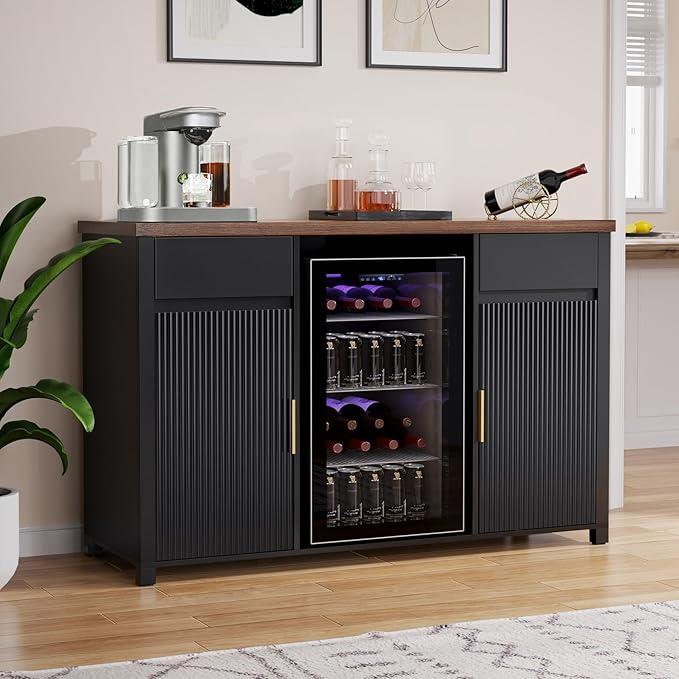
GDLF Coffee Bar Cabinet
This cabinet turns wasted under-stair space into a functional focal point. The 53.2" wide wood top gives you real prep and display room for a shaker, glasses, or a row of bottles. The built-in fridge cavity (about 19.7" W x 19.9" D x 34.7" H) fits most compact fridges, and integrated vents plus cable ports keep things cool and tidy. I also like the charging cluster on top (two AC, a USB and a Type-C). That little detail keeps blenders, scales, and a Bluetooth speaker ready without trailing cords.
What stands out is the blend of looks and utility. The fluted doors and warm top make it feel more expensive than the engineered core. You get two drawers, a wine glass rack, and roomy cabinet space that swallows bottles and mixers. The finish and soft-close hinges read modern. Pre-drilled ventilation and cable ports mean less carpentry and faster install.
This is for the hands-on person who wants a near-trade finish without a full custom build. Expect assembly and bring a partner. It’s sturdy once built, but MDF won’t take the same abuse as solid oak. Minor cons: fiddly assembly, occasional shipping damage, and small gaps that need adjustment. Still, quality and storage win for most basements.
Quick pro tips: measure your fridge and leave airflow clearance, wait for both boxes before assembling, add a centered support foot under the fridge bay for heavy fridges, and anchor the unit to the wall. For style, power, and immediate functionality this cabinet punches above its material class.
Armocity Tall Bar Cabinet
This tall, industrial-style cabinet turns vertical dead space into functional storage without stealing floor area. The reinforced metal frame and MDF panels feel sturdy. Reversible layout, glass racks, a 12-bottle wine slot, open shelves, and a mesh-door cabinet keep everything organized. Built-in outlets and USB ports mean your blender or coffee maker lives where the action is. Dual LED strips with multi-color and music-sync actually change the mood, letting you go from low-key to party mode quickly.
Why I’d pick this for a vertical void: it displays bottles at eye level, tucks stemware overhead, and keeps backup stock hidden behind mesh. Practical touches include adjustable feet, anti-fall anchoring, and a reversible power strip. Downsides: assembly is a couple hours and you’ll want help, and the LEDs sometimes need extra adhesive. It’s MDF and metal, not solid hardwood, so don’t expect heirloom durability.
Best for someone who wants a compact, high-impact bar that looks custom without custom work. Measure your opening first. If you want a turnkey display with lighting and power on board, this is efficient and stylish.
Metal Storage Cabinets: The Lockable Workhorse for High-Duty Needs
Metal cabinets bring durability and security, but specs make the difference. Gauge thickness controls stiffness; look for welded seams rather than spot welds. Shelving should adjust in small increments with clear load ratings. Powder-coat finishes handle chips and corrosion better than paint. For bar work, choose models with wiring knockouts and ventilation cutouts, and heavy-duty locks that throw steel rods rather than plastic cams.
Worth being honest about why this category is on a liquor cabinet page at all: it is the lock. A lock is worth having the moment children can reach the cabinet, and an under-stair bar in a family house is usually at the bottom of the stairs in the part of the room nobody supervises. Keyed, cam and magnetic locks all do the job, and the thing to check is not the mechanism but whether the door flexes enough around it that the cabinet opens anyway. Test the lock before you fill the cabinet, not after.
The trade you are making is appearance. A steel locker reads as a workshop rather than a bar, and in a finished room it will be the piece that looks bought rather than built. If the space is a garage conversion or a genuine utility corner, that is fine and the durability is real, and it is the kind of honest, unfussy choice that ages better than a styled one. If the under-stair bar is in a living room, a wooden cabinet with a keyed lock in the door gets you the same security without the storage-unit look.
There is a middle route that suits a lot of these conversions: keep the display bottles in the glass-front or open cabinetry where they earn their place, and put the expensive ones and the backstock behind a lock in the shallow end of the wedge where the ceiling is too low for anything else. That splits the job the way the geometry already splits the space.
Glass-Front Bar Cabinets That Display Without Compromising Safety
Glass-front cabinets are showpieces, so glass specs matter as much as joinery. Tempered glass is required in many places; low-iron glass gives clearer label color. Mullion spacing and glazing channels should allow thermal expansion. Look for soft-close dampers and magnetic catches to avoid slamming. Internally, glass shelves should be 6 to 8 mm with steel clips, or use wood shelves with a lip to prevent slippage. LED lighting needs diffusers and mounting channels to avoid hotspots; aim for strip LEDs with CRI 80+ for true color rendering. I’ll measure glass thickness, mounting systems, and how lighting and shelving combine to create a safe, attractive display.
FOREST GRAVITY Buffet Cabinets
If you want a fast upgrade that looks intentional, this two-piece display buffet does the heavy lifting. The shallow 15.7" depth and 63" width give you a long, low profile that tucks under stairs or along a basement wall. Arched tempered glass doors turn bottles and stemware into part of the room. Adjustable shelving lets you mix highball glasses in one bay and tall decanters in another. The engineered wood frame is FSC-certified, so you get a stable finish without the weight of solid hardwood. Reviewers call out aligned doors, tempered glass, and included light strips, so the cabinet presents well and plays nicely with LED accent lighting.
For anyone who values display and usable storage in a tight footprint, this hits the sweet spot. Pros: shallow footprint, arched glass for a refined display, adjustable shelves, tempered glass, 1- or 2-piece options. Cons: engineered wood will show wear sooner than hardwood, assembly takes time, and depth limits oversized equipment. Tip: stagger the two pieces under a slope or raise one on a dresser for a stepped liquor wall. Solid performer for turning dead space into a polished bar area.
ONBRILL 55" Wine Bar
If you want to turn an under-stair void into a focal point, the ONBRILL 55" Wine Bar packs a lot in a shallow footprint. It includes a 12-grid wine rack, three tiers for nine stem glasses, adjustable shelves, an RGB LED strip with remote, and two AC plus two USB ports in about a 15.7" depth. That makes it perfect for narrow runs where depth is limited. The sliding tambour-style doors keep the look clean and rounded edges cut down on bumps during late-night runs. LEDs make a dark corner pop and integrated outlets keep appliances tidy without extension cords. Construction is engineered wood, so it looks smart but feels furniture-grade rather than hardwood.
Best for a turnkey built-in vibe without full carpentry. Pros: strong visual impact, built-in power, flexible storage, easy-to-follow assembly. Cons: materials scratch easier than hardwood, sliding doors need patience to align, and shallow depth limits some wide bottles. Practical tips: use a drill for faster assembly, secure the wall kit (80.9 lb safe load), and add a protective top mat if you’ll run heavy espresso gear. Overall, a high-value pick for function, mood, and making dead space useful.
Living Room Built-Ins: Making a Bought Cabinet Read as Built
A living room built-in should read like millwork, not furniture. Fit and finish matter. Look for units designed to integrate with a face-frame or those offering drywall return kits so the join disappears. Check tolerances: adjustable toe-kicks, 3-way hinges, and shims for leveling determine whether seams close up. If the unit houses appliances, specify ventilation paths and service access panels. For AV compatibility, look for cable channels and removable rear panels. Match veneer grain and sheen across adjoining surfaces. In the reviews I’ll assess alignment, serviceability, and the millwork-level details that make an install look intentional.
SICOTAS 92" Sideboard
This wide farmhouse sideboard makes a space feel finished right away. For under-stair installs it works like a plug-and-play facade. The oak-and-dark-contrast finish reads custom, and the 16.1" depth with roughly 31" wide modules gives usable storage without crowding the walk-through. The middle shelf is adjustable so you can stack bottle boxes, line up tall bottles, or hide a drawer zone for glassware and tools.
It’s built for function and looks. The engineered frame is sturdy once assembled and customers say it doesn’t wobble. Assembly needs patience, especially door alignment, so plan two people. If you buy multiple modules, bolt the tops and anchor to floor or wall for a built-in feel. Add LED strips, a shallow wine rack, and a small outlet cutout and you’ve got a neat service station that hides clutter and looks great when hosting.
Who should buy it. If you want a budget route to a built-in look, this is a top pick. Pros: built-in aesthetic, modular sizing, adjustable shelving, strong storage. Cons: manufactured wood, some door fiddling required, not made for built-in refrigeration without mods. Worth a close look for an under-stair liquor setup.
Nathan James Jasper Sideboard
If you want to convert an under-stair void into a proper bar area, the Nathan James Jasper sideboard is very practical. At 16" deep, 31" wide and 32" high (single cabinet), it slides into many stair runs without chewing floor space. Fluted doors and brass pulls give a mid-century, grown-up look so the display reads intentional. Buying multiple units lets you run them side-by-side or step them down the rise of the stairs for a custom feel.
Inside there’s an adjustable shelf for glassware and bottles, soft-close doors, and back access for cables if you want a small fridge or LED puck lighting. The top holds a decanter and a backlit display. Materials are a mix of wood, laminate, and metal; most customers praise the finish though a few see alignment or surface defects, so inspect on delivery.
Assembly is straightforward but not instant. Plan 60-90 minutes and a second set of hands for perfect alignment. Secure it to the wall. Pro tip: if you tuck a cooler behind a cabinet, add a ventilation cut or leave a gap to avoid heat buildup.
Pros: stylish fluted face, modular sets, adjustable shelving, soft-close doors, cable-friendly. Cons: occasional QC/alignment issues, not deep enough for every appliance, some assembly fiddliness. Best for someone who wants a clean, mid-century bar look without a full custom build.
FAQ
How do I measure and plan an under-stair liquor cabinet so it actually fits and works?
Measure everything: total height at the tallest and shortest points, depth at several spots (stairs slope), and width between stringers. Note floor-to-stringer clearances and any HVAC, wiring, or plumbing hiding in that space. Sketch the slope and mark door swing and access paths, because pull-outs or sliding shelves often beat hinged doors for low ceilings. Plan for bottle heights (tall spirits vs wine), glassware, and a small appliance footprint if you want a fridge. Think load-bearing: if you cut into the stringer or framing, talk to a pro. Mock it up with cardboard or plywood before committing so you catch awkward reaches or tread interference.
What materials, finishes, ventilation, and security should I consider?
For durability, go with hardwood or marine-grade plywood for shelving; MDF is okay if sealed but won’t tolerate moisture long term. For tops consider sealed butcher block, quartz, or laminate depending on budget. Proper edge-banding and waterproof finishes protect against spills. Ventilation matters if you hide a fridge, so leave intake/exhaust gaps or add a small vent fan to prevent mildew. Use corrosion-resistant hardware (stainless or brass), soft-close hinges, and LED strips for ambiance. For security: childproof locks if needed, a lockable fridge for expensive bottles, and ventilation for appliances.
Do I need permits, plumbing, or electrical work?
If you’re adding shelves and tapping into existing lighting, you probably won’t need permits unless local rules say otherwise. Adding a sink, drain, or rerouting plumbing usually needs permits and a licensed plumber; new circuits or moving outlets often require a licensed electrician and inspection. Structural changes to the staircase almost certainly need a permit and possibly engineering review. Check local codes and consult pros for electrical, plumbing, or load-bearing work.
Wrapping Up
You now have a specs-driven roadmap to turn that under-stair void into something useful. The core trade-offs repeat: panel and top construction determine stability (prefer plywood cores or 18mm+ carcasses), shelf-span and load ratings dictate whether bottles sit safely or sag (aim for 25-35 kg per shelf for routine bottle loads, 50+ kg for heavy drawers or appliance bays), and metal work only performs if the gauge and seams are solid (18 to 14 gauge and continuous seams give real stiffness). Practical features separate winners from also-rans: integrated power and anti-tip hardware (Aheaplus, Armocity), fridge-ready cutouts and ventilation (the GDLF cabinets), tempered low-iron glass and CRI-80+ lighting for label fidelity (FOREST GRAVITY, ONBRILL), and a long low carcass that reads built-in once it is scribed to the wall (SICOTAS, Nathan James Jasper). Small details matter too: soft-close hinges, steel shelf pins or cam reinforcements, proper edge-banding, and adequate clearances for door swing or tambour tracks change an install from fiddly to factory-fit.
Which direction to pick. If you want vertical density with the power already built in, the Armocity tower is the pragmatic top pick. For a long low base that reads built-in rather than bought, the SICOTAS or the Nathan James Jasper sideboard is the right choice. Tight runs favor slim towers like the Aheaplus. Corner or L-shaped footprints that need continuous tops and appliance bays work best with engineered builds like the GDLF corner cabinet or the LOKO sideboard. Just confirm fridge cavity dimensions and ventilation. For a rustic look that still performs, BON AUGURE balances metal framing and shelf ratings; for showpiece displays pick tempered glass-front units like FOREST GRAVITY or ONBRILL and insist on diffused LED strips with CRI≥80.
Before you buy, run this checklist: full-scale cardboard template of the stair slope, measured fridge and bottle heights (allow 25-50 mm extra above tall spirits), verify shelf span bracing or metal brackets, confirm ventilation/knockouts for power, and validate anti-tip anchoring to studs.
Ready to act. Make that template, decide which capability you value most: display, heavy-duty storage, or a media-plus-bar anchor. Shortlist a few candidates from above, verify panel thickness, shelf loads, ventilation clearances, and hardware types, then assemble with a partner, anchor to studs, provision power and ventilation, and finish with LED lighting and trim for that built-in look. If you want, pick one model from this guide, mock it up with cardboard tonight, and snap a photo, because you’ll catch clearance issues before they turn into a costly retrofit.