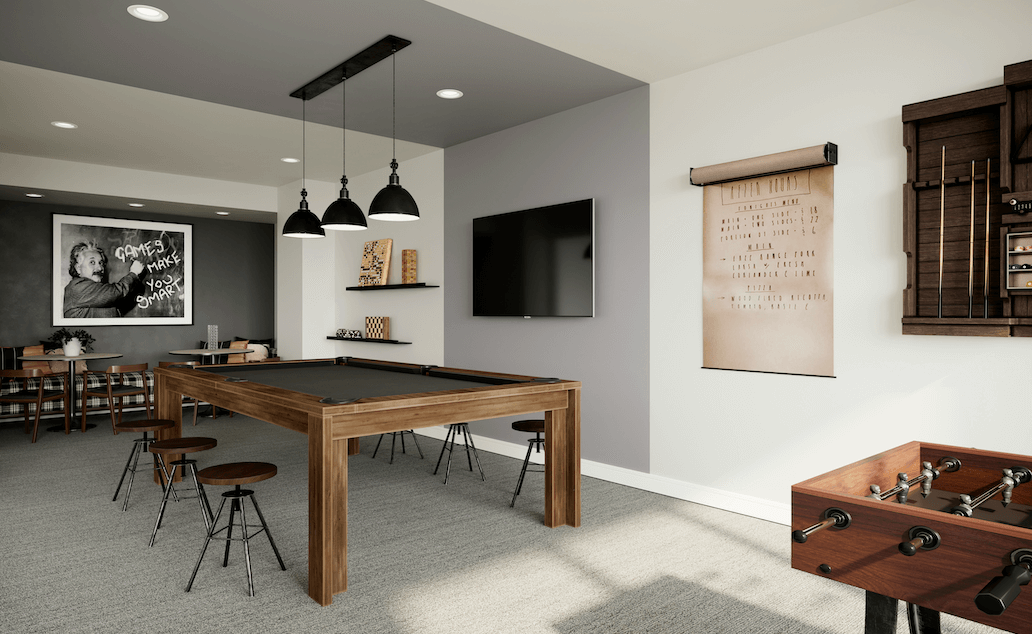
A worktop sized and reinforced for multi-monitor rigs, sim-racing gear, and daily gaming sessions, with cable routing and often push-button height adjustment built in.
Price bands, clearances, and what to buy first for this piece are in our man cave furniture guide.
A gaming desk carries the weight and geometry a battlestation actually needs: a top wide enough for two or three monitors, VESA mounting points or clamp space for a monitor arm, and a frame rated to hold significantly more than a laptop and a lamp. Most sit between 48 and 71 inches wide, deep enough (30 to 35 inches) to keep an ultrawide or triple-monitor array at a comfortable viewing distance, and built around either a fixed steel frame or an electric sit-stand mechanism. Cable routing is built into the design rather than added on afterward: grommet ports, a rear tray or basket, and sometimes a magnetic sheath system keep power bricks, HDMI runs, and a headset dongle off the floor.
The payoff shows up the first time someone tries to run a triple-monitor sim-racing rig off a cheap particleboard desk from a big-box store and watches it flex under two monitor arms and three 27-inch panels. Steel-frame desks built for this job carry 265 to 440 pounds depending on the model, versus roughly 100 to 165 pounds for a basic fixed desk, which is the difference between a monitor arm that stays put and one that slowly droops over a few weeks. Get the height wrong instead, and the cost shows up as a stiff neck after a long session rather than a warranty claim.
None of that makes a gaming desk a different category of furniture from an office desk, and the honest answer is that a good height-adjustable office desk does most of the same job. What separates them is emphasis. A gaming desk assumes multiple monitors, a mechanical keyboard, and a rig that needs airflow, and it often adds a console shelf or a controller drawer that a spreadsheet-focused desk never needed.
Sizing, materials, and what actually needs to hold weight
Width is the first decision, and it is driven entirely by monitor count. A single ultrawide needs 55 to 63 inches to sit at a comfortable arm's length; a dual-monitor setup wants roughly 60 inches; three 27-inch monitors on arms want at least 63 inches, and stepping up to 71 inches or more removes any temptation to angle the outer screens too sharply. Depth matters just as much and gets ignored more often. Thirty inches is the floor for a curved or ultrawide panel, and 32 to 35 inches gives a triple-monitor setup enough room to sit back from the glass instead of craning forward.
Desktop material splits into two camps. Particleboard or MDF with a laminate wrap is the default below roughly $300: stiff enough for normal use, but prone to sag under three monitors on arms plus a subwoofer. Steel-frame desks push the load-bearing job into the legs and crossbars instead of the top, which is why they carry 265 to 440 pounds compared with roughly 100 to 165 pounds for a basic laminate desk. Check cable management features before the material: grommet holes typically run 2 to 3 inches across, and a rear tray or basket keeps the power strip and cable runs from turning into visible clutter underneath.
Height adjustability is the feature that separates a $150 fixed desk from a $450 to $950 electric one. Dual-motor frames typically travel from around 25 inches up to 48 or 51 inches, enough to move from a seated 28 to 30 inch working height to a full standing position, and most rate for a few thousand adjustment cycles before the motor becomes the failure point rather than the desk itself.
Gaming desk vs. standard office desk
The honest distinction is not structural, it is what the desk assumes a person owns. A standard office desk is sized for a laptop, one monitor, and a keyboard tray, and its weight rating reflects that: enough for a screen and a stack of folders, not two monitor arms and a full tower case. A gaming desk starts from the assumption of multiple displays, a mechanical keyboard, external speakers, and often a gaming chair pulled in close enough that arm height and desk height both matter.
The other difference is routing. Office desks treat cables as an afterthought, usually a zip tie applied once everything is already in place. Gaming desks build grommets, a rear tray, and sometimes a full cable spine into the design, because a PC setup runs more cords: power, HDMI or DisplayPort, USB for a headset dongle and webcam, and sometimes a wired ethernet run.
Price tells the same story from the other direction. A capable office desk runs $150 to $300. A gaming desk with a similar footprint, but a steel frame, cable system, and VESA-ready top, starts around there and climbs toward $800 to $950 once electric height adjustment and a reinforced or bamboo top get added.
From LAN party plywood to an $800 electric frame
Gaming desks did not exist as a labeled product category until PC gaming setups outgrew the desks people already owned. Through the 2000s and early 2010s, dedicated PC gamers built battlestations out of office furniture, flat-pack countertops, or plywood sheets on sawhorses, because nothing on the market was sized for three monitors and a full tower case. Desk brands noticed the same audience streaming and building rigs online, and companies built specifically around gaming, Secretlab among the most visible, moved from chairs into desks in the late 2010s, borrowing the electric sit-stand mechanism that office furniture makers like FlexiSpot and Autonomous had already proven out.
That crossover from the standing-desk world is why most premium gaming desks today are height-adjustable rather than fixed: the motor and frame technology already existed, and gaming brands layered on the width, VESA compatibility, and cable systems a battlestation needed. Some desk designs pair that frame with a retractable console shelf that slides an Xbox or PlayStation out from under the desktop instead of leaving it exposed next to the monitor, a detail aimed at a mixed PC-and-console setup.
Common mistakes
Buying for one monitor, then adding two more later. A 48-inch fixed desk holds one monitor and a keyboard fine, but drop a second arm-mounted display on it and the clamps start fighting for space. Buy for the setup planned a year out, not just the one on the desk today, since 60 to 71 inches costs little more up front than 48.
Treating cable management as cleanup after the build. Running power, HDMI, USB, and ethernet cables once the monitors, PC, and speakers are already in place means routing around furniture instead of through it. Grommet holes and a rear tray only earn their keep if cables get planned during setup, not months into using a rig that already has every cord dressed in place.
Matching desk height to the room instead of to the chair. A 29-inch fixed desk feels right until it sits next to a gaming chair with a seat pan a couple inches higher than a standard office chair, which pushes the keyboard too low and bends the wrists at an uncomfortable angle over a long session. OSHA's workstation guidance sets the order deliberately: chair height first, monitor height second, keyboard and mouse last. Skipping straight to desk height and hoping the chair adjusts around it usually ends with the monitor's top edge well above eye level instead of at or slightly below it.
Frequently asked questions
What is a gaming desk, and how is it different from a computer desk?
Gaming desks carry multiple monitors, a mechanical keyboard, and a full PC tower on a frame rated well past what a basic computer desk handles, usually with steel or reinforced-leg construction. Most add VESA mounting points or clamp space for a monitor arm, grommet holes for cable routing, and sometimes an electric sit-stand mechanism. A standard computer desk can technically hold the same gear, but it's typically sized and rated for a single monitor and a laptop, not three displays and two arms.
Do I need a height-adjustable desk for gaming?
No. A fixed-height desk set to the correct 28 to 30 inch working height works fine for most gaming setups, and it costs a fraction of an electric frame. Height adjustment mainly helps if a session runs long enough that standing periodically matters, or if more than one person of a different height shares the same desk. Electric frames add real cost, usually $400 or more, so treat it as a comfort upgrade rather than a requirement.
How wide should a gaming desk be for three monitors?
Plan for at least 63 inches of width for three 24 to 27 inch monitors mounted on arms, and lean toward 71 inches if the monitors sit on stands instead, since stands take up more desk footprint than arms do. Depth matters too: 32 to 35 inches keeps a triple-monitor array far enough away to avoid a cramped, too-close field of view. Going narrower usually means angling the outer monitors more sharply than is comfortable.
What desktop material holds up best under a gaming setup?
Steel-frame desks with an MDF or laminate top handle multi-monitor loads better than a basic particleboard desk, carrying 265 to 440 pounds versus roughly 100 to 165 pounds on a fixed laminate desk. The frame, not the desktop material, does most of the load-bearing work, so a steel or reinforced-leg frame matters more than whether the top is laminate or bamboo. Particleboard desks are fine for a single monitor, but they flex under two monitor arms and heavier peripherals over time.
Can a gaming desk replace a standing desk for general work?
Yes, an electric height-adjustable gaming desk works the same as a standing desk for general computer work, since the frame and motor are usually the same technology used in office standing desks. The main tradeoff is footprint and price: gaming desks run wider, often 60 inches or more, and cost more once cable management and monitor mounting features get included. Buying one electric gaming desk instead of two separate desks covers both needs.
Related terms
Gaming Chair
Racing-inspired or ergonomic-hybrid seating built for long sessions at a desk, with adjustable recline, armrests, and lumbar support tuned for gaming rather than office work.
Audio/Visual & TechCable Management
Organising, routing, bundling, labelling, and concealing AV cables to ensure fire-code compliance, signal integrity, and a clean result, using raceways, trays, sleeves, velcro, and in-wall pathways.
Sim Racing & Gaming TechTriple Monitor Setup
Three identical panels side by side with the outer two angled inward, spanned by one graphics card and told the real angle and eye distance so the render matches the room.
Design Themes & StylesGaming Den
A styling approach built around screens: dark matte walls, layered RGB and bias lighting, and hidden cable runs, borrowed from PC-building and streaming culture rather than a fixed room type.
Read more about Gaming Desk

Top Gaming Desks with Retractable Console Shelves
Compare gaming desks with retractable console shelves. Learn build quality, shelf size, cable management, ergonomics, and the best picks by budget.

Best LED Bias Lighting Kits to Boost TV Contrast
Nine LED bias lighting kits compared, plus the specs that matter: 6500K, CRI above 90, a surround at 5 cd/m2, and where to inset the strip behind the panel.