A styling approach built around screens: dark matte walls, layered RGB and bias lighting, and hidden cable runs, borrowed from PC-building and streaming culture rather than a fixed room type.
What this look costs to build, the room it needs, and how it compares on fit is in our man cave ideas and themes guide.
Walk into a gaming den and the first thing that registers is light, not furniture. A monitor or a wall of them glows in the dark, a strip of RGB traces the underside of a desk or a shelf, and the walls sit in a charcoal, navy, or matte black that keeps reflections down. The desk holds the gear: a PC tower with a windowed side panel, a mechanical keyboard, cable runs tucked behind the monitor arm rather than draped across the floor. None of that requires a dedicated room. A gaming den can be a corner of a bedroom, a finished basement, or a full game room built out from scratch, and it describes how the space looks and lights up, not what the room is officially called on a floor plan.
Getting the look right changes how long someone actually wants to sit in the room. Screens are the focal point of a gaming den, and a screen surrounded by bright walls or overhead fluorescents fights its own contrast, which tires the eyes faster during a long session. Dial the ambient light down, add a soft glow behind the monitor, and the same screen reads as brighter and steadier without touching a single setting on the display itself. The payoff is practical as much as visual: a room built around low, layered light and a controlled palette is a room people can sit in for three hours of a raid or a stream without reaching for the overhead switch.
What a gaming den is not is a fixed shopping list. No accreditation body certifies a room as a proper gaming den the way one exists for a THX-rated home theater, and no design magazine has staked out the term the way they have for mid-century modern or farmhouse. It reads closer to a recognizable bundle of choices, drawn from PC-building culture and streaming setups, than a codified style with a rulebook. That looseness is part of the appeal. It borrows lighting logic from bias-lit editing suites, palette cues from home theaters, and cable discipline from custom PC builds, then blends them without needing anyone's permission to call the result finished.
The lighting, palette, and acoustics that make it work
Layering is the operating principle. Most gaming dens run three light sources rather than one: a low-level ambient source (a floor lamp, cove lighting, or a dimmed overhead), an accent layer of RGB strips along a desk edge, shelf, or wall, and bias lighting, a thin strip mounted directly behind the monitor. That last piece borrows from broadcast and photo-editing suites, where a neutral light behind the screen keeps the eye from constantly readjusting between a bright picture and a dark surround. AV guides commonly recommend a daylight-white bias light around 6500 K set to roughly a tenth of the screen's peak brightness, a ratio close to what the broadcast-mastering standard ITU-R BT.2035 specifies for reference viewing environments. For layering fundamentals that apply well beyond a single monitor, see lighting.
Color palette follows the same logic as the lighting. Darker, medium-value walls in charcoal, deep navy, or graphite, finished in matte rather than gloss, cut down reflections bouncing back off the screen. That preference is a practical convention drawn from how monitors read against their surround, not a certified building recommendation; workplace ergonomics guidance from OSHA actually favors light, matte wall finishes for general glare control, so the dark palette here is a deliberate aesthetic trade, not a copy of that guidance.
Acoustics get less attention than lighting but matter over a long session. A room with hard, parallel walls bounces mechanical-keyboard clatter and game audio around the space, and a rug or a couple of acoustic panels soften that without changing the palette at all.
Gaming den style vs. game room, the space
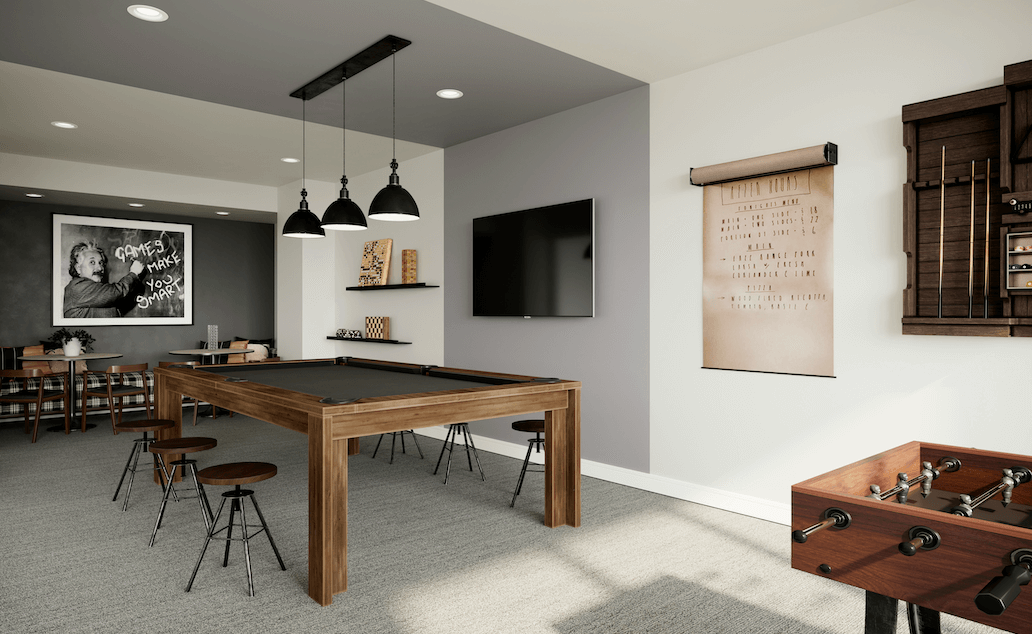
A game room is a room type: a space set aside in a home for gaming, billiards, or general recreation, defined by its function rather than its finish. A gaming den is a style, a specific set of lighting and material choices applied inside a room, whether that room is a bedroom, a basement corner, or a dedicated game room built from scratch. The two overlap constantly because gaming is usually what happens in both, but they answer different questions. A game room answers what the space is for; a gaming den answers how the space looks and feels.
The confusion shows up most in shopping and search behavior. Someone searching for gaming den ideas usually wants palette, lighting, and desk-setup inspiration, while someone searching for game room ideas is just as likely to be asking about a pool table or an arcade cabinet as anything screen-based. A room can be both at once: a finished basement built out as a dedicated game room, styled with the dark palette and layered RGB of a gaming den. It can also be neither fully. A retro arcade cabinet in the corner of a rec room is a game room element without the moody, screen-centric lighting the style relies on.
Where the look actually came from
Gaming den has no clean origin story, and it is worth saying so plainly rather than inventing one. Unlike a governed term with a standards body behind it, gaming den does not show up as a named style in interior design coverage the way farmhouse, mid-century modern, or industrial do. It reads instead as informal shorthand that gathered around three real trends: RGB lighting ecosystems such as ASUS Aura Sync, Razer Chroma, and Corsair iCUE, which turned PC components into programmable light sources through the 2010s; the PC-building hobby's habit of routing and sleeving cables as a visible design element rather than hiding them entirely; and the staged, camera-ready backdrops streamers started building once streaming setups became common after Twitch's public launch on June 6, 2011. None of those three trends carries this name officially. It is a convenient label the gaming and home-decor content world settled on for describing the combination.
Common mistakes that undercut the look
Over-lighting the RGB is the most common one. Stacking several saturated colors at full brightness in the same sightline as the monitor washes out the screen's own contrast and adds glare instead of removing it, defeating the point of running low-level RGB lighting in the first place. The fix is restraint: pick one or two zones, such as behind the monitor or along a shelf, and keep them dimmer than the display rather than brighter.
Skipping cable management is the second. A room can nail the palette and the lighting and still look unfinished if the desk hides a visible tangle of power bricks and charging cables. A cable tray, a PSU shroud, or a basic sleeving kit fixes this for relatively little money, and the payoff shows up in every photo and every stream more than another light strip would.
The third is building for photos rather than for long sessions. A gaming den finished with hard flooring, bare walls, and no soft surfaces turns uncomfortable fast once game audio and keyboard noise start bouncing around during a three-hour session. A rug, a curtain, or a panel or two brings the reverb down without touching the look, and it is the difference between a room that photographs well once and one that stays livable night after night.
Frequently asked questions
What is a gaming den?
A gaming den is a styling approach for a room built around screens and PC gaming gear: dark or medium-toned walls, layered RGB lighting behind monitors and along shelving, matte rather than glossy surfaces, and cable runs kept out of sight. It borrows its lighting and color logic from PC gaming culture and streaming setups rather than from a fixed catalog of furniture. The look works in a spare bedroom, a basement corner, or a full home theater, since it describes a treatment applied to a space rather than the space itself.
What's the difference between a gaming den and a game room?
A game room is a room type, a bonus space set aside for gaming, billiards, or general recreation regardless of how it looks. A gaming den is a styling choice applied inside a room, whether that room is a bedroom, a basement, or a dedicated game room. A retro arcade-themed game room and a gaming den can both hold the same gaming setup, but they lean on different visual cues: one leans on neon marquees and cabinet art, the other on ambient RGB, dark matte finishes, and hidden cable runs behind the monitor.
How much does RGB lighting for a gaming den cost?
Pricing depends on scope. A basic monitor-synced light bar, such as Govee's DreamView line, commonly runs roughly $70 to $100. Addressable LED strips for shelving or a desk edge cost less per foot but add up once a room is fully wired, and whole-room ecosystems that tie into a PC, like Corsair iCUE, Razer Chroma, or ASUS Aura Sync, cost more once every peripheral and light is synced together. Custom-sleeved cable kits, if added, typically start around $99 per kit.
How do I stop RGB lighting from washing out my screen?
Keep accent lighting behind or beside the monitor rather than pointed at it, and dim it below the screen's own brightness. AV guides commonly reference bias lighting near daylight white, around 6500 K, set to roughly a tenth of the display's peak brightness, a ratio drawn from the broadcast-mastering standard ITU-R BT.2035. Bright, saturated RGB aimed into the same sightline as the screen adds glare and eye fatigue instead of the calm backdrop it is meant to create.
Is gaming den a real, defined design style?
Not in the way farmhouse or mid-century modern are. Design publications do not use gaming den as a named movement, and it has no documented origin story or governing rulebook behind it. It functions as informal shorthand, used across gaming and home-design content, for a recognizable bundle of choices: dark matte finishes, layered RGB, and tidy cable management. The individual elements are well established on their own; the label bundling them together is closer to a content convenience than a design history.
Related terms
LED Strip (RGBW)
Flexible tape of LEDs on adhesive backing; RGBW adds a dedicated white diode for true white. Runs $5 to $15 per meter; 5050 strips at 60 LEDs/m draw about 14 to 18 W/m.
Audio/Visual & TechCable Management
Organising, routing, bundling, labelling, and concealing AV cables to ensure fire-code compliance, signal integrity, and a clean result, using raceways, trays, sleeves, velcro, and in-wall pathways.
Room Types & SpacesGame Room
A room built around active games such as pool, foosball, darts, and arcade cabinets, sized and laid out for group play rather than solo retreat.
Furniture & SeatingGaming Desk
A worktop sized and reinforced for multi-monitor rigs, sim-racing gear, and daily gaming sessions, with cable routing and often push-button height adjustment built in.
Video & Streaming SetupStreaming Setup
The full chain of camera, microphone, lighting, computer, and encoding software that broadcasts a man cave live, from a $250 starter rig to multi-cam pro builds.
Audio/Visual & TechAcoustic Panel
Fabric-wrapped mineral wool or fibreglass hung on walls and ceilings to absorb reflections and cut reverb, sharpening dialogue without stopping sound leaving the room.