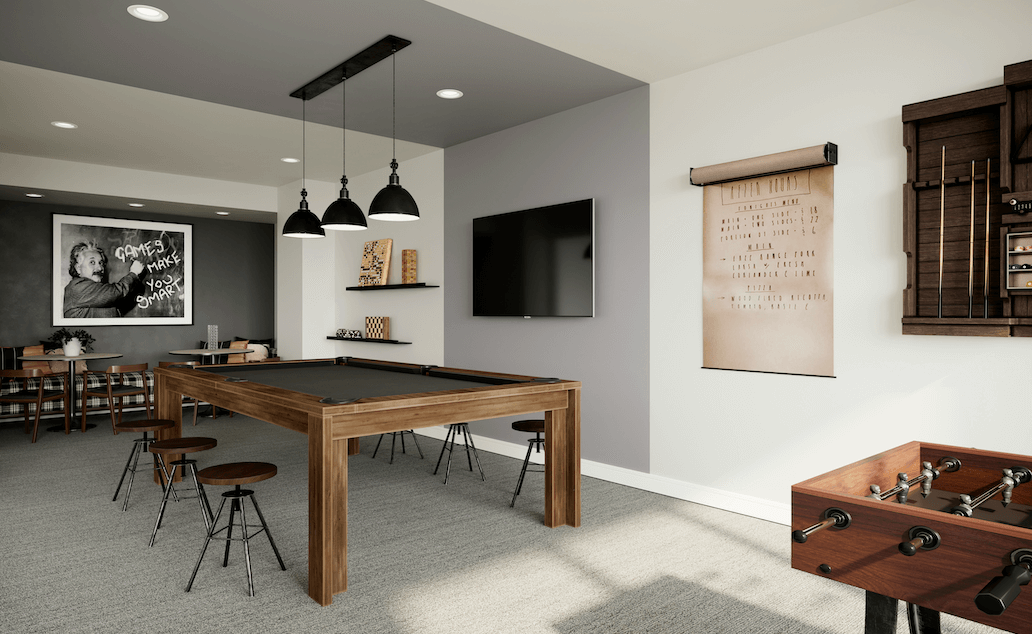
A room built around active games such as pool, foosball, darts, and arcade cabinets, sized and laid out for group play rather than solo retreat.
Also known as: Games Room
A game room is built around active play: a pool table anchoring the middle of the floor, a dartboard on the far wall with clearance to the throw line, maybe a foosball table or an arcade cabinet along a third wall. The Real Estate Standards Organization, whose data dictionary sets the shared vocabulary MLS systems use nationwide, defines it as a bonus room specifically equipped for billiards, ping-pong, video games, or board games. That formal definition matters because it separates a game room from a catch-all bonus room or a media room built for watching rather than playing. Furniture gets chosen for group use: bar stools around a rail, a bench along the wall, seating that clears a walking lane rather than facing a screen.
Getting the room right pays off in how much it actually gets used. A 2017 survey of 155 developers, designers, and builders working on multifamily projects found game rooms and arcades were the single most requested recreational amenity, named by 51.6% of respondents, ahead of gyms and sport courts. That popularity shows up in single-family remodels too: homeowners converting a basement or bonus room into a full game room commonly spend $3,000 to $50,000 depending on scope, per 2026 Angi cost data, with a pool table alone running roughly $1,200 to $12,000 before delivery. Skimp on layout planning and that spending buys a room nobody can move around in.
A game room is not the same thing as a man cave, even though the two overlap constantly in real listings and design blogs. It is also not a home theater, which centers on a screen and acoustic control rather than a walking lane between games. And it is not simply a finished bonus room with a couch pushed to one side. The next section draws the line against its closest cousin in more detail.
Sizing a room for pool, foosball, and everything in between
Every game has its own footprint, and stacking several in one room means adding those footprints rather than eyeballing it. A pool table needs the play surface plus room for a full cue swing on every side: Brunswick's buying guide sizes a 7-foot table at roughly 13 by 16 feet, an 8-foot table at 13 by 17 feet, and a 9-foot table at 14 by 18 feet, using the rule of playing surface plus two cue lengths. Table tennis takes up more room than most people expect, with Dimensions.com putting recreational play at about 28 by 13 feet, closer to 364 square feet, before any spectator space. A dartboard needs far less: the World Darts Federation sets the oche, the throw line, at 7 feet 9.25 inches (2.37 m) from the board face, with the bullseye hung 5 feet 8 inches off the floor. Foosball is the space-saver of the group, needing roughly 3 to 4 feet of clearance on each side, which puts a workable footprint around 10 by 8 feet.
Combine two or three of these and the walking lanes matter more than any single table's footprint. A pool table's cue swing eats into a foosball table's clearance zone the moment both sit against opposite walls, so the planning step is drawing clearances on a floor plan before buying anything. A roundup of game tables and arcade machines built for man caves is a reasonable place to start matching equipment to the footprint actually available.
Game room vs. man cave
The two get used interchangeably online, but the distinction holds up in how each room is designed and who it serves. A man cave is built around one person's identity: a private retreat furnished with a personal collection, dimmer lighting, and seating meant for solo downtime or a small circle of regulars. A game room is built around activity that other people join. Lighting runs brighter because players need to see the table, seating faces the games rather than a screen or a bar, and traffic flow between stations matters as much as the decor.
The overlap is real and worth naming plainly: plenty of man caves contain a pool table or a dartboard, and plenty of game rooms get personalized with team memorabilia or a bar rail. The practical difference is what the room optimizes for. A man cave optimizes for retreat, so it can be small and still work. A game room optimizes for group play, so its size and layout get judged by whether four people can move through it at once without stepping over a cue stick. See the man cave entry for the personalization side of that line.
From the basement rec room to the home arcade
The game room's ancestor is the basement rec room that spread through American suburbs after World War II. Returning veterans fueled a tract-housing boom, and builders often left basements partly unfinished so owners could convert them later. Better Homes & Gardens and similar magazines popularized the finished rec room through the late 1950s, and by the 1970s a paneled basement with a bar, a ping-pong or billiards table, and shag carpet signaled middle-class homeownership. That basement-first model has faded as construction has shifted: as of 2024, only about 17% of new single-family homes in the U.S. were built with basements, a decline that pushed the game room upstairs into bonus rooms, garages, and finished attics.
The equipment inside kept evolving too. Home arcade cabinets saw a documented resurgence starting around 2020, driven by people spending more time at home and licensors like SEGA and Capcom releasing new home-arcade hardware, extending a room once defined by a single pool table into one that might run a full cabinet lineup.
Common mistakes
Cramming in every game at once is the most common error. A room that could handle one pool table and a comfortable walking lane instead ends up with a foosball table wedged against the rail and a dartboard nobody can safely throw at. Retailers who sell game tables for exactly this problem, such as Legacy Billiards, recommend starting with one centerpiece table and leaving expansion space for later rather than filling the room on day one.
The second mistake is sizing for the table and forgetting the clearance around it. A 7-foot pool table fits in a 13 by 16 foot room on paper, but that number already assumes nothing else lines the walls. Add a wall-mounted dartboard or a spectator bench inside that footprint and the cue swing gets interrupted mid-shot.
The third is furnishing for a single use case. Seating bolted or arranged to face one game leaves the room awkward the moment someone wants to watch rather than play. A mix of movable stools, a bench along a clear wall, and lighting on a dimmer that shifts from bright task light for the table to something softer for a game night gathering keeps the room working for more than one kind of evening.
Frequently asked questions
What counts as a game room?
A game room is a room built specifically for active games rather than general lounging. Real estate's MLS data dictionary defines it as a bonus room equipped for billiards, ping-pong, video games, or board games. In practice that usually means a pool table, foosball table, dartboard, or arcade cabinet as the centerpiece, with seating and lighting arranged so players and spectators can move around the equipment rather than face a screen or a bar.
What is the difference between a game room and a man cave?
A man cave is built around one person, furnished with a personal collection and lighting meant for solo downtime. A game room is built around activity that other people join, with brighter lighting, seating that faces the games, and enough open floor for several people to move at once. Many rooms blend both: a man cave with a pool table, or a game room personalized with team memorabilia, so the labels describe emphasis more than a hard boundary.
How big does a game room need to be?
It depends on what goes inside. A 7-foot pool table needs roughly 13 by 16 feet once cue swing is included, and a 9-foot table needs closer to 14 by 18 feet. Table tennis needs more space than most people expect, around 28 by 13 feet for casual play. Foosball is the most compact option at roughly 10 by 8 feet. Combining games means adding those footprints together, not squeezing every table into whatever floor space happens to be left over.
How do I fit a pool table and other games in the same room?
Draw each game's clearance zone on a floor plan before buying anything: a pool table's full cue swing, a dartboard's 7 ft 9.25 in throw distance, a foosball table's 3 to 4 feet of side clearance. Overlap those zones on paper first, not in the room after delivery. Retailers who sell game tables and arcade machines generally recommend picking one centerpiece table and leaving room for a second game later rather than filling the space on day one.
Can a small spare room work as a game room?
A small room can work for one game but rarely for several. A single arcade cabinet or a compact foosball table fits in a spare bedroom sized space, but a pool table alone needs a room close to 13 by 16 feet before anyone can take a full shot without hitting a wall. Trying to combine a pool table, a dartboard, and a ping-pong table in a small room usually leaves at least one of them permanently blocked or unsafe to play.
Related terms
Man Cave
A room set aside for one person's hobbies and entertainment, typically a home bar, game room, theater, or all three. The term dates to a 1992 Toronto Star column.
Room Types & SpacesRec Room
A finished basement or spare room given over to games, movies, and casual entertaining. The rec room is the family version of a man cave: more flexible, more social, and built to take wear.
Room Types & SpacesBonus Room
A finished, habitable room that falls short of the legal definition of a bedroom, giving the owner flexible space without triggering the code, tax, or septic weight an extra bedroom would.
Entertainment & GamesArcade Cabinet
A standing coin-op video game housing: wood body, marquee, control panel, monitor and game board, wired since 1985 to the 56-pin JAMMA standard that made boards interchangeable.
Entertainment & GamesPool Table
Six-pocket pocket billiards table sized 7, 8, or 9 feet, with a slate bed for tournament play. A standard 58 inch cue needs a room about 13 by 16 feet or larger, and slate tables start around $1,500.
Entertainment & GamesFoosball Table
An eight-rod cabinet with 22 miniature players that turns tabletop soccer into a fast, two-to-four-player game built around a roughly four-foot playing surface and telescopic or through rods.
Entertainment & GamesDartboard (Electronic / Bristle)
A round target of sisal bristle or perforated plastic, mounted with its bullseye 5 ft 8 in off the floor and thrown at from a fixed oche distance for regulation darts.
Read more about Game Room

Retro-Futurist Game Room Guide for Man Caves
Build a retro-futurist space-age man cave: expert tips on furniture, lighting, art, tech, DIY projects and budgets to create a stylish, functional game room.

Monte Carlo Casino Room Design Guide
Transform your game room with Monte Carlo-inspired layouts, furniture, and lighting. Get practical tips for a luxurious casino atmosphere without overspending.

Best Retro Diner Booths to Upgrade Your Home Lounge
Discover retro diner booths to convert your home lounge into a vintage oasis; compare comfort, materials, sizes, assembly, and top budget-to-premium picks.

Best Whiskey Barrel Bar Tables for Your Man Cave
Discover the top whiskey barrel bar tables that blend rustic charm with durability. Get buying tips, size comparisons, and top picks for your man cave.

Best Jukebox-Style Vinyl Cabinets for Retro Rooms
Discover jukebox-style vinyl cabinets that protect records, boost storage, and add vintage style to your entertainment space, plus buying tips and top picks.

Great Signs to Personalize Your Creative Escape
Eleven man cave signs compared across tin, marquee, programmable LED and faux neon, plus how to tell real glass neon from LED flex before you buy one.

Top Mini Fridges for Your Man Cave
Upgrade your man cave with compact, high-performance mini fridges. Compare sizes, cooling power, bottle storage, and noise to keep drinks icy and close.