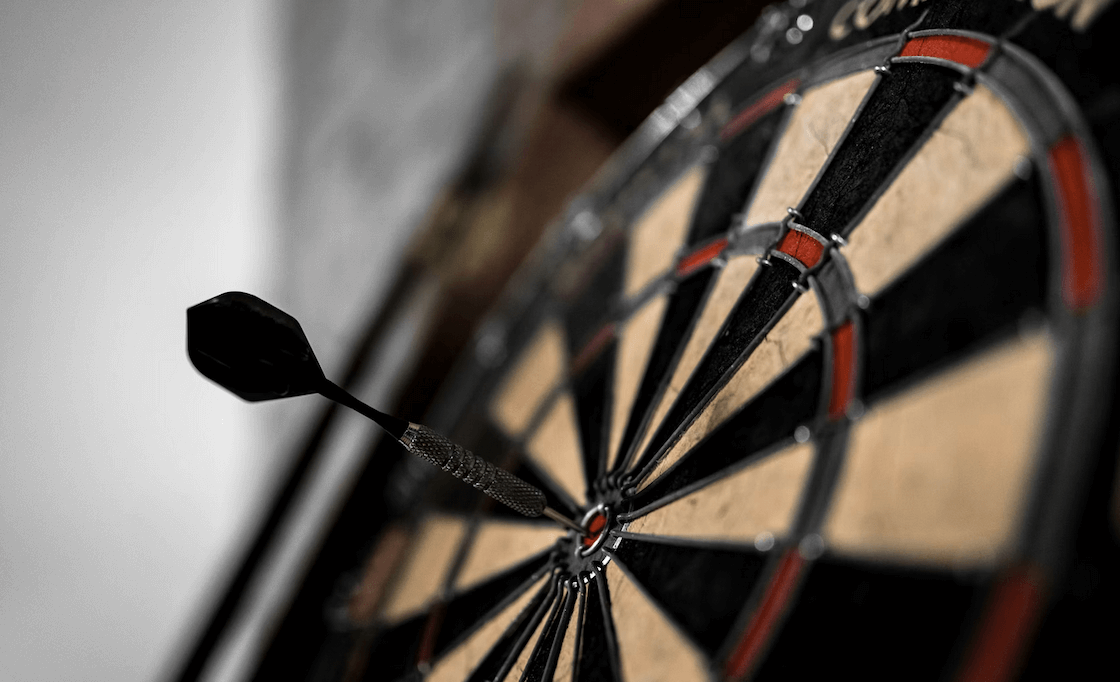
A round target of sisal bristle or perforated plastic, mounted with its bullseye 5 ft 8 in off the floor and thrown at from a fixed oche distance for regulation darts.
Also known as: Bristle DartboardSoft-Tip DartboardSisal Board
Tables, boards, and the gear that goes with them are in our decor and accessories guide.
Hang a round target of compressed sisal fiber or perforated plastic on the wall, split into twenty numbered wedges around a bullseye, and steel-tip or soft-tip darts finally have something official to aim at. In the bristle version, the wedges are cut from bundled sisal fibers packed tight enough that a dart parts the strands instead of tearing them, which is why a well-kept board shows almost no wear after thousands of throws. The electronic version swaps sisal for molded plastic segments studded with tiny holes; a spring-loaded plastic tip pushes into a hole, trips a sensor underneath, and the board's own display adds up the score without anyone keeping chalk marks on a side panel.
Getting the target and the layout right changes how a room plays, not just how it looks. A board mounted a few inches too high throws off every calculation a regular player has memorized over years of practice, and a wall with no backboard collects a stray triple-twenty within the first weekend of ownership. Cost tracks the gap between casual and competition-grade too: a mid-range regulation bristle board runs somewhere in the $60 to $90 band, entry-level boards sit under $30, and a full electronic cabinet with a built-in scorer and dozens of game modes can run from around $100 for a compact wall unit into the low hundreds for a full cabinet setup. Either one earns its keep fast in a room built around dart boards as a centerpiece rather than an afterthought, especially once a second board turns a quiet corner into a rotation for league nights.
What a dartboard is not is a casual decoration you can hang anywhere convenient, at whatever height clears the nearest shelf. The numbering, the ring widths, and the mounting height all trace back to competition rules set by darts governing bodies. Skip those rules and the scoring itself drifts away from how the game was designed to be played, quietly, one throw at a time. A board hung at the wrong height or thrown from the wrong distance no longer matches the game printed on the box, and league players will notice within the first round of a visit.
Reading a board: layout, materials, and what to shop for
A regulation bristle board measures roughly 450mm (about 17.75 inches) across the face, with a playing surface out to the double ring of around 340mm (13.4 inches). The wedges run clockwise from the top in the familiar 20-1-18-4-13-6-10-15-2-17-3-19-7-16-8-11-14-9-12-5 order, a sequence chosen so that a miss on a high number usually lands on a low one. Thin wire (or, on newer boards, molded rubber) separates each wedge and ring, and the whole face sits on a rotating mount so heavy wear near 20 can be spread around by turning the board a few degrees every so often.
Electronic boards trade that wire for perforated plastic panels, usually built around a 15.5 inch target face on standalone cabinets, with compact wall-mount units closer to 13.5 inches. Buyers should look at game-mode count (budget units offer roughly 30 to 40 built-in variants, higher-end units well over that, covering cricket, count-up, and dozens of scoring twists), player-count support, and whether the unit runs on batteries, a wall adapter, or both. A cabinet with fold-out doors also does double duty as a chalkboard-style scoreboard, which is worth comparing against a standalone scorekeeper if the board itself will not display running totals. Whichever style gets chosen, the mat or floor sticker that ships with it marks the darts oche line so nobody has to measure it out by hand every time the board comes off the wall.
Bristle versus electronic: not interchangeable hardware
The single rule that matters most: never throw steel-tip darts at an electronic board. Steel points punch through the plastic segments and destroy the sensors underneath, and there is no repair for that damage short of replacing the whole face. Bristle boards, by contrast, are built to take steel tips indefinitely, which is why every serious game room with a league player in it keeps a bristle board as the primary target.
The two also score differently in practice. A bristle board demands a human scorer or a chalkboard, and a close-in dart against a wire can bounce out and score nothing, which is part of why serious leagues stick with steel tips and sisal. An electronic board tallies automatically and forgives borderline hits inside a segment, which makes it friendlier for kids, parties, and anyone who has never kept a cricket score by hand. What it gives up is the exact feel and sound that steel-tip players expect, along with the self-healing sisal that keeps a bristle face flat for years, whatever arcade cabinet or shuffleboard table happens to share the wall next to it.
Where the standard board layout came from
The 20-at-the-top numbering that every modern board uses is commonly attributed to Brian Gamlin, a carpenter from Lancashire, England, said to have devised it in 1896 specifically to punish inaccurate throws by alternating high and low numbers around the ring. Darts historians have never turned up solid evidence that Gamlin existed, so treat the story as the trade's best-known legend rather than settled fact. What is documented is the sport's governance: the World Darts Federation formed in 1976 to standardize rules across countries, and in 1992 a group of top players split away to form what became the Professional Darts Corporation, taking its current name in 1997. Both bodies still set the numbers a serious buyer should mount to: bullseye height and oche distance, covered next.
Common mistakes: height, distance, and the wrong board for the game
The most common error is mounting height. Regulation play puts the bullseye at 5 feet 8 inches (1.73m) from the floor, the same figure under both WDF and PDC rules, and it applies to bristle and electronic boards alike. A board hung to match a doorway or a piece of furniture instead of a tape measure throws every regular's aim off by an inch or more.
The second is oche distance. Steel-tip play throws from 7 feet 9.25 inches (2.37m) from the board's face; soft-tip electronic play, under National Dart Association rules, moves the line back to 8 feet (2.44m). Copying a steel-tip mat measurement for an electronic setup, or the reverse, quietly changes the difficulty of every match.
The third is board choice for the game being played. Steel-tip darts on a plastic electronic face ruin the sensors in one throw, and soft-tip darts on a sisal board barely register a score because the tips are built for holes, not fiber. Match the dart to the board before the first throw, not after the first repair bill.
A fourth, smaller mistake is skipping the backboard or surround entirely. A missed triple-twenty travels fast, and drywall behind an unprotected board picks up pockmarks within a season of regular play. A round foam surround roughly two feet across, or a full cabinet that folds shut over the face, solves the problem for less than the cost of a single replacement board.
Frequently asked questions
What's the difference between a bristle dartboard and an electronic dartboard?
A bristle dartboard is a solid, self healing sisal fiber target built for steel tip darts, scored by eye or on a chalkboard. An electronic dartboard uses molded plastic segments with sensors behind them, hit with spring loaded plastic tips that trigger the board's own display to add up the score automatically. Steel tips will destroy an electronic board's segments and sensors, so the two are never interchangeable. Bristle boards suit serious steel tip players and leagues, while electronic boards suit casual play, parties, and households with kids.
How high should a dartboard be mounted?
Regulation height puts the bullseye at 5 feet 8 inches, or 1.73 meters, off the floor, measured to the center of the bull. That figure comes from WDF and PDC rules and applies to both steel tip bristle boards and soft tip electronic boards. Measuring from the floor with a tape, rather than eyeballing it against nearby furniture or a doorway, keeps scoring consistent with how the game is meant to play. Off by even an inch, everyone's aim quietly shifts over a season of regular games.
How far should the oche be from the dartboard?
Steel tip darts throw from 7 feet 9.25 inches, or 2.37 meters, measured from the face of the board to the toe line, a standard set by the World Darts Federation and matched by the PDC. Soft tip electronic darts move back slightly under National Dart Association rules, to 8 feet, or 2.44 meters, since lighter plastic tip darts fly a touch differently. Using the wrong distance for the dart type in play changes the difficulty of every match, so confirm which line applies before marking a permanent floor spot.
How much does a good dartboard cost?
A budget bristle board costs well under $30, while a mid range regulation board from a recognized brand typically runs $60 to $90, with premium tournament grade boards running higher still. Electronic dartboards start around $35 to $70 for a basic wall unit and climb toward $100 to $300 or more for a full cabinet with a built in scorer and dozens of game modes. Add a wall surround or a folding cabinet if the board goes up without a dedicated backstop, since that keeps repair costs off the budget entirely.
Can you throw steel tip darts at an electronic dartboard?
No. Steel tips puncture and permanently damage the plastic segments and the sensors underneath an electronic board, and there is no practical repair once that happens. Electronic boards are built exclusively for the plastic or soft tips that shipped with them, sized to trigger the sensor holes without piercing them. Households that want both steel tip league play and casual electronic scoring are better off with two separate boards, one for each dart type, rather than expecting a single board to do both jobs well.
Related terms
Darts Oche
Marks the exact spot a dart thrower's toe can't cross, set 7 ft 9.25 in from the board face under WDF rules, with a raised strip so players feel it without looking down.
Room Types & SpacesGame Room
A room built around active games such as pool, foosball, darts, and arcade cabinets, sized and laid out for group play rather than solo retreat.
Entertainment & GamesArcade Cabinet
A standing coin-op video game housing: wood body, marquee, control panel, monitor and game board, wired since 1985 to the 56-pin JAMMA standard that made boards interchangeable.
Entertainment & GamesPool Table
Six-pocket pocket billiards table sized 7, 8, or 9 feet, with a slate bed for tournament play. A standard 58 inch cue needs a room about 13 by 16 feet or larger, and slate tables start around $1,500.
Entertainment & GamesShuffleboard Table
A long, narrow hardwood table where players slide pucks into scoring zones. Regulation tables run 22 feet; home tables are usually 12 to 16 feet, needing 2 to 3 feet of side clearance.
Entertainment & GamesScorekeeper
The person, board, or app that records and displays points during a game, from a peg counter and dry-erase tally to a programmable LED scoreboard with a remote.