Marks the exact spot a dart thrower's toe can't cross, set 7 ft 9.25 in from the board face under WDF rules, with a raised strip so players feel it without looking down.
Also known as: Throw LineToe Line
Tables, boards, and the gear that goes with them are in our decor and accessories guide.
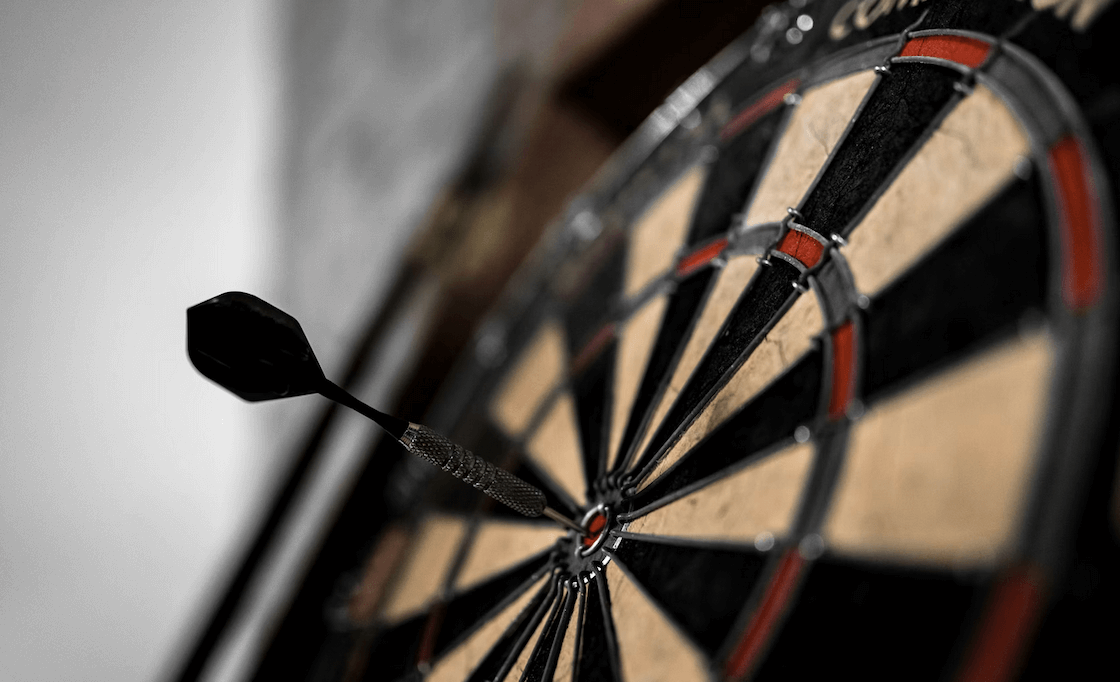
A darts oche marks the exact spot where a thrower's toe has to stay put: a raised strip or taped line running the width of the throwing area, set 7 ft 9.25 in (2.37 m) out from the face of the dartboard. The World Darts Federation specifies a physical marker 38 mm high and 610 mm long, tall enough to feel underfoot without glancing down mid-throw. Home setups often swap that raised strip for a length of gaffer tape or a printed line on a rubber dart mat, which works fine casually but loses the tactile edge serious players lean on to keep their stance honest.
Get the distance wrong and every throw changes difficulty without anyone noticing why. Move the oche a foot closer and even a mediocre player starts clustering tight groups near the treble twenty; push it out and league-standard doubles turn frustrating fast. Competitive integrity aside, the practical cost shows up at build time: a home dartboard setup needs roughly 9 to 12 feet of uninterrupted floor length once backswing clearance behind the throw line gets added in, which rules out plenty of finished game rooms before a single dart gets thrown. Most dartboard buying guides recommend confirming this measurement before you hang anything.
The oche is not the board height marker, a separate spec that puts the bullseye center at 5 ft 8 in off the floor, and mixing the two up is a common setup error. It is also not interchangeable with “hockey,” the word’s own predecessor, still printed in older rulebooks. Modern references use “oche,” “throw line,” and “toe line” more or less interchangeably, though only one of those carries the regulation weight behind it, a distinction the next section untangles.
Measuring and marking the oche correctly
The regulation reference point is a plumb line dropped straight down from the dartboard's face to the floor, not a diagonal measured to the bullseye and not a straight line from the wall behind the board. Hang the board first, at bullseye height of 5 ft 8 in (1.73 m) off the floor, then drop a plumb line or use a laser level to find the exact floor point directly below the board's face. From that point, measure 7 ft 9.25 in (2.37 m) along the floor and mark it. A standard 25-foot tape measure covers the whole job without needing to piece two measurements together.
For the marker itself, WDF rules call for a raised strip 38 mm high and 610 mm long, wide enough to run across a standing thrower's stance and tall enough to register underfoot. Standalone rubber or wood oche strips are sold separately, and most all-in-one dart mats build the raised edge into the mat so the distance is fixed the moment the mat gets unrolled onto a level floor. A taped or painted line skips the raised profile but still needs to sit at the same 2.37 m mark to count as regulation. Whatever material gets used, the line should run the full width of the throwing lane so it stays visible from a standing position, not just directly underfoot, and thick carpet pile can throw off a raised strip's effective height enough to matter in a close league match.
Oche, throw line, toe line: the terminology
Ask three darts players what to call the line and all three answers can be correct. “Oche,” “throw line,” and “toe line” describe the identical regulation marker and get used interchangeably in current rulebooks and casual conversation alike. The one name that has genuinely fallen out of use is “hockey,” which is what British rulebooks and brochures called the marker as recently as 1981, before “oche” became the standard spelling.
That switch matters for anyone reading older darts literature or restoring a vintage pub setup. A 1970s rulebook referencing the “hockey line” describes the identical spot a modern rulebook calls the oche, not a separate or looser standard. The regulation distance behind the name has stayed put since 1977. What changed afterward was the spelling, and the pronunciation drifting into today’s “ockey.” “Toe line” alone is not exclusive to darts, since other games and track sports use the same generic phrase for whatever mark a competitor’s foot cannot cross, so context still matters when the word shows up without “darts” or “oche” nearby.
Where the word came from
Nobody agrees on where “oche” comes from, and darts historians have spent decades chasing it without landing on a conclusive answer. Candidate origins include the Old French ochier, meaning “to notch,” a dialect word “hockle” tied to spitting on a pub floor to mark a throwing spot, and Victorian slang linking “hock” to the foot. One popular story, that the name traces to a brewery called S. Hockey & Sons and the beer crates its bottles shipped in, has been directly debunked: no such brewery ever existed.
The distance itself has a cleaner paper trail. The World Darts Federation set the current 2.37 m standard at a December 1977 meeting in Wembley, splitting the difference between two competing house rules: the National Darts Association of Great Britain's older 7 ft 6 in line and the longer 8 ft distance used in the News of the World's national tournament. Every regulation oche measured since traces back to that 1977 compromise.
Common mistakes
Three errors account for most home oche complaints, and all three are avoidable with a tape measure.
Measuring from the wrong point tops the list. The regulation distance runs from a plumb line dropped from the dartboard's face, not from the bullseye on a diagonal. Skipping the plumb line and eyeballing the diagonal instead typically shrinks the real throwing distance by several inches, which is enough to make casual games feel suspiciously easy.
Ignoring board height while fixing the oche is the second. The two specs work as a pair: bullseye center at 5 ft 8 in and oche at 7 ft 9.25 in. Hang the board too high or too low and the throwing angle changes even with a perfectly measured oche, so players end up nudging the line forward or back until it “feels right,” which defeats the point of a regulation setup in the first place.
Skipping clearance behind the line rounds out the list. The oche marks where a thrower's toe stops, not where their body stops, and backswing needs room behind that mark. Installers who measure only the 7 ft 9.25 in to the board and stop there often end up with a throwing line six inches from a wall, a bar cart, or a cue rack hung too close to the lane. Budgeting closer to 9 to 12 feet of total floor length, board face to back wall, heads that off before the drywall goes up, and it is one of the first things worth checking in any man cave game corner.
Frequently asked questions
What is a darts oche?
The oche is the line a dart thrower's toe cannot cross while throwing, positioned 7 ft 9.25 in (2.37 m) horizontally from the face of the dartboard under World Darts Federation rules. It is usually a raised strip about 1.5 inches tall and two feet long, though home setups often use gaffer tape or a printed dart mat instead. The regulation distance has stayed fixed since 1977, so a correctly measured oche is the same whether it sits in a pub, a league hall, or a finished basement.
What's the difference between an oche and a toe line?
Nothing meaningful. Oche, throw line, and toe line all describe the same regulation marker, and darts players use the three names interchangeably today. The older name was hockey, printed in British rulebooks and brochures into the early 1980s before oche became the standard spelling. If you are reading an older darts source and see hockey line, it is describing the identical 7 ft 9.25 in mark, not a separate or looser distance.
How much room do I need for a regulation dartboard and oche?
Plan on roughly 9 to 12 feet of uninterrupted floor length from the board's wall to the wall behind the throwing line, which covers the 7 ft 9.25 in regulation distance plus backswing and walkway clearance. Width matters too: aim for at least 5 to 6 feet so a thrower's arm has room on both sides. These figures come from dartboard retailers and installers rather than WDF or PDC rulebooks, which specify the oche distance itself but not a minimum room size.
How do I measure the oche distance correctly?
Hang the dartboard first, with the bullseye center at 5 ft 8 in off the floor. Drop a plumb line or use a laser level from the board's face straight down to the floor, and mark that point. From there, measure 7 ft 9.25 in horizontally along the floor and mark the oche. Measuring diagonally to the bullseye instead of using the plumb line point is the most common error, and it shortens the real throwing distance without anyone noticing.
Can I just tape a line on the floor instead of buying a raised oche?
Yes, and plenty of casual setups do exactly that. A taped or painted line at the correct 7 ft 9.25 in distance is just as valid for scoring as a raised strip, since the rule governs distance, not material. What a flat tape line loses is the tactile cue: a raised strip lets players feel the edge underfoot and hold their stance without glancing down mid-throw, which matters more in fast league play than in a casual basement game.
Related terms
Dartboard (Electronic / Bristle)
A round target of sisal bristle or perforated plastic, mounted with its bullseye 5 ft 8 in off the floor and thrown at from a fixed oche distance for regulation darts.
Entertainment & GamesCue Rack
A wall-mounted or floor-standing wood rack that holds pool cues upright in tapered clips, keeping shafts off the felt and clear of the swing radius between shots.
Entertainment & GamesPool Table
Six-pocket pocket billiards table sized 7, 8, or 9 feet, with a slate bed for tournament play. A standard 58 inch cue needs a room about 13 by 16 feet or larger, and slate tables start around $1,500.
Entertainment & GamesBilliards
The umbrella term for cue sports, and specifically the pocketless carom game on a 10 foot table. In everyday American usage it usually just means pool.
Room Types & SpacesGame Room
A room built around active games such as pool, foosball, darts, and arcade cabinets, sized and laid out for group play rather than solo retreat.
Room Types & SpacesMan Cave
A room set aside for one person's hobbies and entertainment, typically a home bar, game room, theater, or all three. The term dates to a 1992 Toronto Star column.