The umbrella term for cue sports, and specifically the pocketless carom game on a 10 foot table. In everyday American usage it usually just means pool.
Also known as: Cue SportsCarom BilliardsPocket Billiards
Tables, boards, and the gear that goes with them are in our decor and accessories guide.
Billiards is a word doing three jobs at once, which is why buyers get confused before they have measured anything. Strictly it is the umbrella term for every cue sport played with balls on a cloth covered table, so pool, snooker and carom all sit under it. More narrowly it names carom billiards, the pocketless three ball game played on a 10 by 5 foot heated table and governed by the Union Mondiale de Billard. In everyday American speech it is simply a slightly formal word for pool, and when somebody says they want a billiards table in the basement they almost always mean a six pocket pool table in 7, 8 or 9 foot form.
The distinction carries a cost, because the three games need very different rooms. A regulation 9 foot pool table has a 50 by 100 inch playing surface and wants around 14 by 18 feet of floor with a standard 58 inch cue. Snooker is fixed at 12 by 6 feet overall and needs closer to 16 and a half by 22 and a half. A carom table has no pockets at all, runs 10 feet long, and is usually heated a few degrees above room temperature to keep the cloth fast and the roll consistent. Ordering the wrong one is not a preference problem, it is a demolition problem.
What billiards is not, in any of its three senses, is a game you can fit by floor area alone. Square footage tells you almost nothing on its own. Cue clearance on all four rails is the real constraint, and a room that is generous in one direction and eight inches short in the other will play badly for as long as you own it.
The room maths, and what to do when you are short
Three table sizes cover almost every home install. The 7 foot bar box has a 39 by 78 inch playing surface, the 8 foot has 44 by 88, the oversized pro 8 has 46 by 92, and the 9 foot tournament table has 50 by 100. Playing area is always twice as long as it is wide, measured cushion nose to cushion nose, and the BCA and WPA put table height between 29 and a quarter and 31 inches from floor to cloth.
The room requirement follows one formula: table dimension plus twice the cue length, in each direction. The Brunswick chart works out at roughly 13 by 16 feet for a 7 foot table with a 58 inch cue, 13 by 17 for an 8 foot, and 14 by 18 for a 9 foot. Drop to a 52 inch cue and those numbers fall by about a foot each way, and a 48 inch cue buys another six inches. Running your actual clear rectangle through a room size calculator before you shop saves a lot of grief.
Under the cloth, slate thickness runs three quarters of an inch on budget 7 foot tables, one inch as the serious standard, and an inch and a quarter on premium builds. BCA tournament setup requires three piece one inch slate. The weight is what people forget: an assembled 8 foot slate table lands somewhere between 600 and 800 pounds, with the slate alone accounting for 375 to 510 of that, all concentrated on a small footprint against residential floors typically designed around 40 pounds per square foot of live load.
Lighting is the last spec, and it wants roughly 50 to 75 footcandles across the bed and the rails, from a movable fixture hung somewhere around 32 to 40 inches above the cloth.
Billiards, pool and snooker are not interchangeable
Pockets are the fastest tell. Pool and snooker tables have six of them; a carom billiards table has none, and the whole game is caroming the cue ball off two object balls.
Ball size follows the same split. Pool balls are 2 and a quarter inches, snooker balls 52.5 millimetres, carom balls 61.5 millimetres, with cue tips scaling to roughly 12 to 13, 9 to 10, and 11 to 12 millimetres respectively. Governance divides the same way: the WPA runs pool, the WPBSA and IBSF run snooker and English billiards, the UMB runs carom, and the World Confederation of Billiard Sports sits above all of them as the body the IOC recognises.
For a buyer the rule is short. If a listing says billiards table, look at the pockets and the length. Ten feet with no pockets is a carom table, which needs a bigger room, different balls, different cues and often a heated bed. Twelve feet is snooker, a beautiful thing and a serious commitment, and the craft involved is worth reading about in this piece on how artisanal snooker tables are built. Anything from 7 to 9 feet with six pockets is the game most American buyers actually want.
Lawn game, mace, slate and celluloid
Billiards started outdoors as a fifteenth century lawn game and moved inside onto a cloth covered table meant to stand in for grass, which is why the cloth is traditionally green. The name is French, from either billart, the wooden mace players originally pushed the ball with, or bille, meaning ball. The earliest documented indoor table appears in a 1470 inventory belonging to Louis XI of France, a story repeated everywhere and sourced mostly to popular histories rather than the archive itself.
The modern game arrived through a run of nineteenth century upgrades. François Mingaud fitted leather to a cue tip around 1807 and discovered spin. John Thurston introduced slate beds in 1826 to stop wooden tops warping, then patented vulcanised rubber cushions in 1845, six years after Goodyear published his discovery. In 1863 the New York supply firm Phelan and Collender offered a prize for a substitute for elephant ivory, and John Wesley Hyatt patented celluloid balls in 1869.
Where home installs go wrong
Buying by floor area is the classic error. A 15 by 20 foot room sounds ample and still fails if a support column or a door swing eats the cue line on one rail. Measure the genuine clear rectangle, apply the formula, then be honest about whether you will happily reach for the short cue on every third shot.
Ignoring the ceiling is second. A fixture wants 32 to 40 inches above the cloth to light the bed evenly, which is awkward under 7 foot basement joists and worse if ductwork crosses one end of the room. Plan the light before the table rather than after it.
Third is putting slate on a floor that was never asked to hold it. Six to eight hundred pounds on an upstairs floor, or across an old joist span, is a structural question rather than a furniture question. Three piece slate spreads the load and gets around a stairwell; one piece slate does neither.
Fourth is the basement itself, where damp is what actually kills tables. MDF and slatron beds swell, cloth slows down, and slate seams creep. Hold the room near 50 to 55 percent relative humidity with a dehumidifier and insist on real slate below grade. If the space is genuinely tight, angling a table into the corner is a real option, and this corner pool table roundup covers what changes when you do that in a small game room.
Frequently asked questions
What is the difference between billiards and pool?
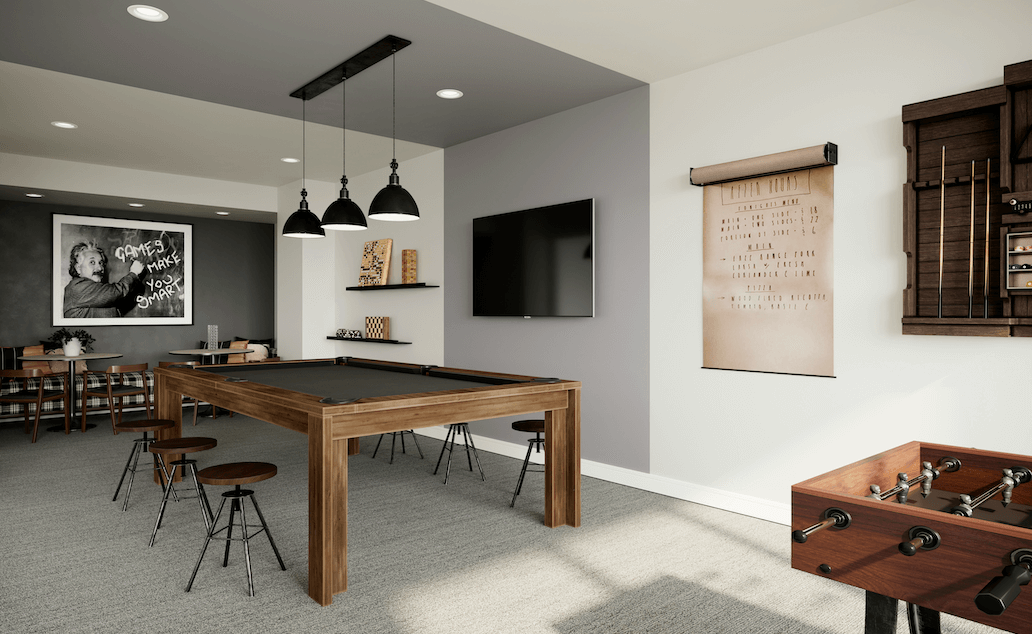
In American usage they are usually the same thing, with billiards being the slightly more formal word. Strictly, billiards is the umbrella term for all cue sports and also the specific name of carom billiards, a three ball game played on a 10 foot table with no pockets at all. Pool means pocket billiards on a six pocket table between 7 and 9 feet. If the table in the photograph has pockets, it is a pool table.
What size room do I need for a pool table?
Take the playing dimensions, add twice your cue length in each direction, and that is the minimum. With a standard 58 inch cue that works out around 13 by 16 feet for a 7 foot table, 13 by 17 for an 8 foot, and 14 by 18 for a 9 foot. Shorter cues buy room back: 52 inch cues save roughly a foot each way and 48 inch cues save a little more, at the cost of comfort on long shots.
How thick should pool table slate be?
Three quarters of an inch appears on budget 7 foot tables and is adequate for casual play. One inch is the serious standard and what BCA tournament setup requires, in three pieces rather than one. An inch and a quarter shows up on premium tables and adds mass more than accuracy. Below all of that, tables with MDF or slatron beds are not slate at all, and in a basement they swell with humidity and go out of level within a few seasons.
Can I put a pool table in a basement or upstairs?
A basement is usually fine structurally, and the real enemy there is damp. Hold the room around 50 to 55 percent relative humidity or the cloth slows, the cabinet swells and slate seams move. Upstairs is a structural question instead: an assembled 8 foot table runs 600 to 800 pounds on a small footprint, against floors typically designed for 40 pounds per square foot. Three piece slate spreads that load and gets around a stairwell. If you are still unsure, a structural engineer’s assessment costs a few hundred dollars and settles the question before the table moves in.
How high should the light over a pool table hang?
Around 32 to 40 inches above the cloth for a movable domestic fixture, which keeps the shade above head height on a standing shot while still lighting the bed evenly. Aim for roughly 50 to 75 footcandles across the whole playing surface and the rails, not just the centre. Published guidance varies by source, so treat those figures as a band rather than a rule, and check the fixture clears a raised cue.
Related terms
Pool Table
Six-pocket pocket billiards table sized 7, 8, or 9 feet, with a slate bed for tournament play. A standard 58 inch cue needs a room about 13 by 16 feet or larger, and slate tables start around $1,500.
Room Types & SpacesGame Room
A room built around active games such as pool, foosball, darts, and arcade cabinets, sized and laid out for group play rather than solo retreat.
Entertainment & GamesCue Rack
A wall-mounted or floor-standing wood rack that holds pool cues upright in tapered clips, keeping shafts off the felt and clear of the swing radius between shots.
Entertainment & GamesChalk Holder
A pocket, belt-clip, or magnetic accessory that keeps billiard chalk within reach during play. It prevents lost chalk and fits the shape of the chalk you use.
Entertainment & GamesShuffleboard Table
A long, narrow hardwood table where players slide pucks into scoring zones. Regulation tables run 22 feet; home tables are usually 12 to 16 feet, needing 2 to 3 feet of side clearance.
Entertainment & GamesDartboard (Electronic / Bristle)
A round target of sisal bristle or perforated plastic, mounted with its bullseye 5 ft 8 in off the floor and thrown at from a fixed oche distance for regulation darts.
Building & ConstructionDehumidifier
A compressor or desiccant appliance that pulls water vapor out of basement air, keeping relative humidity in the 30-50% range that resists mold, musty odors and warped gear.