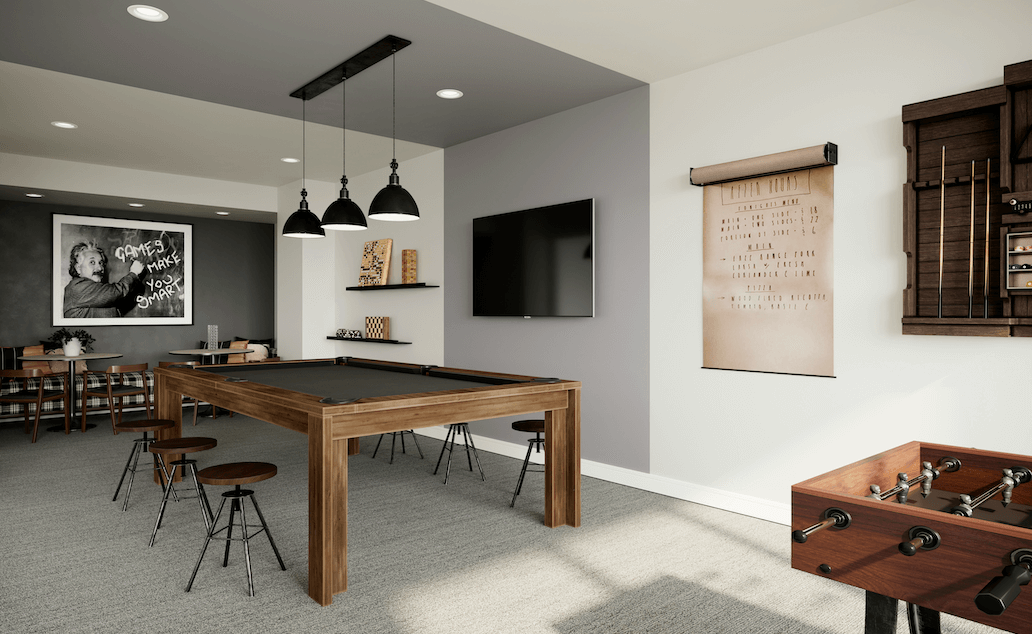
A blower-fed table that floats a polycarbonate puck on a film of air above a perforated laminate playfield. Sanctioned play happens on the 8 ft size.
Tables, boards, and the gear that goes with them are in our decor and accessories guide.
An air hockey table is a sealed air box with a blower bolted underneath. The motor pushes air up through hundreds of pinholes drilled across a laminate playfield, and the puck rides on that film rather than dragging across the surface, which is why a flick of the wrist sends it the length of the table and back. Raised rails keep the puck in play, a goal is cut into each end, and a return channel feeds the puck back to whoever just conceded. A commercial table such as the Dynamo Pro Style 8 ft carries a 93 by 45 in playfield inside a 99.5 by 51.5 in cabinet, stands 31 in tall and weighs 435 lb, which tells you most of what you need to know about where one can realistically live.
Blower output is the number that separates a table still in use in year three from one that ends up folded against a wall. Gold Standard Games fits a 210 CFM motor to its Home Pro Elite and a 350 CFM motor to the Tournament Pro, and that airflow is what keeps the puck floating out at the corners instead of skidding once it leaves the middle. Floor space is the other constraint people underestimate. Leave roughly 3 ft of clear floor down each side and about 5 ft behind each goal, which puts a full 8 ft table in a room of about 14 by 9 ft before a single stool goes in, and keep the ceiling clear, because pucks do leave the surface. Run those numbers through the room size calculator before you buy rather than after delivery.
The flat-pack table at the $200 mark is a related but different object. It runs a small fan into a thin MDF deck, uses moulded plastic rails that dent on the first hard rebound, and loses airflow within a season as dust packs the holes. Set it beside the tables in a roundup of game tables and arcade machines and the gap sits in the substrate and the motor, not in the graphics.
What the blower decides
Airflow does the work, so read the CFM figure before anything else. The 200 to 350 CFM band is commercial territory: Gold Standard Games publishes 210 CFM for its home table and 350 CFM for the tournament model, and Performance Games ships its Tradewind with a 210 CFM commercial motor plus a quieting package. Below that band the puck floats in the centre and dies in the corners, which is exactly where most shots end up.
The playfield is the second thing to check. High pressure laminate bonded to a stable core survives a basement, while bare or thinly coated MDF swells at the seams once humidity climbs, and a swollen playfield cannot be flattened, only replaced. Aluminium rails, 3-1/8 in deep on the Dynamo Pro Style, absorb rebounds without the denting that moulded plastic picks up. Look past the surface for leg levelers you can actually reach, since a table sitting out of level sends the puck drifting on its own, and for optical goal sensors feeding an electronic scoreboard, which is the part that gets used every single game.
Pucks and mallets are consumables and worth buying to tournament spec even at home. USAA rules cap a mallet at 6 oz and under 4-1/16 in across, and approved pucks are Lexan, which chips far less than the soft discs bundled with budget tables. A nicked puck edge breaks the air seal, and the float goes with it.
Air hockey against a shuffleboard table
One is a reflex game in a compact footprint, the other is a touch game that eats a wall. A regulation 8 ft air hockey table occupies roughly 8 by 4 ft of floor, while a shuffleboard table starts near 9 ft and runs to 22 ft, and the long ones need clear standing room at both ends on top of that.
Noise and tempo separate them inside a room. Air hockey pairs a constant blower hum with the crack of a puck off aluminium rails, so it makes a poor neighbour for anyone trying to watch a film in the same open basement, whereas shuffleboard is close to silent and reads as a bar game rather than a contest. The skill curves diverge as well. Air hockey rewards reaction time and hand speed, which is why a ten year old beats an adult inside a week, while shuffleboard rewards weight control and rewards it slowly.
At the top of the market the prices converge, which surprises people. A commercial Dynamo Pro Style lists near $6,795, putting it in the same bracket as a premium bubble hockey cabinet at $4,295 to $8,295. If the game room has one long free wall and adults who like a slow game, shuffleboard earns that wall. If it has a free middle and children in the house, the air table wins.
From a Brunswick workshop to a Houston bowling centre
The game came out of Brunswick Billiards. Engineers Phil Crossman, Bob Kenrick and Brad Baldwin started work on a frictionless playing surface in 1969, the project stalled, and engineer Bob Lemieux later finished it as an abstracted hockey game with a floating puck and photodetector goals. Brunswick patented and released the table in 1972.
Competition organised itself almost immediately. Houston players formed an air hockey association in 1973, which grew into a Texas-wide body, and the first national championship run by the United States Air-Table Hockey Association took place on 24 and 25 June 1978 at a Fair Lanes bowling centre in Houston with around 40 entrants. Jesse Douty won six straight world titles from 1978 to 1983, and Tim Weissman took seven between 1989 and 1993.
The rules have barely moved since. Matches run to 7 points, a player has 7 seconds to take a shot and 10 seconds of possession after conceding, and only 8 ft tables are approved for sanctioned play. A rival body, the Air Hockey Players Association, formed in March 2015, and Houston hosted the world championships again in August 2023.
Where home tables go wrong
Clogged air holes are the failure everyone meets first. Dust and skin oil pack the pinholes, the puck starts hunting and stalling, and the owner blames the motor. Run the blower, then clear each hole with a stickpin, a toothpick or a 1/32 in bit turned by hand. Keep powered drills away from the playfield, because a bit that wanders enlarges the hole and that leak is permanent.
The second mistake is where the table lives. An MDF-cored playfield in an unconditioned garage or a damp basement swells along the seams, and once the surface stops being flat the puck rides high on one side and drags on the other. No home fix exists beyond replacing the surface, so treat humidity as part of the purchase price: a dehumidifier holding the room between 45 and 55 percent costs a fraction of a new playfield.
The third is skipping setup. Almost every table ships with leg levelers, almost nobody touches them, and a table sitting a quarter inch low at one end pulls the puck there through every rally. Put a puck at centre court with the blower running and adjust until it stays put. While you are down there, check that the blower intake is not pressed against a wall or a rug, since a starved intake looks exactly like a dying motor.
Frequently asked questions
What size air hockey table should I buy for a home game room?
Eight feet is the only size approved for sanctioned play, and it is the size that plays like the ones in arcades, with a 93 by 45 in playfield on a typical commercial cabinet. Seven and 7.5 ft tables suit most family rooms and still play well. Anything under 6 ft is a children’s table: the puck reaches the far rail too fast for rallies to develop, and adults lose interest within a few weeks.
How much room do you need around an air hockey table?
Plan for roughly 3 ft of clear floor along each side and about 5 ft behind each goal, since players back off the table to defend. For a full 8 ft table that works out to a room of about 14 by 9 ft with nothing else in it. Ceiling height matters too, because pucks lift off the surface on hard shots, so a low basement with ductwork over the play area will collect dents.
Why is my air hockey table not blowing air properly?
Clogged pinholes cause it far more often than a failed motor. Dust and skin oil pack the perforations until the puck floats in the centre and stalls at the corners. Run the blower and clear each hole with a stickpin, a toothpick or a 1/32 in drill bit turned by hand, never a powered drill, which enlarges the holes permanently. If airflow is still weak, check that the intake underneath is not blocked by a rug or a wall.
Is an expensive air hockey table worth it?
It depends on how often it gets played. The difference between a $300 table and a $2,000 one sits in three places: blower output, playfield material and rail construction. Commercial motors move 210 to 350 CFM against a fraction of that on budget tables, high pressure laminate on a stable core resists the humidity swelling that ruins MDF decks, and aluminium rails take rebounds that dent plastic. For weekly play, the cheap table becomes unusable long before the expensive one shows wear.
Can an air hockey table go in a garage or an unheated basement?
Not safely, unless the space is climate controlled. The playfield core on most tables is MDF or particleboard, and it swells at the seams once humidity climbs, which leaves the surface uneven and the puck riding high on one side. That damage cannot be reversed at home, only replaced. If the table has to live in a garage, run a dehumidifier and keep the space between 45 and 55 percent relative humidity year round.
Related terms
Shuffleboard Table
A long, narrow hardwood table where players slide pucks into scoring zones. Regulation tables run 22 feet; home tables are usually 12 to 16 feet, needing 2 to 3 feet of side clearance.
Entertainment & GamesFoosball Table
An eight-rod cabinet with 22 miniature players that turns tabletop soccer into a fast, two-to-four-player game built around a roughly four-foot playing surface and telescopic or through rods.
Entertainment & GamesPool Table
Six-pocket pocket billiards table sized 7, 8, or 9 feet, with a slate bed for tournament play. A standard 58 inch cue needs a room about 13 by 16 feet or larger, and slate tables start around $1,500.
Entertainment & GamesArcade Cabinet
A standing coin-op video game housing: wood body, marquee, control panel, monitor and game board, wired since 1985 to the 56-pin JAMMA standard that made boards interchangeable.
Entertainment & GamesPinball Machine
A coin-op arcade game where a steel ball ricochets off bumpers and targets across a sloped playfield, kept in play by flippers. Full-size machines run 28 by 55 inches and weigh 250 to 300 pounds.
Room Types & SpacesGame Room
A room built around active games such as pool, foosball, darts, and arcade cabinets, sized and laid out for group play rather than solo retreat.
Building & ConstructionDehumidifier
A compressor or desiccant appliance that pulls water vapor out of basement air, keeping relative humidity in the 30-50% range that resists mold, musty odors and warped gear.