A wall coated with matte chalkboard paint that turns a prepared surface into a writable, erasable blackboard. Used for menus, scoring, and pub-style character in home bars and game rooms.
Also known as: Chalk WallBlackboard Wall
Picks and buying advice for this are in our decor and accessories guide.
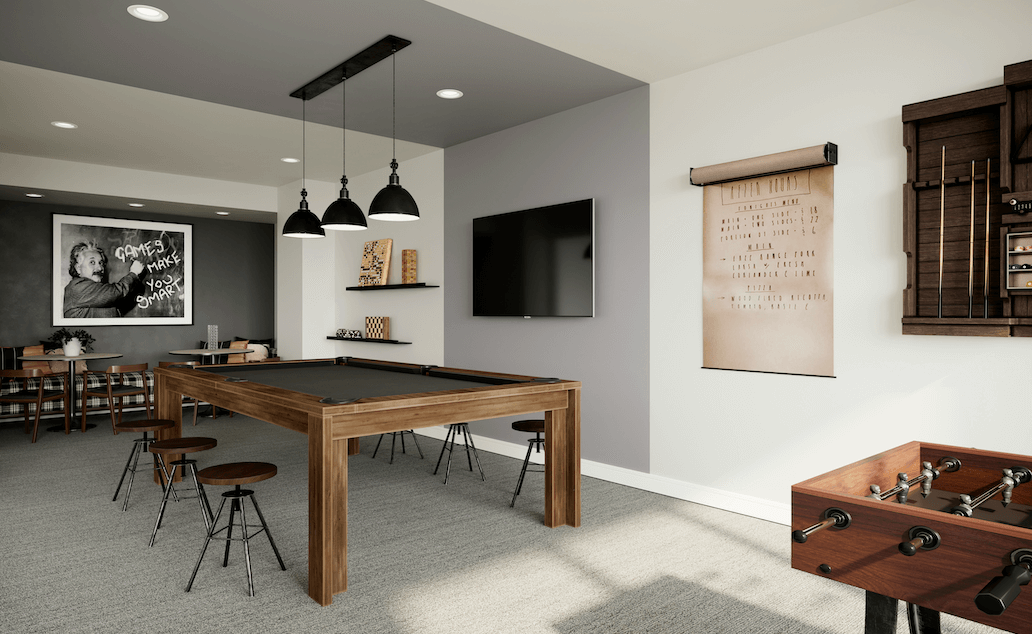
A chalkboard wall is a vertical plane coated in a matte-finish paint formulated with high-solids acrylic resin and a hard flatting agent, usually calcium carbonate or talcum powder, that produces a surface rough enough to catch chalk dust and smooth enough to erase it cleanly. The paint goes on a prepared wall exactly like normal latex, dries to a slate-like finish, and turns the wall into something a classroom had for a century and a restaurant drinks special board has used for decades. In a man cave the chalkboard wall lives behind the bar, beside the dartboard, or on the wall opposite the screen, and it does what a whiteboard cannot: it looks like it belongs in a pub. The matte black or deep green surface absorbs light instead of throwing it back, which makes the room read as intentional rather than office-like. A pub-style man cave with a chalkboard wall listing the taps and the house rules is a pub. The same room with a glossy whiteboard is a conference room with a pool table.
The chalkboard wall carries a cost profile that sits inside almost any planning budget. A gallon of chalkboard paint runs $18 to $60 and covers 40 to 80 square feet per coat depending on wall porosity. For a standard 100-square-foot wall, materials including primer and a roller kit total $50 to $120. Professional labour adds $1.25 to $4.00 per square foot, which puts a turnkey 100-square-foot install at $200 to $520. The deciding factor is the wall surface: smooth drywall falls at the low end, and textured plaster or a previously painted glossy wall that needs aggressive sanding and priming pushes the cost to the high end. A low-lustre polyurethane topcoat or a dedicated chalkboard sealer adds $20 to $60 per gallon in materials and extends the surface life from months to years for walls that see heavy use.
A chalkboard wall is not a whiteboard wall, and the choice between the two is aesthetic before it is practical. Chalk creates dust that settles on the floor and nearby furniture, and the writing surface requires seasoning before first use. Rubbing a full stick of chalk across the entire wall and erasing it prevents the first marks from ghosting permanently into the paint. A whiteboard wall erases with a dry cloth, produces no dust, and needs no seasoning. But a whiteboard wall looks like a classroom inventory list, and in a room designed around wood, leather, and low light, a chalkboard wall looks like it has been there since the place opened. Like an accent wall, it defines the visual focus of the room, but unlike a painted accent wall it earns its place by functioning as well as decorating.
Surface prep, application, and making it last
The paint is only as good as the wall underneath it. Every bump, ridge, divot, and roller stipple telegraphs through the finish, and chalk catches on every imperfection and leaves a streak that will not erase. The correct prep is a smooth skim coat followed by sanding with 220-grit paper to a finish that feels like the back of a sheet of copy paper. Prime the wall with a high-quality latex primer tinted to match the final chalkboard colour, which prevents the substrate from showing through the thin matte finish. Apply chalkboard paint with a dense-foam or short-nap microfiber roller to avoid the orange-peel texture that a standard nap leaves. Two coats is the minimum for an opaque writable surface, and three coats on a porous wall produces the smoothest finish. The paint cures fully in 72 hours at room temperature and average humidity, and no chalk should touch the surface before the cure is complete.
Seasoning is the step that skip-shows sell. Before any writing goes on the wall, rub a full stick of white chalk across the entire surface on its side, covering every square inch. Then erase it with a standard felt eraser or a clean dry cloth. This fills the microscopic pits in the paint with chalk dust and creates a release layer between the paint and the first real marks. A wall that is not seasoned will trap the first drawings and words in the paint, and they will remain as pale ghosts no matter how many times the wall is erased afterward.
Chalkboard wall vs. whiteboard wall
The chalkboard wall chooses texture over speed. It requires chalk, an eraser, and a few seconds of cleanup every time the message changes, and the chalk dust collects on the baseboard and the floor beneath the wall. The whiteboard wall uses a dry-erase marker that writes instantly, erases without dust, and stays legible from across a room longer than chalk does because the contrast ratio of black marker on white is higher than white chalk on black. But the whiteboard wall reflects light, and a bar or game room under dim, warm lighting at 2,700 to 3,000 kelvin turns a glossy white surface into a glare source that fights the mood. The chalkboard wall absorbs light and deepens the room\u2019s colour palette, which means the wall itself contributes to the atmosphere even when nothing is written on it. The choice is functional when the room behaves like a classroom and decorative when the room behaves like a pub. For a man cave, the chalkboard wall wins on atmosphere alone.
Where the term came from
Chalkboard paint traces to the late 19th century, when schools needed to refurbish worn slate blackboards without replacing the heavy slabs of quarried stone. The first documented use of wall paint specifically formulated as a chalkboard surface appeared in a Chicago classroom in 1883, predating the widespread adoption of green porcelain-enamel chalkboards by nearly fifty years. The term \u201Cblackboard\u201D appears in English as early as 1739 in the Oxford English Dictionary citation \u201Cwith Chalk on a black-Board,\u201D and the first American classroom use of a chalkboard dates to George Baron\u2019s mathematics lecture at West Point on September 21, 1801. Slate blackboards, quarried from deposits in Pennsylvania, Vermont, and New York, became standard classroom equipment by the 1840s. Green porcelain enamel replaced slate in the 1930s because the lighter colour reduced glare, and the word \u201Cchalkboard\u201D entered common use to describe the new green surface. The consumer chalkboard paint product, sold in quart and gallon cans for home use, emerged with the home-improvement retail boom of the 1970s and 1980s, when brands like Rust-Oleum and Krylon brought specialty coatings to the hardware store shelf.
Common mistakes
The first mistake is skipping the skim coat. Chalkboard paint cannot hide surface defects; it magnifies them. A wall that looked smooth under eggshell latex will show every seam, screw dimple, and roller ridge under the matte chalkboard finish. Fix the wall first, then paint. The paint is the last step, not the correction layer.
The second mistake is writing on an unseasoned wall. The first words drawn on bare chalkboard paint sink into the surface and become permanent ghosts. The seasoning step with a full stick of chalk and a thorough erasing takes three minutes and prevents the wall from looking like a crime scene where someone tried to erase the evidence.
The third mistake is cleaning the wall with a wet cloth between uses. Chalkboard paint is not slate, and water lifts the surface binder and creates shiny patches that reject chalk. Dry-erase only, with a felt eraser or a dry microfiber cloth. If the wall develops a haze after months of use, wipe it with a cloth barely dampened in water and a drop of mild dish soap, dry it immediately, and re-season it before writing again.
Frequently asked questions
What is a chalkboard wall and how does it work?
A chalkboard wall is a section of wall painted with a special matte-finish paint containing a hard flatting agent that produces a surface rough enough to hold chalk and smooth enough to erase. You season the dried paint by rubbing a full stick of chalk across it and erasing it, which fills the microscopic pores with dust and prevents the first real marks from becoming permanent. After seasoning, the wall accepts standard chalk, chalk markers, or liquid chalk pens, and it erases with a felt eraser or dry cloth. The surface holds up for months to years depending on use and whether a protective topcoat was applied.
How much does it cost to install a chalkboard wall?
For a 100-square-foot wall, materials including chalkboard paint, primer, and a roller kit cost $50 to $120. Professional labour adds $1.25 to $4.00 per square foot, which puts a full install at $200 to $520 depending on region. Smooth drywall lands at the low end, while textured plaster, sanding, and extra coats push toward the high end. Doing the work yourself saves the $125 to $400 labour line but demands more surface prep than a standard paint job. Every defect in the underlying wall shows through chalkboard paint.
What is the difference between chalkboard paint and chalk paint?
Chalkboard paint creates a surface you can write on with chalk and erase. Chalk paint is a decorative furniture paint invented by Annie Sloan in 1990 with a velvety matte finish that requires a topcoat for protection and has no writable function whatsoever. The names are confusing and the products are unrelated. If you buy chalk paint and try to write on it, the surface will absorb the chalk and never fully erase. Buy chalkboard paint for a writable wall and chalk paint for furniture you want to distress.
Can I paint over a chalkboard wall if I change my mind?
Yes. The chalkboard wall sits under any latex paint without special treatment. Sand the surface lightly with 220-grit paper to knock down the gloss, apply a high-quality primer to seal the dark colour and prevent bleed-through, and paint with the new finish. The primer is the step that matters, especially if the chalkboard paint was black or dark green and the new colour is light. Without a stain-blocking primer, the dark base will ghost through the new paint for years.
Can I use liquid chalk markers on a chalkboard wall?
Liquid chalk markers work on chalkboard walls but are harder to erase than standard chalk, especially if left on the surface for more than a few days. Most brands require a damp cloth for removal rather than a dry erase, and repeated wet erasing degrades the paint faster than dry chalk. On a wall with a polyurethane topcoat, liquid chalk markers erase cleanly. On bare chalkboard paint, standard dry chalk is safer for the surface and easier to maintain over time.
Related terms
Accent Wall
One wall finished differently from the other three, in paint, wood slats, veneer stone or LED panels, to give a room a single deliberate focal point.
LightingAccent Lighting
The directional third lighting layer, aimed at one object or surface at roughly three to five times the surrounding light so it reads as the focal point.
Bar & BeverageDry Bar
A dry bar packs cabinetry, glass storage, and a serving counter into a room with no sink or water line, using a plug-in wine or beverage fridge instead of plumbing.
Bar & BeverageHome Bar
A built-in counter with cabinetry, storage and a sink or plug-in fridge that serves drinks in a finished room. The wet-versus-dry decision depends on the nearest drain stack.
Bar & BeverageWet Bar
A home bar built around a sink with running water and a drain, so drinks are mixed, glasses are rinsed, and cleanup happens right at the bar; dry bars have the counter and storage but no plumbing.
Entertainment & GamesDartboard (Electronic / Bristle)
A round target of sisal bristle or perforated plastic, mounted with its bullseye 5 ft 8 in off the floor and thrown at from a fixed oche distance for regulation darts.
Entertainment & GamesBoard Game Shelf
Storage shelving deep enough to hold standard 12-inch board game boxes vertically, keeping a collection visible and safe from the damage of stacking boxes flat.
LightingPendant Light
Single-bulb fixture that hangs from the ceiling on a cord, chain, or rod to throw focused light on a spot below. Hang the shade bottom 30 to 36 inches above a bar counter.