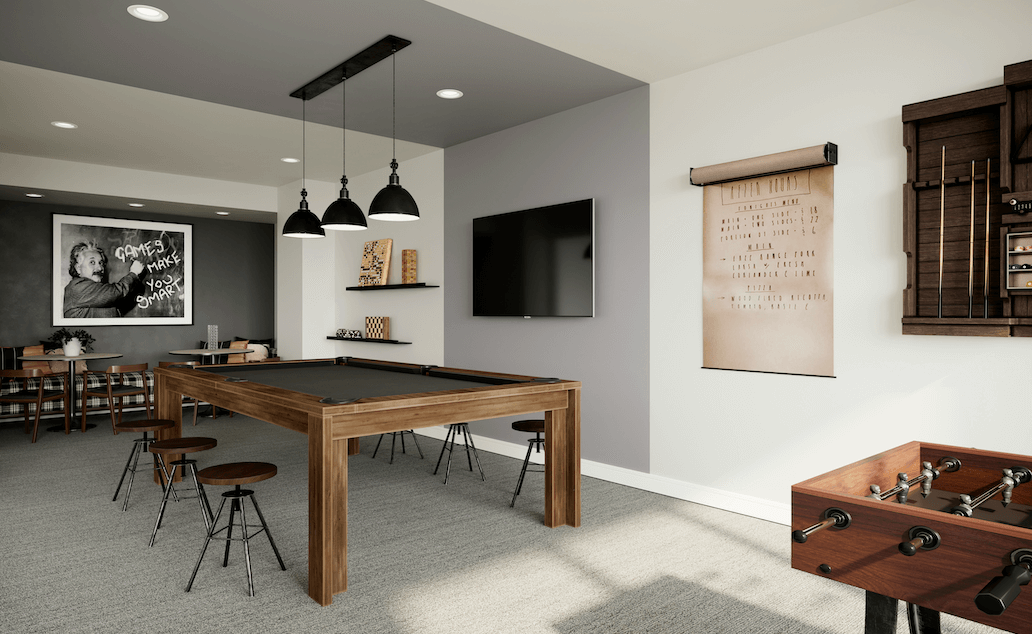
Storage shelving deep enough to hold standard 12-inch board game boxes vertically, keeping a collection visible and safe from the damage of stacking boxes flat.
Tables, boards, and the gear that goes with them are in our decor and accessories guide.
A board game shelf is any shelving unit deep enough to store modern board game boxes spine-out without overhang, and in practice the entire category revolves around a single number: 13 inches. Standard square board game boxes, the format that Ticket to Ride locked in at 11.75 by 11.75 by 3 inches in 2004, need at least 13 inches of shelf depth to sit flush. Most general-purpose bookshelves are 10 to 12 inches deep and leave boxes protruding 2 inches past the edge, where corners catch on clothes and the shelf reads as messy.
The IKEA Kallax became the community default for a simple reason: its cubes measure 13 by 13 by 15 and a quarter inches, and a cube that size holds 4 to 6 standard games vertically with room to grip the sides and pull. Each cube is rated for 29 pounds distributed, enough for hardcover RPG books, dense Eurogames, or a row of party titles. A 2-by-4 Kallax at $79.99 holds roughly 30 to 50 games. A 4-by-4 at $179.99 holds 80 to 120. The line has been in continuous production for two decades under two names, Expedit first and then Kallax after a 2014 redesign that thinned the exterior frame but kept the internal cube dimensions identical.
What this shelf is not is a bookshelf that happens to work. The IKEA Billy, the best-selling bookcase in the world, has 10-and-a-quarter-inch shelves and cannot hold a standard Catan box without overhang. The distinction matters because a full board game collection in a visible, organised shelf doubles as wall decor: the box art of modern board games is illustration-quality, and a wall of spines reads as curated rather than cluttered when a dedicated game room often centres its layout around the shelf wall.
Shelf depth, vertical storage, and protecting a collection
The dimension that separates a board game shelf from everything else is depth. A standard square box like Wingspan or Dominion measures roughly 12 by 12 inches, so a shelf at 13 inches deep gives a half-inch of clearance front and back. Oversized titles break the format: Gloomhaven at 16.3 by 12.3 by 7.8 inches will not fit vertically in a standard cube and must sit on top of the unit or on a separate deeper shelf. Fantasy Flight Games\u2019 old coffin box format at roughly 17 by 12 inches needs 15 to 17 inches of shelf depth, which is why serious collectors with large-format games gravitate to the IKEA Tonstad at 13 and three-quarter inches depth, the Hemnes at 11 and a half inches with an extra three-quarter-inch bottom trim, or custom built-ins at 14 to 16 inches.
Vertical storage with the spine facing out is the standard because it prevents box lids from sagging under the weight of games stacked on top, eliminates the need to unstack to access the bottom game, and keeps every title visible. The trade-off is that loose components inside the box shift during vertical storage. Baggies, aftermarket inserts, or rubber bands solve that. A mixed approach works for fragile titles with heavy miniatures or inserts: store those horizontally on a lower shelf in short stacks of three or four boxes maximum, and store everything else vertically.
Humidity control is the factor nobody talks about until a box shows up warped. Cardboard and paper components are stable between 35 and 55 percent relative humidity at 55 to 68 degrees Fahrenheit. Above 55 percent, mould develops and board stock warps. Below 35 percent, the material becomes brittle and corners snap. Basements, garages, and exterior walls produce the largest temperature and humidity swings, so keep the shelf on an interior wall with 1 to 2 inches of clearance behind the unit for airflow.
Board game shelf versus display cabinet
Glass-door display cabinets solve the dust problem and make a collection look like a museum rather than a store, but they trade capacity for showcase. A cabinet might hold 20 to 40 games behind glass doors; a 4-by-4 Kallax holds 80 to 120 on open shelves. The choice is between protecting a small, cherished set and storing an active, growing collection. For most man cave game rooms, the answer is open shelving for the main collection and a single display cabinet or glass-door section for the signed copies, the out-of-print titles, and the sentimental ones.
Board game tables with built-in storage solve a different problem. They hold games below the play surface for quick access during a session, but the capacity is limited to one or two dozen boxes, and the table\u2019s footprint determines the storage volume. A dedicated shelf and a game table are complementary, not alternatives: the shelf is the library, the table is the reading desk.
How a bookshelf became the community standard
The modern board game box problem started with Catan. Klaus Teuber\u2019s Settlers of Catan launched in 1995, sold 400,000 copies its first year, won the Spiel des Jahres, and created the Eurogame category. Its box was small. The explosion of the hobby through the 2000s brought progressively larger boxes, and when Ticket to Ride shipped in 2004 its 30 by 30 by 8 centimetre format became the industry standard for medium-weight games. That size fits precisely into a USPS Medium Flat Rate box, which was not a happy accident: it was calculated for shipping economics.
IKEA launched Expedit in the early 2000s as a square-cubby system for vinyl records. Board gamers discovered that 13-inch cubes fit their boxes, and by the time IKEA replaced Expedit with Kallax in 2014, the community response was panic. Internal dimensions stayed identical, and Kallax became the unofficial board game shelf with no marketing from IKEA whatsoever. Custom solutions like Allplay\u2019s Jasper modular system at $612 for a 3-by-3 unit arrived in the 2020s, but Kallax remains the reference point.
Mistakes that ruin a collection
Shelves that are too shallow are the fundamental error. A 10-inch-deep bookshelf makes every box overhang, and overhanging boxes accumulate dust, catch on passing shoulders, and become harder to pull. The minimum is 13 inches and 15 inches is safer.
Horizontal stacking is the slow destroyer. A stack of four games puts the weight of three on the lid of the bottom one, and over months the lid warps, the corners split, and the game boards inside take a permanent curve. Every game you need to unstack to reach is a game you reach for less often, and a game that sits unplayed because it is buried might as well not be in the collection.
Not anchoring a tall unit is a safety oversight. A loaded 4-by-4 Kallax can hold 464 pounds of games. That is the weight of two adult men, and if a full unit tips, the damage is severe. IKEA ships anti-tip brackets with every tall unit. Install them.
Frequently asked questions
What is the best shelf for board game storage in a man cave?
The IKEA Kallax is the near-universal answer among board game collectors. Its 13-by-13-inch cubes fit virtually all standard board game boxes, with 15 and a quarter inches of depth that even takes most oversized titles. A 2-by-4 unit at $79.99 holds 30 to 50 games, and a 4-by-4 at $179.99 holds 80 to 120. For large collections of 200 or more games, custom built-ins with 14 to 16 inches of shelf depth at $150 to $400 per linear foot give maximum flexibility.
Can I store board games on a regular bookshelf?
Most regular bookshelves are too shallow. The IKEA Billy, the most popular bookcase in the world, has shelves only 10 and a quarter inches deep, so a standard board game box at 11.75 by 11.75 inches overhangs by nearly 2 inches, risking corner damage, dust accumulation, and an untidy look. If you must use a standard bookshelf, limit it to card games and small-box titles under 10 inches deep, and accept that every medium or large game will sit proud of the edge.
Should board games be stored vertically or horizontally?
Vertical storage with the spine facing out is the recommended method: it prevents box lids from sagging under weight, stops bottom boxes from crushing, and keeps every title visible and reachable without unstacking. The trade-off is that loose components inside may shift, so secure pieces in baggies or aftermarket inserts. Heavy games with fragile inserts and miniatures should lie horizontal in short piles of three or four boxes on a lower shelf. Put weekly-play games at eye level and the heaviest titles below the waist, so every pull is easy and nothing lands on a toe.
How many board games can a Kallax shelf hold?
A single Kallax cube holds 4 to 6 standard-sized games stored vertically. A 2-by-4 unit with 8 cubes holds roughly 30 to 50 games. A 4-by-4 unit with 16 cubes holds 80 to 120 games depending on box mix. Oversized boxes like Gloomhaven at 16.3 inches long will not fit vertically in a standard cube and must sit on top of the unit or on a separate deeper shelf. The largest common configuration, a 5-by-5 Kallax with 25 cubes at $299.99, fits 100 to 150 or more games. For collections exceeding 200 titles, multiple Kallax units or custom built-in shelving is necessary.
What depth do board game shelves need to be?
Minimum 13 inches for standard 12-inch board game boxes to sit without overhang. For oversized coffin box titles from Fantasy Flight Games at roughly 17 by 12 inches or large campaign games like Gloomhaven at 16.3 inches, you need 15 to 17 inches of shelf depth. The IKEA Kallax at 15 and a quarter inches depth handles almost everything except the very largest boxes. The Tonstad at 13 and three-quarter inches is the shallowest that still works for standard large games. Anything under 10 and a half inches, like the IKEA Billy, will leave boxes protruding and is not suitable for full-sized board game storage.
Related terms
Tabletop Gaming
Games played face to face around a table, from board and card games to miniatures wargaming and role-playing campaigns. Table footprint drives almost every other setup decision.
Room Types & SpacesGame Room
A room built around active games such as pool, foosball, darts, and arcade cabinets, sized and laid out for group play rather than solo retreat.
Entertainment & GamesCard Table
A square, round, or octagonal table with a padded felt surface and raised rail, sized for 4 to 8 players, with built-in cup holders and chip trays for poker, bridge, and other card games.
Entertainment & GamesFoosball Table
An eight-rod cabinet with 22 miniature players that turns tabletop soccer into a fast, two-to-four-player game built around a roughly four-foot playing surface and telescopic or through rods.
Entertainment & GamesPool Table
Six-pocket pocket billiards table sized 7, 8, or 9 feet, with a slate bed for tournament play. A standard 58 inch cue needs a room about 13 by 16 feet or larger, and slate tables start around $1,500.
Decor & Wall ArtDisplay Case
A glass or acrylic enclosure that holds and protects a collection, from vintage beer cans to game-worn jerseys, keeping dust, fingerprints, and light damage away from what's inside.
Decor & Wall ArtFloating Shelf
A wall shelf with no visible bracket underneath, held level by a hidden cleat or rod anchored into wall studs so the board appears to float against the wall.
Lifestyle & CultureGame Night
A recurring get-together, often weekly or monthly, that turns a table into the main event: board games, card games, or party games instead of sports or drinks as the draw.