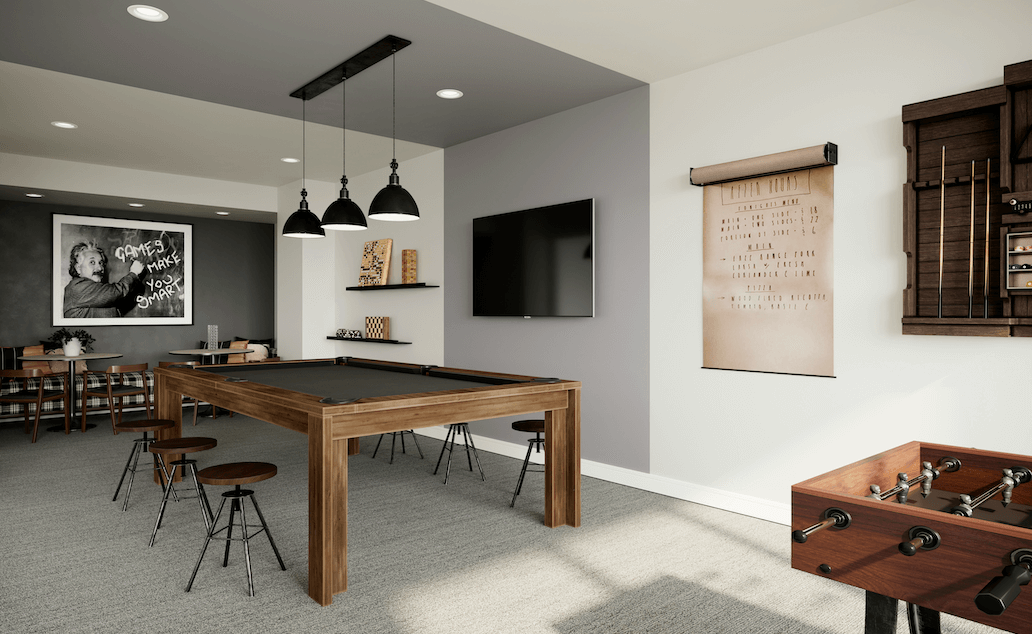
Games played face to face around a table, from board and card games to miniatures wargaming and role-playing campaigns. Table footprint drives almost every other setup decision.
Also known as: Tabletop GamesAnalog Gaming
Tables, boards, and the gear that goes with them are in our decor and accessories guide.
Tabletop gaming covers everything a group plays sitting around a table: board games, card games, dice games, miniatures wargaming, and role-playing games run by a game master. The common thread is analog and face to face, with the components in front of everyone and the players reading each other instead of a screen. In practice the label matters because it dictates the furniture. A card game needs a square foot of space, a Warhammer battle needs a board wider than most dining tables, and picking between game tables and arcade machines is where that decision usually gets settled. The sizing numbers are unforgiving once you look at them. Four to six players want a play surface roughly 48 to 60 inches deep and 72 to 84 inches long, at about 20 to 24 inches of width per seated player, and the practical width band runs 36 to 44 inches, because past roughly 60 inches nobody can reach the middle of the board. Height splits the same way: 29 to 30 inches for seated play, matching a dining chair, against 36 to 38 inches for standing or bar-height designs. Get those wrong and every session involves someone half standing to move a piece. The hobby has the money behind it too. One market estimate put tabletop gaming at 18.41 billion dollars in 2025 rising to 21.43 billion in 2026, though different research firms publish materially different figures for the same market, so treat any single number as an estimate rather than a fact. Tabletop gaming is not a synonym for board games, and the distinction has real consequences for a game room. A board game has a printed board, fixed rules and a win condition. A role-playing game has none of those: it is an open-ended story with a game master, dice, character sheets and no board at all. Miniatures wargaming needs terrain and painted figures and the largest surface of the three. Buying furniture for one of those and expecting it to serve the others is the most common planning error in the whole category.
Sizing a table to the game, not the room
Wargaming has the clearest published conventions, because tournaments need them. Common skirmish board sizes run 22 by 30 inches, 44 by 30, 36 by 36 and 48 by 48, and the 36 by 36 inch board is the single most flexible footprint, serving as the shared baseline across Necromunda, Malifaux, Shatterpoint and Kill Team. Mass-battle systems want considerably more: a minimum around 120 by 120 cm, roughly 47 inches square, with 150 by 150 cm, near 59 inches, preferred where the room allows it. Board games and role-playing sessions size by players instead of by rules. The 20 to 24 inches of width per seat covers a hand of cards, a dice tray and a personal tableau without anyone's components sliding into a neighbor's. Depth matters more than most people expect, since a shared central board plus player boards on both sides eats 48 inches quickly. Shelving for the boxes is the other half of the equation, because a collection that lives on the table is a collection nobody plays. Pricing spreads wider than almost any other man cave furniture. Purpose-built folding tables start near 199 dollars, modular tables with topper inserts run roughly 800 to 3,700 depending on the wood and the options, and the luxury end reaches Wyrmwood's Prophecy, which starts at 10,000 dollars for the base cherry configuration with a velvet-lined vault under the play surface. A repurposed dining table costs nothing and works fine for most groups.
Tabletop gaming vs. board games vs. TTRPGs
The one-line distinction: tabletop gaming is the umbrella, and board games and role-playing games are two of the things under it. A board game is a closed system, with rules that resolve every legal action, a physical board, and a defined way to win. Catan, Ticket to Ride and Monopoly all work that way, and the box tells you the player count and the running time before you open it. A tabletop role-playing game inverts almost all of that. Players run ongoing characters through a story a game master improvises around them, resolution comes from dice against rules that leave gaps on purpose, and there is no winner and often no ending. The furniture needs differ accordingly: a board game wants a clear shared center, while an RPG session wants elbow room, dice space and somewhere to hide a screen. Card and dice games sit at the small end, close to what a card table or a poker table already handles, and miniatures wargaming sits at the other extreme with terrain that has to stay put between sessions.
Catan, D&D and the crowdfunding era
Dungeons & Dragons, published by Tactical Studies Rules in 1974, is the origin point for the whole role-playing side. Gary Gygax and Dave Arneson built it out of the Chainmail miniatures rules by way of Arneson's Blackmoor campaign, turning a wargame about units into a game about individual characters. It marked its 50th anniversary in 2024. The modern board game boom traces to Catan. Klaus Teuber, a German dental technician designing games in his spare time, released it in 1995, won the Spiel des Jahres that year, and took the Origins Award after the American release in 1996; it has since sold more than 40 million copies in 50 languages. Crowdfunding did the rest. Kickstarter took more than 176 million dollars in tabletop pledges in 2019, and in 2022 over 4,000 tabletop campaigns funded successfully, up 14 percent on the year before, at a success rate near 76 percent.
Common mistakes
The first mistake is buying a table for the room instead of for the games. A standard dining table is often around 36 by 72 inches, which is short of the 36 by 36 inch skirmish baseline once terrain goes down, and nowhere near the 120 cm minimum a mass-battle system expects. Check the footprint the systems you actually play call for, then buy the table or the topper that fits it. The second is forgetting per-player width. Five and six player games fall apart on a table sized for four, with cards overlapping into neighbors' areas and dice rolling through someone's tableau. Budget 20 to 24 inches of edge per seat and 48 to 60 inches of depth, and the same table hosts a heavy euro game and a game night card session without rearranging anything. The third is picking the wrong height. Bar-height tables at 36 to 38 inches look excellent and punish a four-hour role-playing session, while a 29 to 30 inch dining-height table is uncomfortable if the group mostly stands around a wargaming board. Decide which format dominates and size for that one. And leave the surface finish alone in the planning: a felt or neoprene mat costs little, stops dice skittering off the edge, and protects whatever you bought underneath it.
Frequently asked questions
What counts as tabletop gaming?
Anything a group plays around a table without a screen: board games, card games, dice games, miniatures wargaming, and tabletop role-playing games such as Dungeons and Dragons. The term groups them by how they are played rather than by genre, which is why a two-player card game and a six-foot wargaming battlefield sit under the same heading. For anyone planning a room, the useful consequence is that the table itself, its size, height and finish, is the piece of equipment all of them share.
What size table do I need for board games?
For four to six players, aim for a play surface roughly 48 to 60 inches deep and 72 to 84 inches long, budgeting 20 to 24 inches of edge width per seated player. Standard seated height is 29 to 30 inches, matching a dining chair. Width beyond about 60 inches becomes a problem rather than a bonus, since nobody can reach the center of the board without standing. Heavier games with individual player boards push toward the deeper end of that range.
What is the difference between a board game and a tabletop RPG?
A board game has a printed board, a closed set of rules that resolve every legal action, and a defined win condition, so the box can tell you the player count and the running time. A tabletop role-playing game has none of those. Players run ongoing characters through a story that a game master improvises, dice resolve uncertain outcomes, and campaigns can run for years without anyone winning. Both are tabletop gaming; only one of them fits in a box with a printed board.
How big should a miniatures wargaming table be?
Skirmish systems commonly use boards of 22 by 30 inches, 44 by 30, 36 by 36 or 48 by 48, and a 36 by 36 inch surface is the most flexible single size, since several unrelated systems including Necromunda, Malifaux, Shatterpoint and Kill Team use it as their baseline. Mass-battle games need considerably more room, with a minimum around 120 by 120 cm, roughly 47 inches square, and 150 by 150 cm preferred where the space allows. Terrain height matters as much as area.
Do I need a dedicated gaming table?
No. Most groups play perfectly well on a repurposed dining or poker table, and the money is usually better spent on games. A dedicated table earns its keep when you play often enough that setting up and tearing down becomes the barrier, since a recessed play surface lets a campaign stay on the table between sessions. Purpose-built folding tables start near 199 dollars, modular models run roughly 800 to 3,700, and the luxury end passes 10,000.
Related terms
Game Room
A room built around active games such as pool, foosball, darts, and arcade cabinets, sized and laid out for group play rather than solo retreat.
Entertainment & GamesBoard Game Shelf
Storage shelving deep enough to hold standard 12-inch board game boxes vertically, keeping a collection visible and safe from the damage of stacking boxes flat.
Entertainment & GamesPoker Table
A dedicated card table with a padded rail and cup holders. Round tables fit four to six players, octagons up to eight, and 84 to 96 inch ovals seat eight to ten. Speed cloth outlasts felt.
Entertainment & GamesCard Table
A square, round, or octagonal table with a padded felt surface and raised rail, sized for 4 to 8 players, with built-in cup holders and chip trays for poker, bridge, and other card games.
Lifestyle & CultureGame Night
A recurring get-together, often weekly or monthly, that turns a table into the main event: board games, card games, or party games instead of sports or drinks as the draw.
Entertainment & GamesDartboard (Electronic / Bristle)
A round target of sisal bristle or perforated plastic, mounted with its bullseye 5 ft 8 in off the floor and thrown at from a fixed oche distance for regulation darts.
Furniture & SeatingHeight-Adjustable Table
A table with telescoping legs that shifts between sitting and standing heights by crank, pneumatic lift or electric motor. Pub-height versions use the same leg mechanisms as sit-stand desk frames.