Recurring home gathering built around a card table, chips, and fixed stakes, usually Texas Hold’em. A 300 chip set covers six players; a 500 chip set handles a full table of eight or nine.
A poker night is a recurring home gathering built around a card table, a rack of chips, and a fixed set of house rules, usually centered on Texas Hold’em. It is the standing appointment that turns a spare room into a game room: a table that seats eight, chairs that fold away when they are not needed, a chip set, two decks of cards, and a host who has agreed on the stakes before the first hand is dealt. The format barely changes week to week, which is what makes it a ritual rather than a party.
The equipment matters less than the structure. A home poker night runs on a buy-in, a chip value, a small blind and a big blind, and a dealer button that moves one seat after every hand. A standard 300 chip set covers about six players, a 500 chip set handles a full table of eight or nine, and the denominations usually run $1 white, $5 red, $10 blue, $25 green, and $100 black. Decide whether it is a cash game, where chips match dollars and players can rebuy, or a tournament, where everyone starts equal and the blinds rise until one player holds everything.
A poker night is not a casino night, and it is not a general game night. It is one game, played the same way, with stakes on the table, and those boundary lines matter for planning the room and for keeping the evening friendly. Both distinctions get their own sections below.
Running a home poker night, from setup to first hand
The table is the anchor. A purpose-built poker table seats eight around a padded rail with cup holders, a folding card table seats four to six, and a dining table with a poker topper seats the most with the least commitment. Add folding chairs rated for the full guest list, because a night that pulls in overflow needs seats that appear out of a closet at game time.
The structure comes next. Set the buy-in and the chip values before the cards come out, agree on the blinds, and run them on a timer if it is a tournament, with 15 to 20 minute levels so the night ends when you want it to. Deal two hole cards, run the flop, the turn, and the river with a burn card before each street, and let the dealer button enforce the rules. Cash games keep the same blinds all night; tournaments raise them on schedule, and the honest host writes the schedule down so nobody feels the game changed mid-hand.
Chip distribution matters more than chip count. A common tournament start is about $3,000 in chips spread over 40 to 50 chips per player, built in a low-to-high denomination ratio so nobody makes change every hand. Color up the small chips as the blinds rise, swap in the higher denominations, and a 500 chip set carries a full table to the final hand. A one-table tournament with eight players runs about three hours on a 15 minute blind schedule, which makes it the format that fits a weeknight; cash games have no natural end, so most home hosts run tournaments and save cash games for weekends.
Poker night versus game night
Both put a table at the center of the room, and both rotate through a similar guest list, but they are different events with different planning. Game night rotates the games, moves between party games and heavy strategy games, and usually has no money involved. Poker night is one game, played with the same rules every week, with chips standing for money and a format that barely changes.
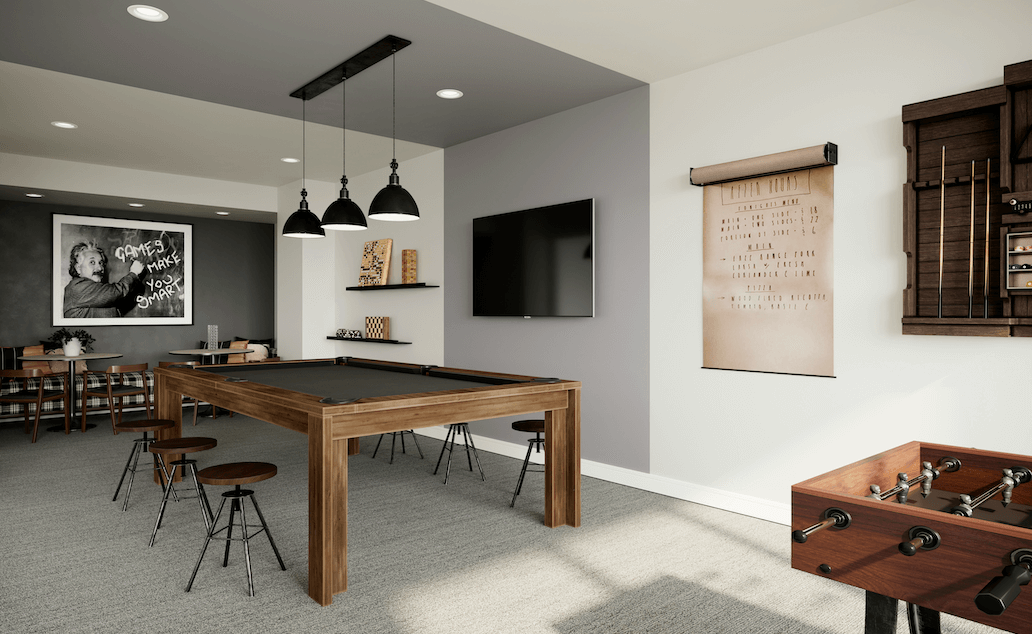
The distinction shapes the room. A game night works on any table with enough surface for a board game and whatever drinks are in hand. A poker night wants a real card surface, a padded rail to lean on, cup holders, and a dealer button, which is why dedicated poker rooms grow around a purpose-built table while game night can live on a kitchen table. Plan the room for the event you actually host, and the table you choose follows from that.
Where the term came from
Poker grew out of the French game poque, which itself came from the German pochen, and it took shape in New Orleans in the decades after the Louisiana Purchase of 1803. The original game used a 20 card pack dealt to four players, and it spread north along the Mississippi with the riverboat gamblers. The first printed reference to poker appeared in 1837 in a frontier memoir, the 52 card deck took over in the 1830s and 1840s, the draw came around 1850, stud arrived during the Civil War, and community card games appeared around 1925.
Texas Hold’em, the game most home nights play, stayed a regional Texas game until the late 20th century. It was played in Dallas clubs around 1930, reached Las Vegas in the 1960s, and became the main event of the World Series of Poker. Online poker in the late 1990s and televised tournament poker in the early 2000s made no-limit Hold’em the most played variant in the world, which is why a home poker night in the 2020s usually means two hole cards and five cards on the board.
Common mistakes
Skipping the house rules is the first. A night with no agreed stakes, no chip value, and no rule for a disputed hand ends in an argument, so write down the buy-in, the blinds, and the street order before the first hand and keep the sheet by the table. State it once, out loud, before anyone buys in, and the night runs on agreement instead of assumption.
Building a home bar without seating for the table is the second. Guests who have nowhere comfortable to sit will stand, reach across, and knock chips around, and a night that started social turns cramped. Seat the table before you stock it.
Letting the blinds run away is the third. Tournament blinds that double too fast turn every hand into a shove, and blinds that never rise stretch a night to four hours. Use a printed schedule with 15 to 20 minute levels and stick to it, and the evening ends at the time you promised, with the game tables and arcade machines ready for whatever comes next.
Frequently asked questions
What do you need for a poker night at home?
You need a table that seats your group, chairs, a chip set, two decks of cards, and agreed stakes. A 300 chip set covers about six players, and a 500 chip set handles a full table of eight or nine. Decide whether it is a cash game or a tournament, set the blinds, and write the house rules down before the first hand is dealt.
What is the difference between a cash game and a poker tournament?
In a cash game, chips match real money, players can rebuy, and the blinds stay the same all night, so the game has no fixed end. In a tournament, everyone pays one buy-in for the same starting stack, the blinds rise on a schedule, and play ends when one player holds all the chips. Home hosts usually run tournaments because they end on time.
How many poker chips do you need for a home game?
Plan for 40 to 50 chips per player. A 300 chip set comfortably covers about six players, and a 500 chip set handles a full table of eight or nine. Use a low-to-high denomination ratio, such as four low-value chips to three medium to two high, so players are not making change every hand, and color up the small chips as the blinds rise.
What poker games are best for home poker nights?
Texas Hold’em is the default for a home night because it is the most widely known variant and plays fast with any group size. Five-card draw is easier for beginners, seven-card stud suits smaller groups, and Omaha works for players who want more action. Dealer’s choice rotates the variants so nobody gets stuck with a game they do not enjoy.
Can you play poker for money at home?
Small-stakes home games are common and generally legal in most US states as long as the host takes no cut, the game is not advertised as a public event, and nobody profits from running the house. Rules vary by state and country, and strict gambling jurisdictions may treat a recurring game differently. Check local law before putting money on the table.
Related terms
Poker Table
A dedicated card table with a padded rail and cup holders. Round tables fit four to six players, octagons up to eight, and 84 to 96 inch ovals seat eight to ten. Speed cloth outlasts felt.
Entertainment & GamesCard Table
A square, round, or octagonal table with a padded felt surface and raised rail, sized for 4 to 8 players, with built-in cup holders and chip trays for poker, bridge, and other card games.
Furniture & SeatingFolding Chair
A hinged-frame chair that collapses flat for storage, used as extra seating when a poker night or party pulls in more guests than the regular chairs cover.
Lifestyle & CultureGame Night
A recurring get-together, often weekly or monthly, that turns a table into the main event: board games, card games, or party games instead of sports or drinks as the draw.
Entertainment & GamesTabletop Gaming
Games played face to face around a table, from board and card games to miniatures wargaming and role-playing campaigns. Table footprint drives almost every other setup decision.
Bar & BeverageHome Bar
A built-in counter with cabinetry, storage and a sink or plug-in fridge that serves drinks in a finished room. The wet-versus-dry decision depends on the nearest drain stack.
Read more about Poker Night

Best Whiskey Barrel Bar Tables for Your Man Cave
Discover the top whiskey barrel bar tables that blend rustic charm with durability. Get buying tips, size comparisons, and top picks for your man cave.

Monte Carlo Casino Room Design Guide
Transform your game room with Monte Carlo-inspired layouts, furniture, and lighting. Get practical tips for a luxurious casino atmosphere without overspending.