The base layer of light in a room: broad, diffuse output from ceiling fixtures, cove runs or wall washers that makes the space usable before task and accent lighting go anywhere near it.
Also known as: General LightingBase Layer Lighting
Fixtures, bulbs, and colour temperature for this are covered in our decor and accessories guide.
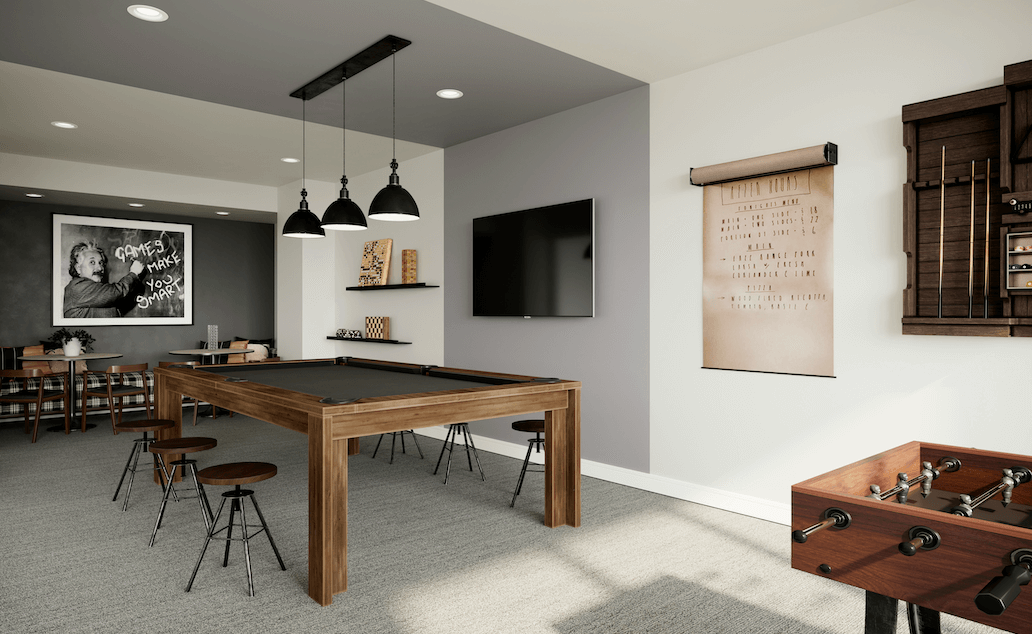
Ambient lighting is the layer you notice only when it is wrong. It comes from recessed cans, flush and semi-flush ceiling fixtures, cove runs bouncing off the ceiling, wall washers and floor uplights, and its job is to fill a room evenly enough that people can move around, find a seat and read a face without any single fixture drawing attention. In a lounge or basement cave it usually sits at 2700K to 3000K, warm enough that the room reads as somewhere to sit rather than somewhere to work, and it almost always wants to be dimmable.
Getting the level right matters more than getting the fixtures right. Residential guidance built on the current IES document, ANSI/IES/ALA RP-11-20, commonly puts general lighting in a living or lounge space somewhere between 5 and 20 footcandles, roughly 54 to 215 lux, with recreation areas landing near 30 fc. Spacing sets whether that level arrives evenly: the IESNA spacing-to-mounting-height ratio runs 0.5 to 1.0, which the trade shortens to ceiling height divided by two, so an 8 ft ceiling wants cans about 4 ft apart with the first row 24 to 36 in off the wall. Installed recessed fixtures run roughly $100 to $300 each, so the layout is worth drawing before anything gets cut.
What ambient lighting is not is the layer that creates atmosphere. Accent lighting does that, and it needs contrast to register: a commonly cited threshold is about 3:1 against the surrounding ambient level, rising to 5:1 for a focal area and 10:1 or more for real drama. Push the ambient layer too bright and every accent in the room flattens out. The three-layer approach in layered lighting only works when the base layer knows its place.
Setting the level, the colour and the dimming
Start from total output. A working rule for general lighting is 10 to 20 lumens per square foot, so a 14 by 16 ft room needs roughly 2,200 to 4,500 lumens spread across the ambient layer, which the lighting lumens calculator will size against the fixtures you are actually considering. Split that across several sources rather than one, because one bright fixture in the middle of a ceiling produces a flat room with dark corners no matter how many lumens it makes.
Colour temperature sets the mood before anything else does. Lounge and media spaces sit at 2700K to 3000K, kitchens and workshops at 3500K to 4000K, and anything at 5000K and above reads clinical in a room meant for relaxing. Mixing colour temperature across fixtures in one room is the fastest way to make a careful install look accidental. On rendering, ENERGY STAR sets a floor of CRI 80 for certified LED lamps, which is fine for circulation, while CRI 90 and above is worth the premium where people spend hours looking at wood, leather and skin tones.
Dimming is not optional in a room with a screen. A dimmer switch matched to the driver decides how far down the layer goes and how gracefully it gets there: ordinary 0-10V drivers often bottom out around 5 to 10 percent, while Lutron’s Hi-Lume 1 percent driver reaches 1 percent and the Premier version 0.1 percent. Phase-cut TRIAC and ELV dimming costs less and misbehaves more, with buzz and flicker showing up when driver and dimmer are mismatched. Beam spread finishes the job: most residential recessed lighting ships around 40 degrees, and wider beams overlap more forgivingly than narrow ones on an 8 ft ceiling.
Ambient against accent lighting
Ambient covers, accent points. Ambient fixtures are broad and fixed, sized to a room; accent fixtures are narrow and aimable, sized to an object, and they only read as accent when they are several times brighter than the wash around them.
The consequence is that the two layers get designed together or not at all. Set the ambient layer at a comfortable evening level and a 3:1 ratio on a picture light or a gimbal head over a bar makes the object jump. Set the ambient layer at kitchen brightness and that same accent fixture disappears into it, which is how rooms end up with six adjustable heads doing nothing at all. Dimming resolves this in practice, because a room needs different ratios for cleaning, for a poker night and for a film.
Bias lighting behind a screen is a third thing again, and worth separating. It is a low-output strip aimed at the wall behind a television to lift the surround just enough that pupils stop fighting a bright image in a black room. It reduces eye strain and preserves perceived contrast; it lights nothing else, and it belongs on its own switch, not on the ambient circuit.
Where the layered model came from
The framework goes back to one lighting designer. Richard Kelly, who lit the Seagram Building, Philip Johnson’s Glass House and the Kimbell Art Museum, delivered a lecture titled Lighting as an Integral Part of Architecture on 23 April 1952 to a joint meeting of the American Institute of Architects, the Society of Industrial Designers and the Illuminating Engineering Society, and published it that year in College Art Journal, volume 12, number 1. His three categories were focal glow, ambient luminescence and play of brilliants, and the middle one is the direct ancestor of the word used here.
The regulation arrived much later. The FTC’s Lighting Facts label became mandatory on 1 January 2012 under 16 CFR 305.23, putting lumens rather than watts on the front of the box. California’s Title 24 requires permanently installed residential luminaires to be high-efficacy and JA8-marked, and requires a dimmer in habitable rooms unless the circuit is under 20W or sensor-controlled, with the 2025 code taking effect for permits from 1 January 2026. The Department of Energy’s backstop standard lifts minimum lamp efficacy past 120 lumens per watt by 25 July 2028, against the 13 to 18 lm/W an incandescent managed.
Common mistakes
One fixture in the middle of the ceiling is the classic. It lights the floor, leaves the corners in shadow and flattens everything in between. Add a second source at a different height, a floor lamp, a sconce or a cove run, and the room gains depth before a single accent fixture goes in.
Over-lighting a lounge is the next one, and it is usually a spec sheet error rather than a design decision. A room built at kitchen brightness has nowhere to go in the evening and throws glare at the screen, so aim at the lower end of the residential range and put the whole layer on a dimmer that reaches a genuinely low bottom end.
The rest are details that show up immediately once the drywall is closed. Cans too close to a wall scallop the surface, cans too far apart leave dark bands between pools, and dark finishes swallow roughly a fifth more light than pale ones, so tighten spacing where the walls are dark. Keep bare LED sources out of sight lines as well, since a direct-view strip at eye level produces glare that no amount of dimming fixes; the CIE’s Unified Glare Rating, introduced in 1995, puts a practical ceiling around UGR 19 for comfortable spaces.
Frequently asked questions
What is the difference between ambient and accent lighting?
Ambient is the broad base layer that makes a room usable, delivered by recessed cans, flush mounts, cove runs or wall washers. Accent is narrow and aimable, pointed at a specific object such as a bar back, a poster or a shelf. Accent only registers when it runs several times brighter than the ambient around it, with about 3 to 1 the usual threshold and 10 to 1 for real drama. Set the base layer too bright and every accent fixture in the room disappears.
How many lumens do I need for ambient lighting in a room?
A working figure for general lighting is 10 to 20 lumens per square foot, so a 14 by 16 foot room lands somewhere around 2,200 to 4,500 lumens across the whole ambient layer. Spread that across several fixtures rather than one, because a single bright source in the ceiling produces a flat room with dark corners. Residential guidance built on the IES residential document commonly targets 5 to 20 footcandles for lounge spaces, which is roughly 54 to 215 lux.
What colour temperature should ambient lighting be in a man cave?
Warm, in almost every case. Lounge and media spaces sit best at 2700K to 3000K, which reads relaxed and flatters wood, leather and skin. Reserve 3500K to 4000K for a workshop bench or a kitchen area, and avoid anything at 5000K or above unless the space genuinely doubles as a workspace. The bigger rule is consistency: mixing colour temperatures across fixtures in one room makes a careful install look accidental within seconds of switching on.
How far apart should recessed lights be spaced?
Divide the ceiling height by two for on-centre spacing, so an 8 foot ceiling wants cans roughly 4 feet apart and a 10 foot ceiling about 5 feet. That shortcut comes from the IESNA spacing-to-mounting-height ratio of 0.5 to 1.0. Keep the first row 24 to 36 inches off the wall, since closer produces visible scalloping and further leaves the perimeter dark. Tighten spacing by around 20 percent where walls and floors are dark, because those finishes absorb far more light.
Does ambient lighting need to be dimmable?
In any room with a screen, yes. A single fixed level cannot serve cleaning, a card game and a film, and non-dimmable ambient light is the most common reason a well-specified room feels wrong at night. It is also a code requirement in California, where Title 24 calls for a dimmer in habitable rooms unless the circuit is under 20 watts or sensor-controlled. Match the dimmer to the driver, and check the published low end, since many drivers stop around 10 percent.
Related terms
Accent Lighting
The directional third lighting layer, aimed at one object or surface at roughly three to five times the surrounding light so it reads as the focal point.
LightingTask Lighting
Focused, higher-intensity light aimed at a work surface rather than a room: under-cabinet strips behind a bar, a pendant over a table, a directional fixture over a bench.
LightingRecessed Lighting
Light fixtures installed flush in a ceiling opening, so the lamp sits inside the ceiling and only the trim shows. LED retrofits dominate, and IC rating decides whether they can touch insulation.
LightingDimmer Switch
A wall-mounted control that lowers light output by chopping the AC power wave, with wiring and load ratings that differ for incandescent, halogen, and LED bulbs.
LightingColor Temperature (Kelvin)
A measure of a light source's color appearance, from warm amber at 2700K to cool blue-white at 6500K. The Kelvin number on every bulb box decides whether a room reads as pub, workshop, or hospital.
LightingLumens
SI unit of luminous flux, the total visible light a source emits as the eye perceives it. One lumen is one candela-steradian; household bulbs range from about 450 to 1,600 lumens.
LightingBias Lighting
A dim, neutral 6500K light behind a screen that raises perceived contrast and softens the jump between a bright picture and a dark room. Around 10 percent of peak white.
LightingLight Zone
Group of light fixtures controlled together from one switch, dimmer, or scene. Zones let a single room run separate lighting moods, and energy codes cap automatic-shutoff zones at 600 square feet.
Read more about Ambient Lighting

High-Tech Home Theater Blueprint
Plan a high-tech home theater for your entertainment den: detailed layout, AV picks, seating, acoustics, lighting, smart controls, decor and budget tips.

Transform Your Space with Global Retreat Designs
Discover global room designs and get practical ideas to upgrade your personal retreat—style, layout and features, lighting and budget tips you can apply today.

Best LED Bias Lighting Kits to Boost TV Contrast
Nine LED bias lighting kits compared, plus the specs that matter: 6500K, CRI above 90, a surround at 5 cd/m2, and where to inset the strip behind the panel.

Lighting Ideas to Transform Your Entertainment Space
Discover smart, stylish lighting plans to set mood, improve visibility, sync with media, and showcase gear—practical tips for upgrading your entertainment space.