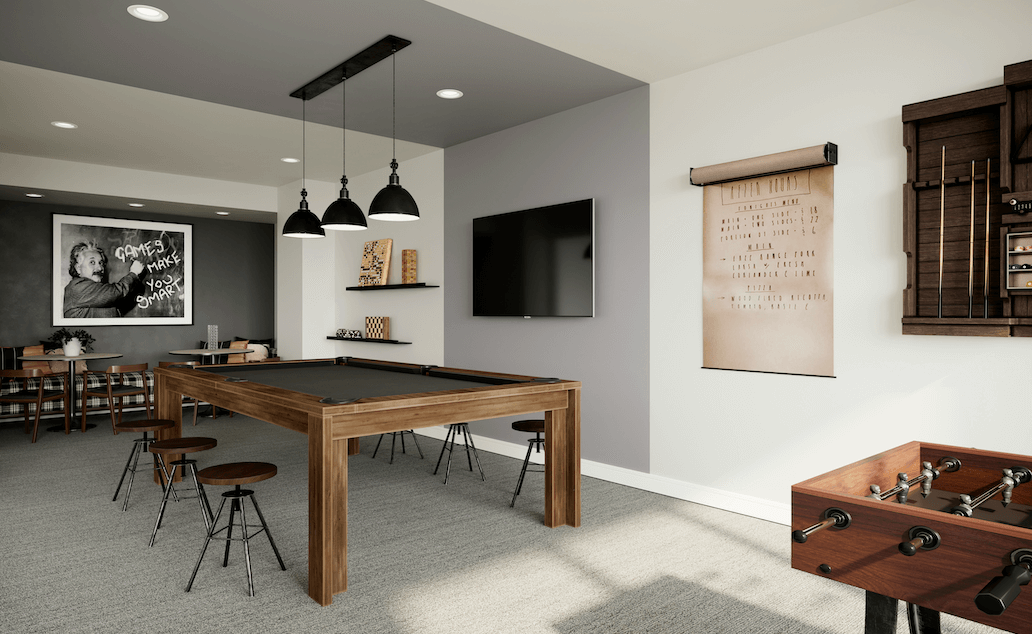
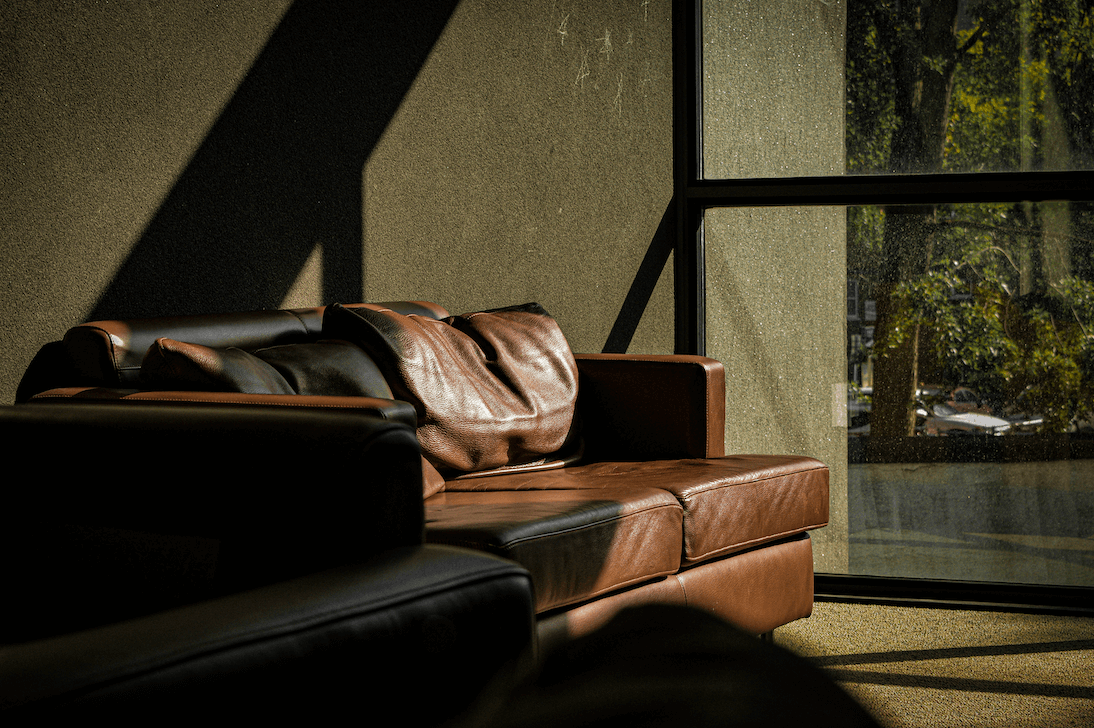
A rustic mountain aesthetic built from natural materials and substantial furniture, drawing from National Park lodges and Adirondack Great Camps to create rooms that feel warm and grounded.
What this look costs to build, the room it needs, and how it compares on fit is in our man cave ideas and themes guide.
The cabin and lodge theme is what happens when a room trades drywall for wood, carpet for stone, and a table lamp for an antler chandelier. It is a specific aesthetic inside the broader rustic category, and what separates it from general rustic or farmhouse is scale and source material. The reference points are the National Park lodges of the early 1900s and the Adirondack Great Camps of the Gilded Age, meaning the materials are real and the proportions are generous. Knotty pine or cedar clads the walls, stacked stone wraps the fireplace floor to ceiling, wrought iron and distressed leather anchor the furniture, and the colour palette stays in earth tones: warm browns, deep greens, cream, rust, and muted navy. Nothing in the room should read as synthetic, and nothing should read as delicate.
In a man cave the theme works because it meets the room halfway. A basement already wants to feel like a retreat from the rest of the house, and the lodge aesthetic gives that instinct a coherent material language rather than a collection of bar signs and framed jerseys that happen to share a room. The fireplace, which in many basement builds is already the focal point, becomes the organising element: stone floor to ceiling, a heavy timber mantel, leather seating arranged to face it. The theme rewards spending on a few things that are massive and real rather than many things that are small and decorative. One oversized leather Chesterfield, one stacked-stone surround, one live-edge table, and the room is largely done. The challenge is editing, because the materials carry so much visual weight that adding more usually subtracts.
What this theme is not is a permission slip to turn a room into a taxidermy gallery. One or two mounted pieces add to the language; a wall of heads reads as aggressive rather than welcoming, and it puts the room on the wrong side of the line between atmospheric and unsettling. It is also not a farmhouse aesthetic with different wall sconces. Farmhouse is lighter, brighter, shiplap-forward, and dominated by white and cream. Cabin and lodge is darker, heavier, and relies on the architecture itself (the beams, the stone, the timber) to do the work that farmhouse assigns to decor. If the room would look empty without the signs and the knick-knacks, the theme has not been built into the structure yet.
Materials that carry the weight
The four materials that define the look are wood, stone, leather, and metal, and they have to be real because the theme relies on texture and mass rather than pattern and colour to make its case. Wood means knotty pine, reclaimed barnwood, or cedar on walls and wide-plank flooring, plus exposed beams that should be structural or convincingly boxed to read as structural. Stone means stacked fieldstone or rhyolite on the fireplace and possibly on one accent wall, with grout joints that are generous rather than refined. Leather means full-grain or top-grain in oxblood, cognac, or dark brown, on a sofa deep enough to sleep on and a pair of club chairs with nailhead trim. Metal means wrought iron in the chandelier, the sconces, the curtain rods, and the hardware, with brass or copper as warm accents rather than dominant finishes. Textiles pull the hard surfaces together: wool throws, a cowhide rug, chunky knit cushions, and buffalo plaid in small doses.
Cabin and lodge vs. rustic and farmhouse
All three of these labels get used interchangeably on furniture websites, and they are not the same vocabulary. A rustic theme is the broadest category: natural, aged, organic materials used in any combination. Cabin and lodge is a specific subset that includes the grand scale and hunting-lodge references (antlers, hides, massive hearths) drawn from specific historical buildings. A farmhouse interior is lighter in palette, often features shiplap and beadboard rather than log walls, and leans on vintage simplicity rather than rugged drama. A Scandinavian cabin interior is paler still, with whitewashed wood, minimal decoration, and an emphasis on light rather than warmth. The cabin and lodge theme sits at the far end of the spectrum in terms of visual weight, and that weight requires a room with enough volume to carry it: vaulted ceilings or at least 9-foot flat ceilings, and an open space of 300 square feet or more before the oversized furniture begins to crowd the room.
Where the look came from
The lineage runs through the Adirondack Great Camps of the late 19th century and the National Park lodges built in the decades that followed. William West Durant built Camp Pine Knot on Raquette Lake in 1877, drawing on European Alpine architecture and local rustic cabins to create what is now recognised as the first Great Camp. He built over a dozen structures by 1895, establishing a template of bark-covered log walls, stone foundations, and massive hearths that defined the style. The most famous architectural descendant is the Old Faithful Inn in Yellowstone, designed by 29-year-old Robert Reamer and built between 1903 and 1904 for $140,000. Its seven-story lobby is framed in lodgepole pine logs with a rhyolite stone fireplace at its centre, and the building became the prototype for what the National Park Service eventually called Parkitecture. The Santa Fe Railway’s El Tovar at the Grand Canyon followed in 1905, and lodges in Yosemite, Glacier, and other parks cemented the formula through the 1920s.
Common mistakes that break the spell
The fastest way to undo the look is to use fake materials. Faux-stone veneer panels and printed log wallpaper announce themselves as counterfeit on first glance, and the whole appeal of this theme is that the materials are honest even if they are rustic. The second mistake is going too dark. A room with dark wood walls, a dark stone fireplace, dark leather furniture, and dark iron lighting will read as a cave unless you balance the mass with cream-coloured walls on the non-feature planes, lighter textiles in the throws and cushions, and layered lighting that includes task fixtures and accent spots, not just a single antler chandelier on a dimmer. The third mistake is crowding the floor. The lodge aesthetic needs open floor around the seating, because the scale of the pieces already fills the visual field. Adding side tables, floor lamps, coat racks, and bar carts until the walking paths narrow defeats the purpose of a room that is meant to feel expansive.
Frequently asked questions
What is the cabin and lodge interior design style?
The cabin and lodge style is a rustic mountain aesthetic built around natural materials at a generous scale. Walls are clad in knotty pine or cedar, fireplaces are wrapped in stacked stone, and furniture is oversized in distressed leather and wrought iron. It draws from National Park lodges and Adirondack Great Camps rather than farmhouse or general rustic, and the palette stays in earth tones with deep greens, warm browns, cream, and rust.
Can I achieve the cabin look in a small room?
You can, but you need to scale down the elements rather than the aesthetic. Use one wood accent wall instead of full log cladding, a stone veneer fireplace surround rather than a floor-to-ceiling masonry hearth, and a single leather club chair rather than an oversized sectional. Focus on the material palette and texture, and keep the furniture proportional to the room’s footprint so the space still breathes.
What is the difference between cabin-lodge and rustic style?
Rustic is the broad category that values natural, aged, organic materials in any combination. Cabin and lodge is a specific subset of rustic that draws on grand mountain lodges and hunting-lodge references including antlers, hides, and massive hearths. Cabin-lodge is darker, heavier, and more dramatic than general rustic, which can include lighter treatments like whitewashed barnwood or Scandinavian-influenced simplicity.
What furniture anchors a lodge-themed room?
An oversized, deep-seated leather sofa in oxblood or distressed brown is the anchor piece, typically a Chesterfield or a tufted club style with nailhead trim. It faces a stone fireplace, which is the room’s focal point. Supporting pieces include a pair of leather club chairs, a live-edge or reclaimed-wood coffee table, wrought-iron floor lamps, and a cowhide or fur rug.
Is the cabin-lodge theme expensive to execute?
It can be, because the materials are real and substantial: full-grain leather, solid wood beams, natural stone, and wrought iron are not budget finishes. The cost can be managed by choosing one feature wall in wood rather than four, using stone veneer instead of full masonry, and investing in one key furniture piece rather than trying to fill the room at once. A phased approach lets the room grow into the theme without cutting corners on material quality.
Related terms
Rustic Theme
A decorating style built from natural, aged, and distressed materials: reclaimed wood, stone, iron, and leather in an earth-tone palette. Rooted in the American frontier and the National Park lodges.
Decor & Wall ArtStone Veneer
Thin stone-like cladding for walls, either real rock sawn into slabs or molded concrete, applied at 8 to 25 pounds per square foot so it needs no dedicated foundation and installs over framing.
Building & ConstructionExposed Beam
Ceiling timbers left visible instead of hidden behind drywall: either real load-bearing framing on display or a lightweight faux shell built to mimic it in a rustic room.
Decor & Wall ArtShiplap
Wood boards with a rabbeted edge that overlap in a shallow lip, leaving a clean shadow gap between rows. The modern farmhouse wall finish, it also suits rustic and coastal man cave bars.
Decor & Wall ArtWainscoting
Panelling on the lower third of a wall, capped by a rail. Beadboard and board and batten are patterns within it, and the one-third height rule is convention, not code.
Design Themes & StylesIndustrial Theme
Factory-inspired decor: exposed brick and beams, raw concrete, black steel, Edison bulbs, and visible pipes and ductwork in a neutral palette of gray, black, and brown.
Furniture & SeatingSectional Sofa
A multi-piece couch in an L or U shape that locks together into one continuous seating surface. Standard units run 95 to 110 inches wide and seat four to five.
Furniture & SeatingRecliner
An armchair with a reclining back and a raising footrest, the default throne for movie nights. Manual, power, and wall-hugger variants change how much room the chair needs.