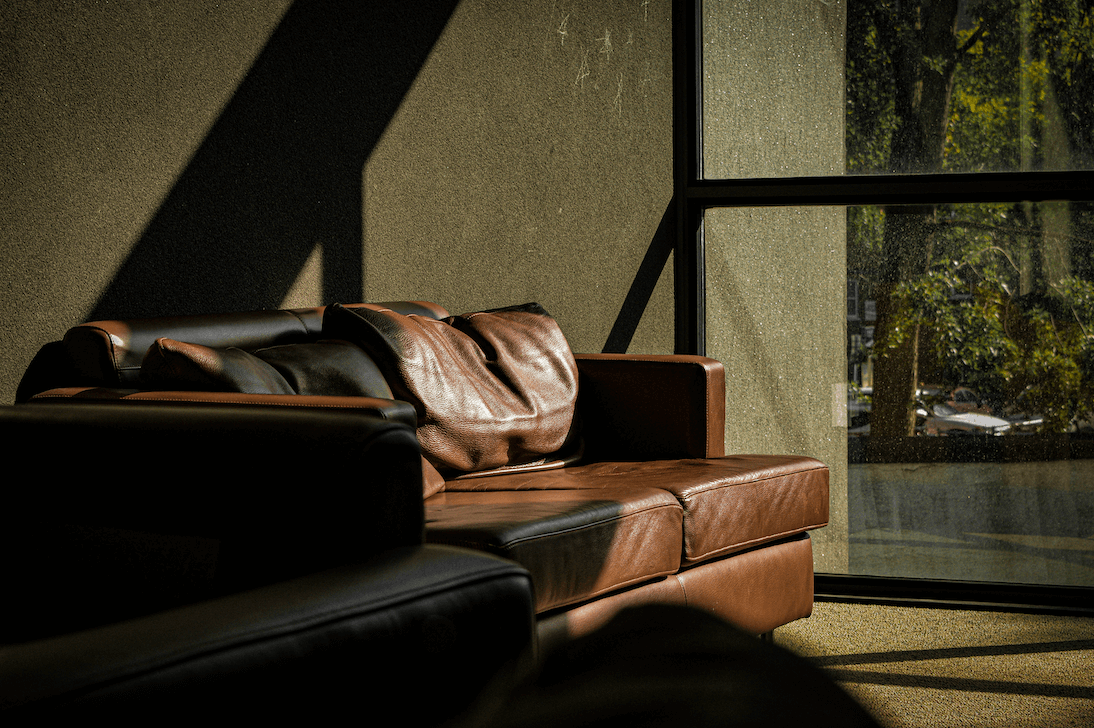
An armchair with a reclining back and a raising footrest, the default throne for movie nights. Manual, power, and wall-hugger variants change how much room the chair needs.
Also known as: La-Z-BoyRocker ReclinerWall Hugger
Price bands, clearances, and what to buy first for this piece are in our man cave furniture guide.
A recliner is the chair that does exactly one job, and does it better than anything else in the room: it tips back, raises your feet, and holds you there for the duration of the movie. The mechanism that makes it work is a reclining back tied to a folding footrest, triggered by a lever, a push-back, or a motor, and it is the difference between a movie night and a night in a chair that fights you for two hours. In a man cave the recliner is the anchor seat, the one piece of furniture every game-day or movie-hosting plan builds around.
The case for one is comfort plus placement. A recliner lets you choose your posture instead of adapting to the furniture, and that matters in a room where sessions run three hours or more. It is also the only seat that works in awkward corners, because a single chair needs far less room than a sofa and can face a TV at an angle that no couch would fit. The theater seating rows in a real cinema are recliners at heart, and the man cave version is the same idea with better fabrics and no row behind you.
The practical questions all come down to the mechanism and the clearance. A standard manual recliner needs roughly 24 inches of clearance behind it to tip back fully, because the chair leans into that space as it reclines. A wall-hugger or zero-clearance model solves that by moving the seat forward instead of the back backward, so it sits fine within 4 to 5 inches of a wall, which is why wall-huggers dominate tight home theater rows. Power recliners add a motor, a wired remote or buttons, and often a USB port and a heated option, and they typically run 1 to 2 inches deeper than the manual version because of the motor box.
Price scales with the mechanism and the cover material. A basic manual recliner starts around $300 to $500, a power recliner runs $500 to $1,200, and a leather power chair with heat, massage, and storage climbs past $1,500. For a man cave furniture budget, the value pick is a power wall-hugger with fabric upholstery: it solves the clearance problem, saves your arms the lever work, and costs little more than the manual version.
A recliner is not the same thing as a gaming chair, and the two get confused because both are single-seat thrones. A gaming chair is built around posture for a desk: upright, adjustable arms, sometimes on casters, tuned for long sessions at a monitor. A recliner is built for the opposite, lounging at a viewing distance, and it has no casters because it is not meant to roll anywhere. The right choice is about the activity. Racing and esports in front of a monitor want the gaming chair; movies and football in front of a TV want the recliner.
How to pick a recliner that fits
Fit comes before features, because a recliner that does not fit the person or the room gets returned. Sit with your back against the backrest: your feet should reach the floor, your knees should bend just past 90 degrees, and the lumbar support should sit at your lower back, not your shoulders. Seat depth matters more than width, and most brands size for an average 5 foot 9 inch adult, so taller or shorter buyers should look at tall-back and petite lines.
The room math is the second half. Standard chairs want about 24 inches behind them and 18 to 24 inches of footrest travel in front, so the ottoman path needs to be clear. Wall-hugger models cut the behind-clearance to 4 to 5 inches but still push the footrest forward the same distance, so the space in front still has to be empty. Measure the spot, add the recline travel, and buy the mechanism that fits the room, not the one that looks best in the showroom.
Recliner vs. theater seating
The line between a recliner and a piece of home theater seating is mostly a matter of scale and connection. A single recliner is a chair that happens to recline. Theater seating is a row of recliners engineered as a unit, sharing a console with cup holders, power ports, and sometimes lighting, sized for a room whose whole point is viewing.
The practical takeaway is that a recliner is the flexible option and theater seating is the committed one. A recliner in the corner works when the room is a rec room during the day and a theater at night. A row of theater seats announces that the room is a theater, period, which is wonderful if that is the truth and wasted if the room hosts poker night half the time. Buy for the room you actually use, not the catalog render.
Where the recliner came from
The recliner is a 1928 American invention, and its origin story is a garage tale. In Monroe, Michigan, cousins Edward Knabusch and Edwin Shoemaker built a folding wood-slat porch chair that reclined to follow the body’s contour, and when a furniture buyer suggested upholstering it for indoor use, they had their product. They named it in a contest, trademarked La-Z-Boy in 1930, patented the mechanism in 1931, and the name became the generic term for the category, the way Kleenex did for tissue.
The product kept iterating. The first built-in footrest arrived in 1952, the rocker-recliner in 1960, electric controls in 1970, and power recliners and lift chairs in 1986. By the 1990s La-Z-Boy offered chairs with heat, massage, beverage coolers, and even a built-in telephone, proof that the recliner had completed its journey from a porch chair to the command seat of the American living room and, eventually, of the man cave.
Common mistakes
First, ignoring the recline clearance and buying a chair that cannot actually recline in the spot it is going. People measure the chair but not the travel, then discover the backrest needs 24 inches behind it that the wall does not have. Check the mechanism type against the room before you buy, and pick a wall-hugger if the spot is tight.
Second, sizing by brand instead of by body. A recliner that is too deep or too shallow for the main user becomes a chair nobody sits in, however good the brand. Sit-test the actual model, and check the seat depth against the person who will use it most.
Third, buying power without checking the power plan. A power recliner row in a theater can draw real current, and putting four of them plus an AV stack on one circuit is how breakers trip mid-movie. Give the seating its own circuit, and check that the chair’s 110V transformer is not fighting the receiver for the same outlet.
Frequently asked questions
How much room does a recliner need behind it?
A standard manual recliner needs about 24 inches of clearance behind the backrest because the chair leans backward into that space as it reclines. A wall-hugger or zero-clearance model solves this by moving the seat forward instead of the back backward, so it only needs 4 to 5 inches behind. Both types still need 18 to 24 inches of clear space in front for the footrest, so measure the spot both directions before buying.
What is the difference between a manual and a power recliner?
A manual recliner uses a lever or a push-back mechanism to tip the back and raise the footrest, costs less, and needs no wiring. A power recliner uses a small motor controlled by buttons or a remote, typically adds 1 to 2 inches of depth for the motor box, and often includes extras like USB ports, heat, and massage. Power chairs also need to sit near an outlet or have wiring run to them, which matters when you are placing several in a theater row.
How much does a good recliner cost?
A basic manual recliner starts around $300 to $500, a power recliner runs about $500 to $1,200, and a leather power chair with heat, massage, and storage climbs past $1,500. For a man cave the value pick is usually a power wall-hugger with fabric upholstery, which solves clearance problems and adds convenience for close to the manual price. Prices vary with brand, material, and mechanism, so the spec sheet matters more than the showroom tag.
Are recliners good for your back?
A recliner can help or hurt depending on how it fits you. Reclining with your legs elevated takes load off the lumbar spine, which is why people report less back pain than from an upright sofa. But a recliner that is too deep or too shallow forces a slumped position, and a headrest that does not reach your neck leaves the head unsupported. Sit-test the actual model, check the seat depth and lumbar placement, and keep the room at a viewing angle that does not strain your neck.
Can a recliner sit against a wall?
A standard recliner cannot, because the backrest needs about 24 inches of travel behind it. A wall-hugger or zero-clearance recliner is built for exactly that: it moves the seat forward as it reclines, so it needs only 4 to 5 inches behind it and can sit against a wall. Just remember the footrest still extends 18 to 24 inches into the room, so the space in front of the chair must stay clear for the full recline.
Related terms
Theater Seating
Purpose-built home cinema recliners arranged in rows facing one screen, matched in height and often set on a riser so every seat holds the same sightline.
Furniture & SeatingLoveseat
Two-seat sofa scaled for tight rooms, typically 48 to 60 inches wide. Pairs with a recliner as secondary seating; budget to premium pricing runs about $200 to $5,000.
Furniture & SeatingSectional Sofa
A multi-piece couch in an L or U shape that locks together into one continuous seating surface. Standard units run 95 to 110 inches wide and seat four to five.
Furniture & SeatingGaming Chair
Racing-inspired or ergonomic-hybrid seating built for long sessions at a desk, with adjustable recline, armrests, and lumbar support tuned for gaming rather than office work.
Furniture & SeatingOttoman
A backless, armless upholstered seat that works as a footrest, an extra chair, or a coffee table with a tray; named for the Ottoman Empire, where it was the main domestic seat.
Room Types & SpacesHome Theater
A dedicated room with a large screen, surround sound, controlled lighting and tiered seating built for an immersive cinema experience. Room dimensions and viewing angles follow THX or SMPTE standards.
Furniture & SeatingCaptain's Chair
Originally a 19th-century wooden armchair with a curved back and spindle legs used on ships. In modern home theatres, a powered recliner with dual armrests, often the centre seat in a row.
Comfort & ClimateArea Rug
A loose-laid rug sized to a seating group rather than a room, adding measurable warmth over a slab and taking the edge off hard-floor echo without committing to wall-to-wall carpet.
Read more about Recliner

The Spending Paradox: How to Budget Your Sanctuary for True Joy
Discover how to balance cost and joy in your personal sanctuary with psychology-backed budget tips. Create true lasting happiness without overspending.

Tiny Man Cave Zoning: Relax, Work & Game
Maximize a tiny man cave by zoning relaxation, work, and gaming areas—layout, lighting, and storage hacks plus what works (and what to avoid) for real results.

High-Tech Home Theater Blueprint
Plan a high-tech home theater for your entertainment den: detailed layout, AV picks, seating, acoustics, lighting, smart controls, decor and budget tips.

Basement Entertainment Essentials
Upgrade your basement into a premium entertainment space: seating, lighting, bar gear and tech reviews to help you pick durable, high-value pieces. Pro tips.

Best Massagers for Your Creative Escape
Discover top massagers to upgrade your creative escape. Compare power, comfort, and features to relax faster, ease pain, and build the perfect recovery spot.

Best Recliners for Your Man Cave
Discover top recliners to upgrade your man cave with comfort, support and tech-friendly features, find the perfect chair for movie nights, gaming and relaxation

Best Couches for the Ultimate Man Cave
Discover durable, comfort-first couches: recliners, modular sectionals, and leather sleepers that boost game-day lounging, storage and style in your man cave.

Best Chairs to Upgrade Your Man Cave
Compare top recliners, accent and gaming chairs to boost comfort, style and function in your man cave, from space-saving recliners to tech-friendly seats.