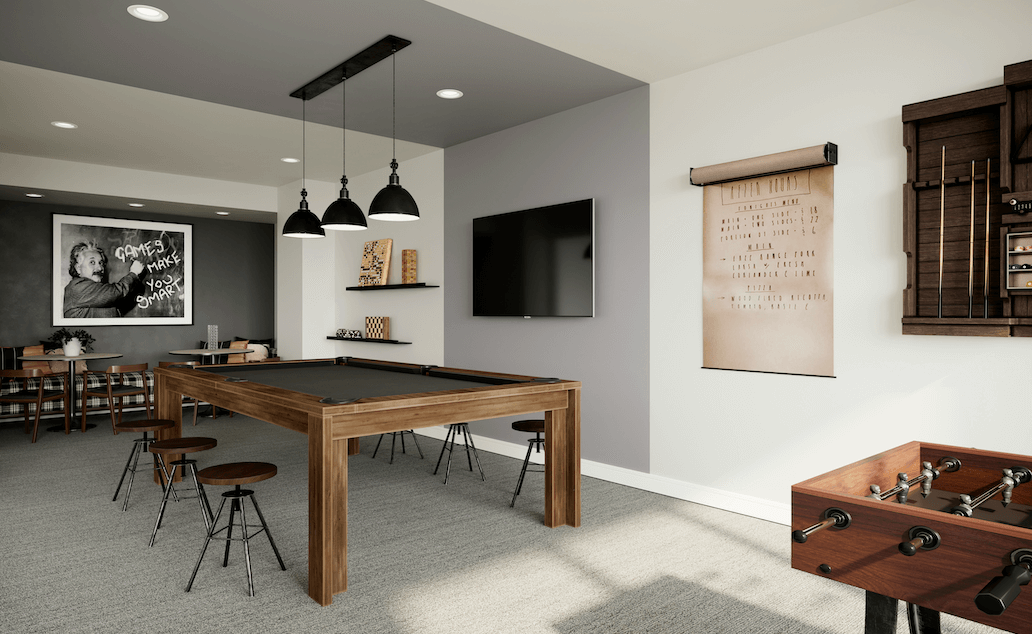
A video game mode where two or more players work together toward a shared goal on the same screen or local network. Couch co-op on a big screen turns a solo den into the social heart of the house.
Also known as: Couch Co-op\Local Co-op\Shared-Screen Co-op
A co-op gaming session on a big screen in a man cave is what a bowling alley was to the 1970s and a LAN party was to the early 2000s: a physical gathering where the people in the room matter more than the game. Two to four players sit on the same couch, each holding a controller, each staring at a quadrant or a shared view on a 65-inch or larger display, and they fight through a campaign, build a base, or survive a horde mode together. The screen is the campfire. The hardware underneath, a console or a PC with enough graphics headroom to render four viewports at the same frame rate, handles the split-screen rendering that was a technological miracle when GoldenEye 007 shipped on the Nintendo 64 in 1997 and has been a deliberate design choice ever since by the developers who still believe local play matters.
The measurable payoff of co-op gaming in a man cave is a room that earns its square footage. A solo gaming den serves one person at a time and has a hard ceiling of one living room's worth of value. A room built for four-player co-op supports game nights, family sessions, and the kind of drinking-and-gaming evening where the controller gets passed around and nobody checks their phone. The room becomes the place people ask to come over to use, which is the difference between a man cave and a room with a console in it. When Halo: Combat Evolved launched in 2001 with system-link support for up to 16 players across four connected Xbox consoles, the weekend LAN party was born, and the social architecture of a generation of gamers was built around physically shared space. That architecture still works today, and a co-op-ready cave is the room that recreates it.
Co-op gaming on a couch is not online multiplayer with headsets and lobby queues. Confusing the two misallocates the build. Online multiplayer requires a stable internet connection, a separate screen and console per player, a subscription service, and a tolerance for strangers. Couch co-op requires a single console, a single copy of the game, a big enough TV that multiple viewports remain legible, and friends who are physically present. The two modes do not substitute for each other. A room wired for individual battle stations is a LAN center, not a co-op den, and its budget and layout calculations are entirely different.
How split-screen forces your display and seating choices
Split-screen co-op does not come free. Rendering two camera viewports simultaneously doubles the processing load on the console, so a game targeting 60 frames per second in single-player mode drops to 30 frames per second in two-player split-screen unless the developer reduces draw distance, texture resolution, or object density. Four-player split-screen cuts the visual fidelity further or halves the frame rate depending on the engine bottleneck. On a PlayStation 5 or Xbox Series X, a four-player split-screen game at 1080p output yields roughly 960 by 540 pixels per player quadrant, roughly one-quarter the pixel count of a full 1080p image. On a Nintendo Switch the numbers are harsher, which is why its co-op library skews toward shared-screen games like Super Smash Bros. Ultimate rather than true split-screen titles. In a man cave the practical implication is that screen size directly sets the player-count ceiling. A 55-inch display makes four-player split-screen barely playable with good eyesight; a 75-inch or larger display turns it into an experience. For shared-screen co-op games, where all players share a single camera view (Diablo IV, Teenage Mutant Ninja Turtles: Shredder's Revenge, Overcooked), the screen-size constraint relaxes, but a minimum viewing distance of 6.5 to 9.5 feet still applies for comfortable sessions. Budget at least $600 to $1,500 for a 65-inch to 75-inch display at couch viewing distances; a projector and screen fall in the same range and can scale to 120 inches for four-player gaming with genuinely usable viewports.
Co-op gaming vs. competitive multiplayer
The line sits at the scoreboard. In co-op, the players win together or lose together, and the enemy is the game, not the person on the next cushion. In competitive multiplayer, the game ranks the players against each other, and the scoreboard crowns a winner. Co-op builds bonds; competitive play tests them. The distinction matters for a man cave because the two modes want different seating, different audio, and different social contracts. Competitive sessions benefit from side-by-side seating where screen-peeking is the whole point and trash talk travels a few inches; co-op sessions work with stadium seating, recliners spread across the room, and a shared audio mix where nobody needs a headset. Choose co-op if the goal is to make the man cave the gathering place; choose competitive if the goal is to crown a champion. The best cave supports both, but the seating plan decides which one happens more often.
Where couch co-op came from
Shared-screen multiplayer began in arcades, not living rooms. Taito's Space Invaders in 1978 alternated two players on a single screen. Atari's Warlords in 1980 introduced a four-player cocktail cabinet with paddles on each side. Gauntlet, released by Atari Games in 1985, was the first arcade title to support four simultaneous players in cooperative play, a decision designer Ed Logg made because four coin slots on a single cabinet multiplied revenue without multiplying floor space. The Nintendo 64 launched in 1996 with four controller ports built into the console, and Rare's GoldenEye 007 in 1997 proved that four-player split-screen deathmatch on a 27-inch CRT could define a generation's social life. Halo: Combat Evolved in 2001 extended the model to system-link LAN parties, where people brought their own Xbox consoles and CRT televisions to a single apartment for 16-player matches. By 2010 broadband internet and Xbox Live had largely displaced the couch, and in 2015 Halo 5: Guardians shipped without any split-screen support, an explicit trade of local play for 60-frames-per-second rendering. The pendulum has swung back partially: Baldur's Gate 3 launched on PlayStation 5 with full couch co-op in September 2023, It Takes Two won Game of the Year in 2021 as a title playable only cooperatively, and the independent PC market continues to sustain local multiplayer with titles like TowerFall, Overcooked, and Broforce.
Common mistakes when building for co-op gaming
The first mistake is buying a screen too small for the player count. A four-player split-screen on a 43-inch display viewed from 10 feet away gives each player a quadrant roughly equivalent to a 15-inch monitor, which might work for Mario Kart 8 but becomes unplayable in detail-heavy titles like Borderlands or Baldur's Gate 3 where text, inventory screens, and particle effects shrink into illegible smudges. Fix this by matching screen size to player count: 55 inches minimum for two-player, 65 inches for three-player, and 75 inches or larger for four-player split-screen at standard couch viewing distances.
The second mistake is running four wireless controllers on a single charging cable daisy-chained across the floor. Four controllers each drawing 5 volts at roughly 500 milliamps during charging produce four separate cables snaking underfoot, each a trip hazard in a dimly lit room. Fix this by installing a powered USB charging hub on a shelf or mounted under the console shelf, with dedicated dock slots so controllers snap into their charging positions after every session without cables ever touching the floor.
The third mistake is treating audio as an afterthought. Four players in the same room generate four simultaneous layers of game audio, voice chatter, and ambient noise, and a small hard-surfaced room becomes an echo chamber within 20 minutes. Fix this by mounting acoustic panels on at least two walls, placing an area rug under the seating zone, and positioning a soundbar or discrete speaker system so the game audio projects toward the players rather than reflecting off every hard surface.
Frequently asked questions
What is co-op gaming in simple terms?
Co-op gaming is a video game mode where players work together toward a shared goal rather than competing. They fight the same enemies and solve the same puzzles cooperatively instead of trying to outscore each other. The experience can happen on one screen with everyone in the same room, called couch co-op, or over the internet with each player on their own device, called online co-op. The defining feature is a shared victory condition: the group wins together or loses together. This shared-stakes dynamic is what turns a man cave from a solo retreat into a genuine social space where the room matters as much as the game.
What is the difference between co-op gaming and online multiplayer?
Co-op gaming and online multiplayer differ in the relationship between players and the required setup. In co-op, players share a victory condition and work together against the game. In competitive multiplayer, players work against each other and one person wins. For setup, couch co-op requires one console, one copy of the game, one screen, and controllers, with everyone in the same room. Online multiplayer requires separate screens and consoles per player, an internet connection, and typically a paid subscription. A co-op cave puts its budget into a large central display and comfortable group seating, while a competitive multiplayer cave spreads its budget across multiple individual stations and wired networking.
How big should my TV be for four-player split-screen gaming?
For four-player split-screen gaming at standard couch viewing distances of 8 to 12 feet, a 75-inch or larger display is the comfortable minimum. At 65 inches, a four-way split produces roughly 32.5-inch diagonal viewports per player, which works for bright high-contrast games like Mario Kart but becomes difficult for darker detail-heavy titles like Borderlands or Baldur's Gate 3. At 55 inches, each quadrant is roughly 27.5 inches diagonal, which is playable only for games with large UI elements and strong color contrast. If a large television exceeds the budget, a short-throw projector with a 100-inch to 120-inch screen delivers comparable per-player viewing area at a similar price point and is often the more flexible choice for a dedicated co-op den.
What are the best co-op games for a man cave setup?
The best co-op games for a man cave are titles that support four local players, stay legible in split-screen, and reward cooperative communication. Mario Kart 8 Deluxe on Nintendo Switch supports four-player split-screen at 60 fps and is the standard-bearer for accessible all-ages co-op. Overcooked and its sequel provide chaotic four-player shared-screen teamwork that tests communication as much as reflexes. Diablo IV on console supports two-player local co-op with full drop-in drop-out functionality. Borderlands 3 supports four-player split-screen on console and is a rare example of a modern first-person shooter that retains true couch co-op. Teenage Mutant Ninja Turtles: Shredder's Revenge delivers six-player arcade-style brawling with a shared camera view that eliminates the screen-size problem entirely.
Can I play co-op games online if my friends cannot come over?
Co-op games can be played online, but the experience is different from couch co-op in ways that affect how the man cave functions. Online co-op requires each player to own their own copy of the game and their own hardware, and it removes the physical presence that makes the man cave a social destination. The benefit is logistical: friends who live in different cities can play together on a scheduled night. Many modern titles including Baldur's Gate 3, It Takes Two, and the Borderlands series support both online co-op and local split-screen, so the same game library serves both use cases. If the man cave is built primarily for in-person gatherings, prioritize games that support four-player local co-op and treat online play as a bonus feature for weeknight sessions.
Related terms
Arcade Cabinet
A standing coin-op video game housing: wood body, marquee, control panel, monitor and game board, wired since 1985 to the 56-pin JAMMA standard that made boards interchangeable.
Entertainment & GamesBoard Game Shelf
Storage shelving deep enough to hold standard 12-inch board game boxes vertically, keeping a collection visible and safe from the damage of stacking boxes flat.
Entertainment & GamesCard Table
A square, round, or octagonal table with a padded felt surface and raised rail, sized for 4 to 8 players, with built-in cup holders and chip trays for poker, bridge, and other card games.
Furniture & SeatingConsole Shelf
A platform holding a game console under or beside a desk, keeping vents clear and cables routed out of sight. A well-placed shelf reclaims a square foot of desktop and prevents thermal throttling.
Room Types & SpacesEntertainment Den
A flex space, often a converted basement, bonus room, or living room, built around a TV and casual seating rather than formal entertaining or a dedicated home office.
Lifestyle & CultureFantasy Sports Draft
A live snake or auction event, usually hosted at home, where fantasy football owners draft real NFL players onto rosters before the season starts.
Entertainment & GamesFoosball Table
An eight-rod cabinet with 22 miniature players that turns tabletop soccer into a fast, two-to-four-player game built around a roughly four-foot playing surface and telescopic or through rods.
Audio/Visual & TechCable Management
Organising, routing, bundling, labelling, and concealing AV cables to ensure fire-code compliance, signal integrity, and a clean result, using raceways, trays, sleeves, velcro, and in-wall pathways.