A recurring hosted evening with a fixed slot and a consistent group: poker on the first Friday, a monthly board game rotation, a fight card whenever the pay-per-view lands.
A theme night is a standing appointment with a format attached: the same group, the same slot on the calendar, one activity everybody already knows the rules of. Poker on the first Friday of the month. A fight card whenever the pay-per-view lands, a board game rotation, a whiskey tasting with four bottles and a scoring sheet, a retro arcade session with a running high score written on the wall. The room around it can be a finished basement bar or a garage with a folding table and eight stools, because the format carries the evening rather than the fittings. What separates a theme night from ordinary hosting is repetition: a fixed cadence, a consistent group, and house rules nobody renegotiates at the door. That repetition is worth designing for, because home is increasingly where people want the evening to happen. A 2025 Talker Research survey of 2,000 US adults found 72 percent prefer staying in with friends over going out whenever they can, naming a more comfortable environment (65 percent), cost (53 percent) and being able to hear each other (47 percent). NielsenIQ puts half of Americans entertaining guests at home at least monthly, with 21 percent hosting daily or weekly. Price pressure pushes the same way: Bureau of Labor Statistics figures for the year to December 2025 show food away from home up 4.1 percent against 2.4 percent for food at home. The night is not the room, and the two get planned in the wrong order constantly. Most of the advice in man cave ideas describes what to build, while the theme night is what the build is for, so knowing which format runs weekly should set the seat count, the table size and the screen position before anything gets bought. A theme night is also not a one-off. One Super Bowl Sunday is an event with a date on it, whereas twelve consecutive Thursday poker games is a habit, and the two ask for completely different things from a room.
Sizing the room to the biggest night, not the average one
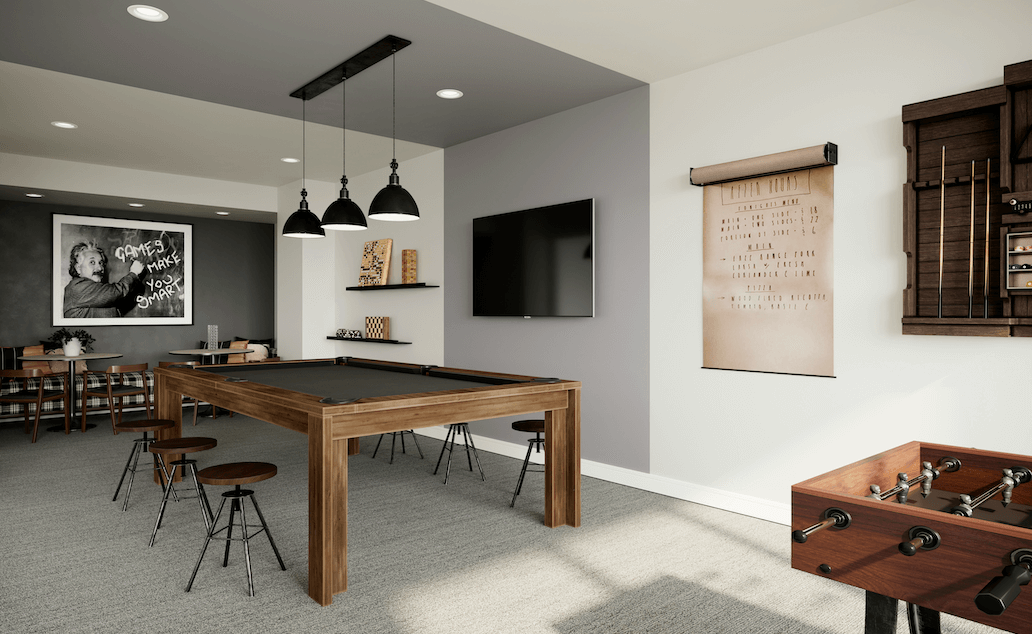
Plan around the highest-attendance format you run, because the evening that fills the room is the one that breaks it. A poker night that regularly draws eight sets the table size and the seat count, a fight card or a watch party sets the sightlines and the audio, and a game night sets how much flat surface has to exist at the same time. Design to the median Tuesday instead and the busiest evening spills onto laps and kitchen counters, which is the point where people quietly stop coming. Flexible seating covers most of the gap without permanent floor space. Stackable stools, a folding table that lives against a wall between uses and ottomans that double as spare seats let a room hold eight and shrink back to four, which matters far more in a converted garage than in a dedicated basement. What cannot flex is the sightline. If half the group watches a screen from an acute angle, the format that depends on the screen stops working no matter how good the picture is. Drinks deserve their own plan. Roughly 4 in 10 Americans said they were trying to drink less in 2025, up seven points on the previous year, and 38 percent of Gen Z drinkers bought more non-alcoholic options than the year before, so a bar stocked only with spirits and beer writes part of the group out of the evening. Hosts are already spending on that side of the room: Houzz search data for January to March 2025 showed interest in dedicated whiskey bars up almost twofold, small wet bars and beverage bars up around 1.5 times, and coffee bars up 19 percent.
A standing night against a one-off watch party
The one-line distinction: a watch party is scheduled by the broadcaster, and a theme night is scheduled by you. Everything else follows from that. A watch party exists because a particular fixture is on at a particular time, so attendance depends on whether people care about that game or that fight, and the format resets to nothing afterwards. A theme night carries its own calendar. The date is fixed in advance, the activity repeats, and the group accumulates a shared history around it: running scores, a house champion, a rule someone lost an argument about in March. That accumulation is why standing nights outlive the enthusiasm that started them, and why the gear earns its keep instead of running twice a year. The practical consequence is where the money goes. A room built for occasional watch parties should spend on the screen and the seating that faces it. A room built around a weekly card or board game night should spend on the table, the light above it and the storage that keeps everything within reach, because a night needing twenty minutes of setup gets cancelled far more often than one needing two.
What changed in home hosting
Nobody coined the format and no date marks its arrival. Home poker games, family game night and Super Bowl parties all predate any phrase for them, so the honest history here is a market one rather than an origin story. The scale shows up most clearly at the single biggest fixture. The National Retail Federation and Prosper Insights & Analytics found a record 121.1 million US adults planned to throw or attend a Super Bowl party in 2026, with a further 18.2 million watching at a bar or restaurant, out of 213.1 million adults tuning in. Projected spend for the day reached $20.2 billion, or $94.77 a head, and the average party budget came to $104.11, up 2.3 percent on 2025, running 81.2 percent to food and beverage. That survey covered 7,791 adults between 2 and 8 January 2026 with a margin of error of 1.1 points. It measures one Sunday in February rather than recurring nights, but it prices the at-home format better than anything else available. Pay-per-view tells a lopsided version of the same story. Mayweather against Pacquiao in 2015 remains the high-water mark at roughly 4.4 million US buys and a record $72.2 million live gate, and UFC 229 in 2018 drew somewhere around 2.4 million. The tabletop side has grown more steadily: Grand View Research valued the global playing cards and board games market at $19.9 billion in 2024 and projects $31.9 billion by 2030. Streaming has moved the other way. Disney Plus GroupWatch and Amazon Prime Video Watch Party were both retired, Sling dropped its co-viewing feature in early 2024 and Netflix never shipped one, leaving third-party tools such as Teleparty and Scener to cover remote viewing. Hosting everyone in one room is the part that kept working.
Where a standing night falls apart
The first failure is a floating date. Ending an evening on let us do this again sometime hands the scheduling job to whoever is most organised, and within two months the group has thinned to three. Fix the slot instead, whether that is the first Friday or every second Thursday, and let people miss one without losing their place in the rotation. The second is a room set up for two. A sofa aimed at a television and a coffee table in front of it works perfectly until eight people arrive, and then there is nowhere to deal cards, nowhere to put food and half the group is watching the screen from the side. Buy for the busiest recurring night: one full-size table at the right height, seating that stacks or folds, and a screen position that works from every seat rather than from the best one. The third is treating every format as the same event. A tasting wants light on the glasses and quiet enough to talk, a fight night wants the opposite, and a board game night wants a surface that clears in a minute. Run all three off one lighting scene and one fixed furniture layout and each of them is compromised. Separate switching, a table that moves and a drinks range that includes low and no-alcohol options cost a fraction of rebuilding the room, and they are what lets one space carry three different nights properly.
Frequently asked questions
What is a theme night?
A theme night is a recurring social evening hosted at home around one fixed format, held on a repeating slot with a consistent group. Common versions are poker night, a board game rotation, a movie or fight-card watch night, a whiskey tasting and a retro arcade session. What makes it a theme night rather than a party is the cadence and the repetition: the same activity, the same rough date each month or week, and house rules the regulars already know.
What is the difference between a theme night and a watch party?
A watch party is scheduled by the broadcast: a specific game, fight or finale at a specific time, with attendance driven by interest in that event. A theme night is scheduled by the host and repeats regardless of what is on, so the activity rather than the fixture pulls people in. The practical difference is where the budget goes. Watch parties reward screen and seating spend, while standing card or board game nights reward the table, the lighting over it and fast storage.
How much does hosting a theme night cost?
No survey prices a recurring theme night. The closest figure covers one fixture: the National Retail Federation put average Super Bowl party spend at $104.11 in 2026, roughly $94.77 per person across the day, with 81.2 percent going to food and beverage. Recurring nights normally run far cheaper because the equipment is already bought and the catering is smaller. Hosting also compares well against going out, with restaurant prices up 4.1 percent in the year to December 2025 against 2.4 percent for groceries.
How do you keep a recurring game night going?
Fix the date before anything else. A repeating slot such as the first Friday or every second Thursday removes the scheduling work that otherwise falls on one person and kills the group. Size the room to the largest turnout rather than the average, so there is a full table and a seat for everyone on the busiest night. Keep the setup under a couple of minutes by storing the gear in the room, and stock low and no-alcohol options alongside the rest.
Can a theme night work without a fixed date?
Not for long. Without a repeating slot the group shrinks to whoever happens to be free, one person ends up chasing everybody every month, and attendance drifts until the night stops happening. The fixed date is what makes attendance a default rather than a decision, and it is also what justifies buying a proper table or dedicated seating, since the room earns that investment weekly instead of twice a year.
Related terms
Poker Night
Recurring home gathering built around a card table, chips, and fixed stakes, usually Texas Hold’em. A 300 chip set covers six players; a 500 chip set handles a full table of eight or nine.
Lifestyle & CultureGame Night
A recurring get-together, often weekly or monthly, that turns a table into the main event: board games, card games, or party games instead of sports or drinks as the draw.
Lifestyle & CultureWatch Party
Shared, real-time viewing of a show, movie or game, either in one room or synchronized remotely across viewers’ own devices with a text or video chat layer.
Lifestyle & CultureHouse Rules Sign
A wall-mounted sign listing the rules of private spaces, usually wood or metal, carrying humorous commandments about behavior, drinks and guests. Descended from the 17th-century tavern sign tradition.
Lifestyle & CultureWhiskey Tasting
A four-stage ritual for reading a whiskey, from color and legs to nose, palate, and finish, usually poured into a tulip glass with water added a few drops at a time.
Lifestyle & CultureMovie Marathon
Extended viewing session of multiple films back to back, often around a franchise, director, or genre. Descendant of the 1930s double feature; predates streaming binge-watching.
Bar & BeverageHome Bar
A built-in counter with cabinetry, storage and a sink or plug-in fridge that serves drinks in a finished room. The wet-versus-dry decision depends on the nearest drain stack.
Furniture & SeatingTheater Seating
Purpose-built home cinema recliners arranged in rows facing one screen, matched in height and often set on a riser so every seat holds the same sightline.